Numeric’s Data Foundation: Built for your Close and Your Controls

.png)
Through 21 years at EY, 8 of which I served as an audit partner, I worked with finance teams navigating the same fundamental tension: maintaining robust financial controls while managing increasingly complex accounting operations.
What drew me to come work at Numeric was that it isn’t just another close management tool—here, we recognize that data quality is the foundation that makes everything else possible.
When data flows cleanly from your ERP into your close process, controls also become dramatically more effective. When it doesn't, even the most thoughtfully designed control framework struggles. Let me walk you through how Numeric supports finance teams across three critical dimensions of financial controls, and why good data hygiene is the lubricant that makes everything move smoothly.
(Care to hear more about why I joined Numeric? I spoke to my career switch, the joys of auditing, and why relationships matter most in our industry in this episode of the Numeric podcast, Incoming Statements)
How Monitors Help with Transaction-Level Controls
Your ERP—whether that's NetSuite or another system— as well as other source systems upstream from your ERP, likely handle the majority of your transaction-level controls. Those controls exist upstream from Numeric, and that governance happens in those source systems. They act as a first line of defense, ensuring data accuracy and completeness before anything ever hits your financial statements.
Because Numeric doesn’t process transactions, it doesn’t impact those controls directly. Still, our solution can help greatly in reinforcing those controls. How so?
When bad data hits your general ledger, it's often the result of control failures, control gaps, or process issues that happened earlier in the transaction lifecycle. Numeric's Monitors can act as a detection mechanism, surfacing these upstream issues as data flows into the platform.
Here’s an example:
- You set up a Monitor to check for any expenses that are missing a coded department.
- You check the Monitor and see that a few expenses came up missing a dept. code.
- Instead of having to sift through NetSuite for these transactions, or worse, not knowing they existed, they immediately surface in your Monitor. Then, you can trace back upstream to address the root cause issue that led to an uptick in expenses coded without a department.
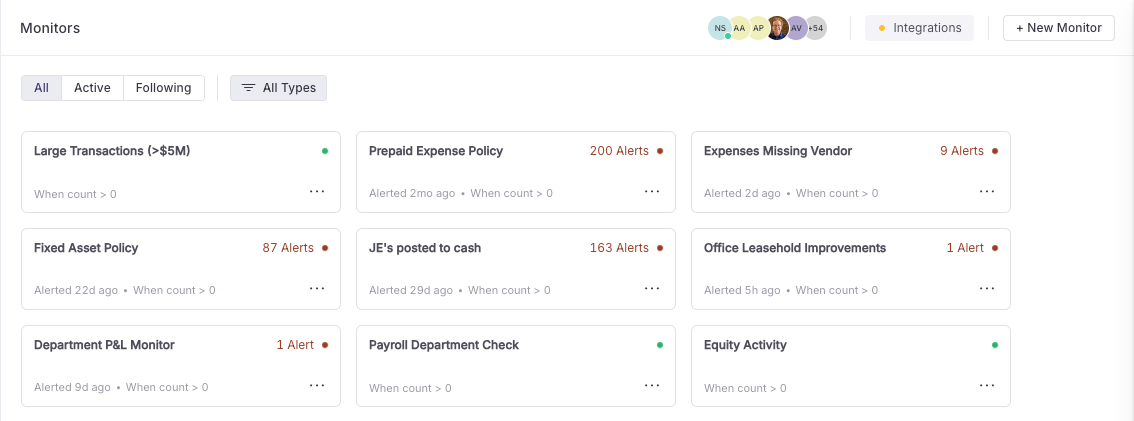
Think of Monitors as creating a virtuous cycle — one where if your processes and transaction-level controls work effectively, then the Monitors in Numeric are at rest. However, when the Monitors flash red, they signal that you need to evaluate processes upstream to understand what could have caused the discrepancy.
You might be humming along with twelve closes a year, everything running smoothly. Then in month eight, your close suddenly takes eight days instead of seven, or the team had to burn both ends to stay on track. You identify the root cause—maybe it's a vendor coding issue, a missing department tag, or key entries that were posted later than expected. You create a Monitor to surface that specific issue earlier in future closes. Over time, you build up a library of Monitors that catch problems before they slow you down.
Maintaining Data Immutability in Numeric
I know what many finance leaders are thinking: "If I'm warehousing my financial data into another platform, how do I know the data hasn't changed? How can I trust what I'm seeing?" This is a legitimate concern, and it's why Numeric's SOC 1 Type 2 report is critical.
Our SOC 1 report affirms that if you can rely on information in NetSuite, you can rely on it in Numeric. The data transfer is lossless and immutable—numbers don't change when they move from your ERP to our platform. We warehouse your NetSuite data, but there's no data loss in the transfer. What you're analyzing in Numeric is the same data that exists in your source system, not some transformed or stale copy.
This matters for controls because it means Monitors in Numeric are effectively detecting issues in your NetSuite data; we're just providing better visibility and alerting than you'd get from saved searches or manual reviews.
Reconciliations: Real-Time Data Analysis Without the Excel Gymnastics
I often remark that reconciliations are table stakes in accounting. Everyone has to do them, and close management was essentially invented around reconciliation workflows. And of course, they’re a core part of SOX controls.
For reconciliations, what Numeric excels at is helping with much of the inherent pre-reconciliation work, eliminating the pain of NetSuite-based data analysis during close.
Say you’re preparing to reconcile a balance sheet account and need to check that your GL entries line up with your subledgers. Traditionally, one would export data from NetSuite via saved search, pivot it in Excel, analyze stagnant data, and repeat this process every time you need a different view. The moment you export that data, it's already old, and that doesn’t even factor in the time it takes for processing and analysis.
Here's how Numeric changes this: when you need to investigate expense data—looking at vendor trends, department patterns, accrual gaps—you can slice and pivot that data in real-time without ever leaving the platform. You're working with live NetSuite data, not just a snapshot in time.
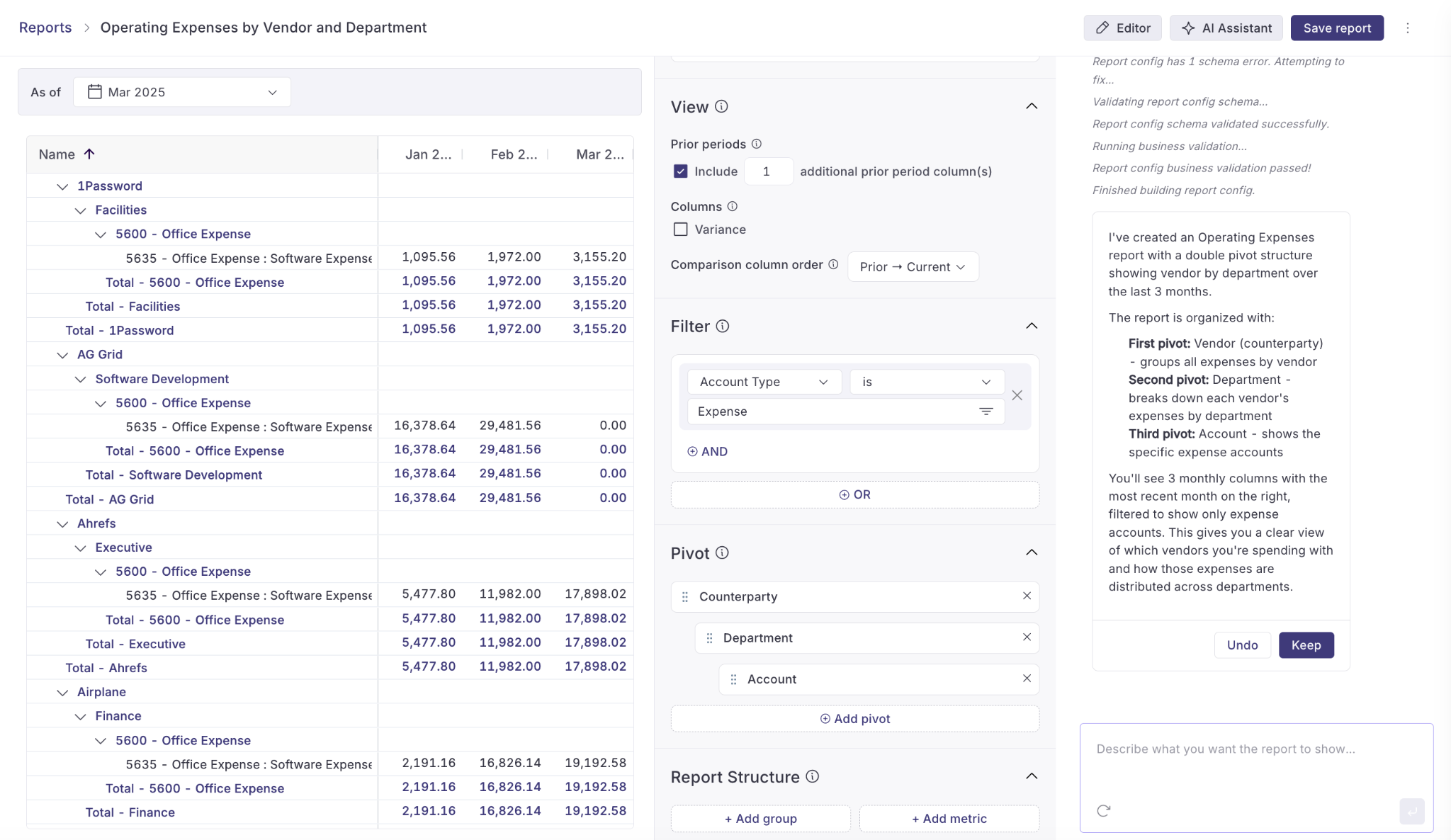
Let me give you a concrete example. In the traditional Excel workflow, you’d run saved searches or download transaction data into Excel before pivoting by department and vendor to begin your investigation. At that point, you’d potentially find an anomaly – say you're reviewing vendor expenses and notice that a vendor who typically bills $30,000 per month suddenly drops to $15,000. All the same, you’re contending with stagnated data that might have changed since you started your analysis.
In Numeric, you’re essentially removing the Excel middleman and running pivots (even double pivots) on your real-time NetSuite data. You can build the same Excel dimensions instantly, spot the variance, and investigate – all with real-time data and in-platform.
There's another critical control consideration here: how do you know the pivots and reports you're building in Numeric are accurate? The risk with Excel is that you can fat-finger data, accidentally delete rows, or miscopy formulas.
The pivots and groupings in Numeric are based on deterministic, formulaic source code—like hitting "1+1=2" in Excel. You can't change our source code when you're building reports. The logic is defined, repeatable, and auditable.
Management Review Controls: Precision, Context, and Audit Trail
Management review controls operate at the end of accounting processes. You're surfacing analytical trends to business-savvy people who have the domain expertise to say whether or not something makes sense. The quintessential example is flux analysis—examining variances between periods to identify anomalies.
Good control design requires flux analysis at different levels of disaggregation. You can run flux at the financial statement level, at the trial balance level, or even more granularly. The more disaggregated your analysis, the more precise your control becomes, and the more evidence it yields.
This is where Numeric's reporting flexibility becomes powerful. We allow you to design management review controls beyond just trial balance level. You can report on any dimension in any way you want. Here at Numeric, our Head of Finance sets up P&L sections for each function leader— for example, our marketing lead gets a report showing just marketing expenses, not the full income statement, because that's her area of domain expertise. That level of precision means she can perform meaningful management review because she’s looking at data with context that only she has.
But having context isn't enough for SOX compliance. You also need evidence that the review happened. This is where our Review Notes close the loop.
When I review a team member's work and spot something that needs investigation, I leave a Review Note. The team member has to action that note. I have to review their response and explicitly close the note. That entire audit trail lives in Numeric—when it was opened, what questions were asked, what answers were provided, when it was resolved.
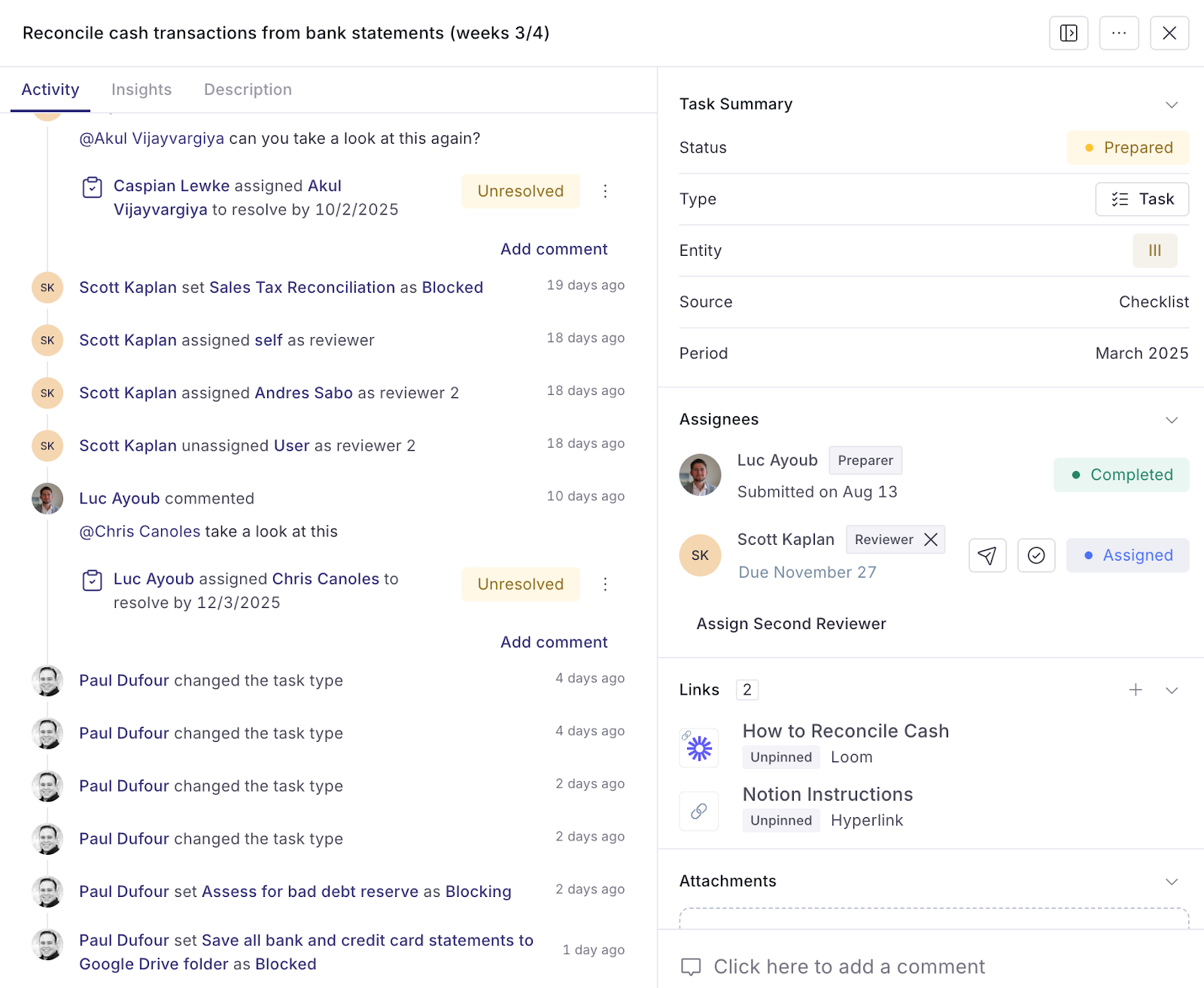
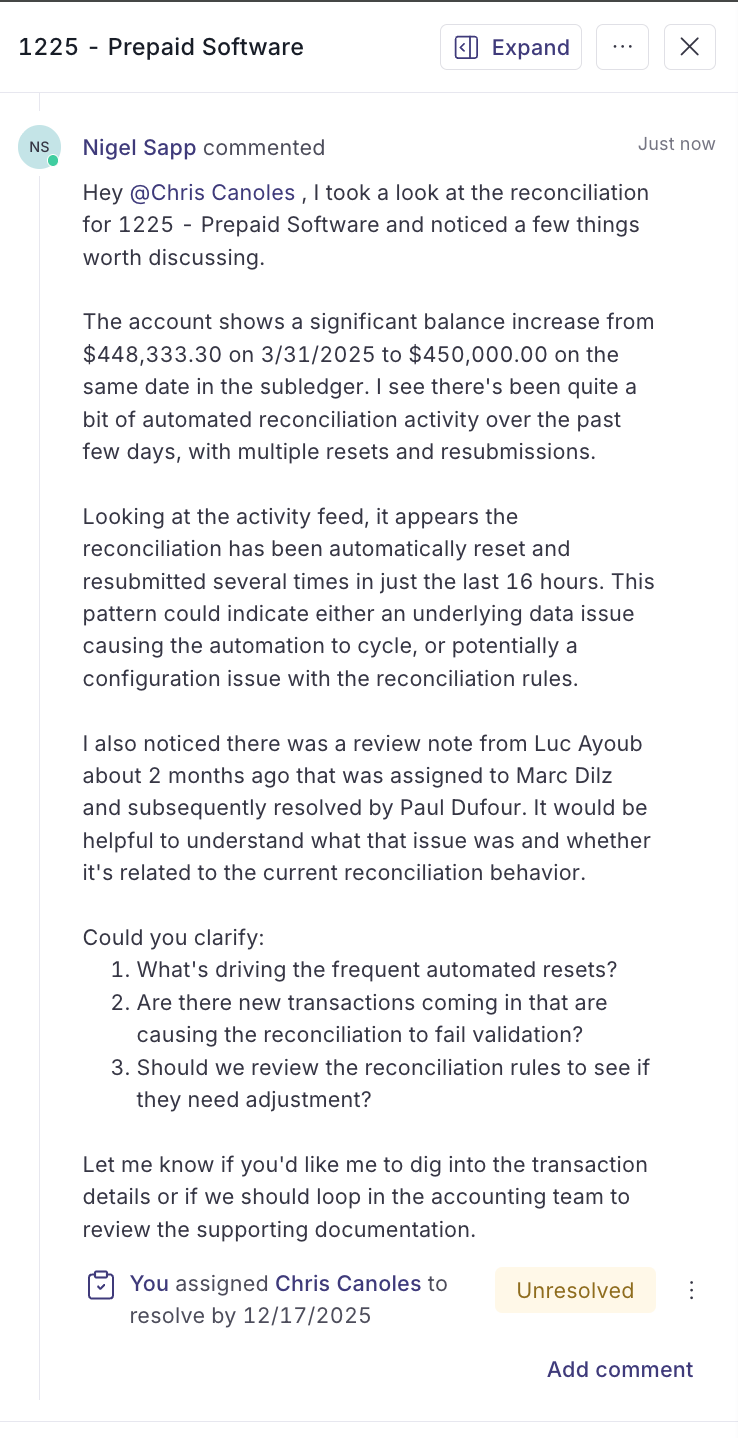
We've even built in period-close controls around this. You can configure Numeric to prevent closing a period if open Review Notes exist, or if Review Notes haven't been fully resolved (meaning the original reviewer validated the response was appropriate).
From Checking to Fulfilling: The Complete Journey
What I want finance leaders to understand is that Numeric’s features enable better controls management for teams far in advance of the need for a full compliance module.
You can start with Monitors helping you check that data quality issues aren't creeping into your close. You can use real-time reporting to streamline your NetSuite-based reconciliation workflows. And you can scale all the way to documenting robust, audit-ready management review controls using reporting, flux, and full review note audit trails.
This isn't just about making close faster—some teams are pleased with their close timelines. It's more about making controls more effective without making them more painful. During my years at EY, the teams that struggled most with controls weren't lacking diligence; they were fighting their tools. Spreadsheets everywhere, stale data, manual handoffs, and audit trails stitched together across multiple systems.
Numeric's close management structure brings this all together atop your data foundation. When your NetSuite data flows into Numeric with integrity—lossless and immutable—and you can analyze it in real-time with deterministic logic, suddenly controls become part of your workflow rather than obstacles to it.
Whether you're a pre-IPO company building your initial control framework or a public company managing SOX compliance, the reality is the same: data hygiene enables everything else. That's what drew me to Numeric, and it's what I believe makes the platform particularly valuable for finance teams serious about controls. You move from checking whether controls should be happening to actually fulfilling your controls compliance—all within the same platform where you're doing the work.
That's the kind of foundation I wish I could have given my audit clients years ago.
Numeric – the #1 automation platform for the close
.png)
Related Content
.png)
Numeric vs. Maxima: Which AI Close Platform Fits Your Team?
Numeric and Maxima both automate close work. Compare how each handles reconciliations and cash matching, who owns the rules, and when each one fits.
.png)
7 NetSuite Reporting Tools, and When to Just Replace NetSuite
Compare 7 NetSuite reporting tools by use case and cost, and learn when replacing NetSuite solves reporting problems at the source.
.png)
What Is Multidimensional Accounting? Benefits, Examples, and 3 Steps to Set It Up
Learn how multidimensional accounting tags transactions by department, product, and customer, with examples and 3 steps to set it up.