BlackLine Pricing in 2026: Costs, Plans, and What Teams Actually Pay

.png)
If you are reading this, you have probably either been handed a BlackLine quote that came in larger than you expected or are early in an evaluation, trying to figure out what you would pay before you book the demo.
Either way, you have run into the same wall everyone does: BlackLine does not publish its pricing. Every number lives behind a sales conversation, and the figures floating around the internet vary by an order of magnitude.
This guide cuts through that. We will walk through how BlackLine prices its platform, what teams are paying in 2026, the costs that never appear in the initial quote, and how to judge whether the total is worth it for a team of your size.
Key Takeaways
- BlackLine does not publish pricing. Every deal is custom and quote-based, which is why the figures you find online vary.
- Realistic 2026 ranges: Vendr puts the median contract near $40,125 a year, with most landing between $13,200 and $101,000. SpendHound's data on enterprise buyers averages $541,209 a year.
- The subscription is only the starting line. Implementation, services, and training add to it, and SpendHound's data shows BlackLine spend climbing year over year for both SMB and enterprise buyers.
- BlackLine fits large, control-heavy, multi-entity organizations, often public and on SAP, with the headcount to own the platform. It tends to strain leaner mid-market teams that need value within weeks.
- The new Studio360 and Verity AI layer is a significant shift, but newer capabilities are added as new line items, so scope it deliberately rather than assuming they are bundled.
BlackLine Plans (and What Changed)
BlackLine is a modular platform. You license the pieces you need, and the total scales with that selection. The core modules most finance teams evaluate include:
- Task Management — orchestrating the close, assigning work, and tracking progress with an audit trail
- Account Reconciliations — standardized, customizable templates with auto-certification below set thresholds
- Transaction Matching — automated matching for high-volume, repetitive transactions, so people focus on exceptions
- Journal Entry — centralized preparation, approval, and posting with supporting documentation stored centrally
- Intercompany — intercompany transactions, reconciliations, and eliminations across entities
- Variance Analysis — flagging fluctuations in balances and activity for review
- Cash Application — matching incoming payments to open invoices
The bigger shift since you may have last looked: BlackLine has reorganized the platform around Studio360, its data and workflow orchestration layer, and introduced Verity, a suite of AI agents that sit on top of it.
Verity includes agents for preparing reconciliations, matching transactions, automating accruals, and handling collections and remittances. BlackLine positions this around governance and auditability — the agents work from its repository of accounting logic, and every action is traceable.
Why this matters for pricing: as BlackLine ships new functionality, newer capabilities are typically licensed at additional cost. So when you scope a deal, you are deciding how much of the newer AI layer you want and budgeting for the likelihood that next year's release will carry its own line item.
What BlackLine Costs in 2026
It depends, and the public estimates are all over the map because every deal is custom. The most-cited third-party benchmark, Vendr, reports a median BlackLine contract of about $40,125 per year across 74 tracked purchases, with most deals falling between roughly $13,200 and $101,000 annually.
SpendHound, which aggregates de-identified spend from more than 1,300 companies, splits it by company size. Across 160 BlackLine customers, businesses with 50 to 1,000 employees pay an average of $46,318 a year, while companies above 1,000 employees average $541,209. That gap is the clearest signal of who the platform is priced for. Entry-level, single-module setups can start lower, but that is unusual for the teams BlackLine targets.
Variables that drive BlackLine pricing:
- Modules licensed: The single biggest lever; cost scales with how many capabilities you turn on
- Entity count: Many modules are priced per legal entity, so multi-entity and multinational structures cost more
- Transaction volume: Matching, cash application, and intercompany are often volume-based
- User count: Priced per named or concurrent user, depending on the module
- Contract term: Multi-year commitments unlock lower annual pricing meaningfully
If you are comparing a quote against the market, the useful move is to confirm which of these variables your quote is priced against, and whether the count BlackLine used (entities, users, transactions) matches your footprint.
The Hidden Costs of BlackLine
The subscription figure is just the start. Here are line items that catch teams off guard:
- Implementation and professional services: BlackLine implementations commonly run three to six months. Vendr's contract data shows professional services frequently equal or exceed first-year subscription costs on mid-market and enterprise deployments.
- Configuration and integration: Connecting BlackLine to your ERP and other systems, and configuring it for your workflows, is typically scoped and billed separately.
- Data migration: Moving historical reconciliation data and supporting documentation into the platform is an additional charge.
- Training and change management: User and admin training is often quoted separately from the license.
- Annual increases: SpendHound's 2026 data shows BlackLine spend up 32.7 percent year over year among SMB customers and 14.7 percent among enterprise customers. Multi-year terms are the main lever to offset it.
- Add-on modules: Starting with a limited module set often means higher per-module pricing when you expand mid-contract.
Tip: Bundling modules can substantially reduce costs compared to buying them piecemeal, and multi-year commitments unlock better discount tiers. Buyers who come to the table with a defined scope, a fixed-fee implementation ask, and a credible alternative in evaluation consistently land better terms. BlackLine's fiscal year ends in December, so Q4 tends to be the strongest window for concessions.
See why Posit switched from BlackLine to Numeric and took their close from 7 days to 2.5.
What You Get for the Cost
For that investment, BlackLine delivers a deep, mature feature set:
- Account reconciliation: BlackLine account reconciliation provides standardized yet customizable templates for reconciling workpapers with your general ledger, adjustable workflows, and auto-certifications when reconciliations fall below a specified threshold.
- Task management: Relevant team members can monitor, certify, and collaborate on various financial and accounting tasks, with a clear audit trail.
- Transaction matching: Repetitive transactions can be matched and reconciled in real time, freeing human effort for exceptions.
- Journal entry: Journal entry processes can be managed, centralized, and automated, with supporting documentation stored in the cloud.
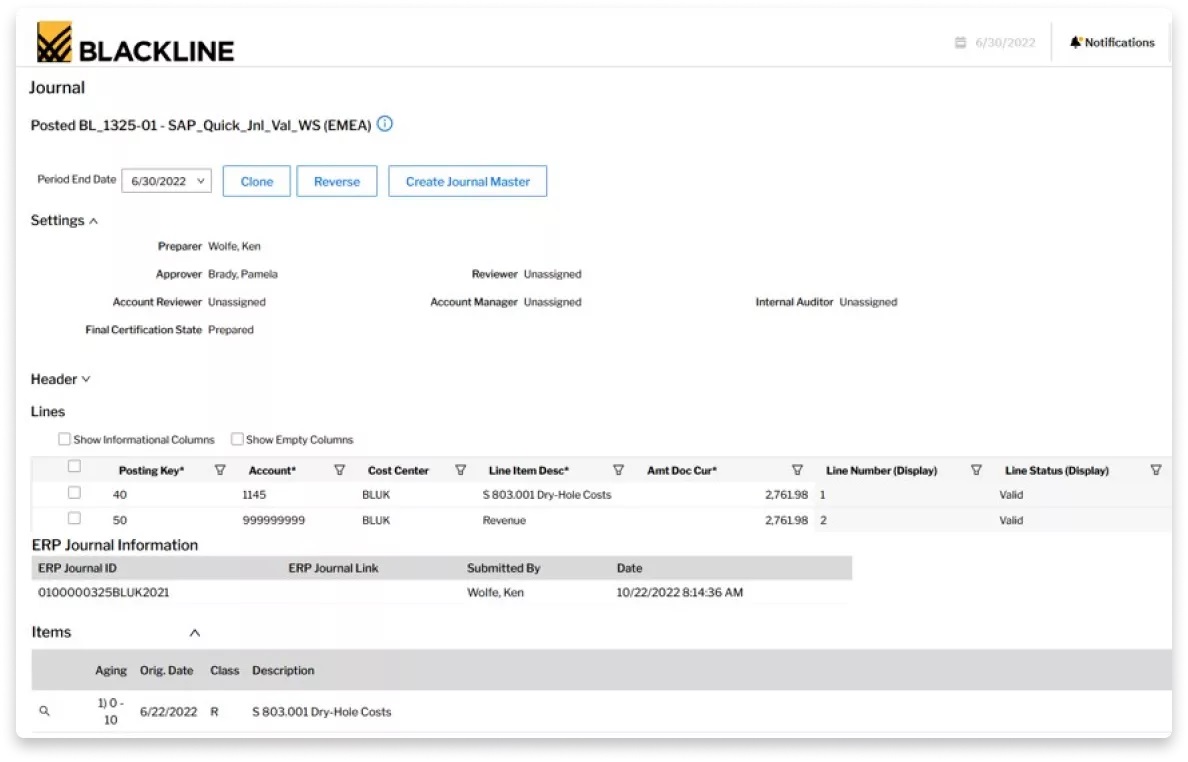
- Account analysis: BlackLine automates the examination of account balances for high-volume, high-risk accounts at the transaction level.
- Financial reporting analytics: You can streamline and optimize financial statement analysis processes.

- Variance analysis: BlackLine helps identify potential risks and discrepancies by calculating and highlighting fluctuations in activities and balances.
- Smart close for SAP: Teams can organize and improve activities related to the financial close process in SAP, including scheduling tasks, monitoring activities, and verifying outcomes.
- Consolidation integrity manager: You can implement existing business rules for intercompany accounting and hierarchies to streamline system-to-system reconciliations and map GL accounts.
- Compliance: Companies can manage risks and implement control workflows to ensure end-to-end compliance with internal policies and external requirements.
Layered on top, BlackLine's Verity agents extend into AI-assisted reconciliation prep, complex matching, accruals, and invoice-to-cash. The pitch is automation with an audit trail — governed and traceable, aimed at large, control-heavy finance organizations.
The catch is that this depth is also the cost. The platform's flexibility and breadth tend to demand a dedicated owner to configure and maintain it, and the implementation runway is measured in months. For the right organization, that is a fair trade. For a leaner team, it can become a tool you maintain rather than a tool that works for you.
Get started with Numeric — a modern BlackLine alternative
.png)
Is BlackLine Worth It?
BlackLine is worth it for:
- Large, often public companies with audit and SOX requirements
- Organizations with multi-entity, intercompany, and multicurrency complexity
- Teams running SAP or similar enterprise ERPs
- Finance functions with the headcount to own configuration and the runway to absorb a long implementation

For those teams, the depth, controls, and governance are worth what they cost.
It tends to be a poor fit when:
- You are mid-market without a dedicated BlackLine administrator
- A complex implementation has already stalled a previous tool rollout
- You need time-to-value in weeks, not quarters
- Your close is painful, but your team is small and resource-constrained
If you recognize your team in that second list, the question is less "can we afford BlackLine?" and more "what gets our team from BD10 to BD5?" — that is, closing the books by the fifth business day instead of the tenth, since that is the number controllers and CFOs are graded on either way.
What Gets You From BD10 to BD5
Three things move that number, and they're worth checking any platform against, BlackLine included:
- Real-time ERP sync, so the close starts on live data instead of a batch export from last night.
- AI that drafts the work — a flux explanation written and waiting for edits is worth more than a variance flagged for someone to write up later.
- A platform that doesn't need a full-time owner, since every hour spent administering the close tool is an hour not spent closing the books.
BlackLine clears the first two for teams with the infrastructure to run it through its ERP sync and Verity AI layer. However, it strains for the third — the administrative load that makes BlackLine durable for a 200-person finance org is the same load that eats a five-person team alive.
That's the gap Numeric is built to close. Same three requirements, sized for a team that doesn't have a dedicated platform administrator:
- Set up in minutes. You do not need a dedicated administrator or a multi-quarter implementation to get value. Your senior accountants spend their time running the close, not maintaining the tool.
- AI is built into the workflow. Instead of writing flux commentary by hand after every close, you get one-click first-draft AI flux explanations you can edit. AI runs across close, reconciliations, and reporting — and because it's woven into the platform rather than a separately licensed layer, you can also ask questions directly inside your checklist, recs, or flux report and get answers without leaving the workflow.
For teams that want to go further, Numeric's MCP connects the platform to the rest of your accounting stack so AI can act across tools, not just within one.
- Reporting that goes one layer deeper. When a sub-ledger and your GL stop tying out, Numeric shows you the exact transaction causing the difference. Transaction Monitors extend that across the month, flagging miscodes and policy violations in real time — so when a CFO asks a question mid-close, you have an answer rather than an estimate
- A modern interface that teams want to use. With management reporting, you can build custom reports on your financials without needing to be a NetSuite expert. The close checklist keeps the whole team coordinated on one timeline, with every task, preparer, reviewer, and supporting document captured as you go — so audit season is a download rather than a reconstruction.
- Cash reconciliation automated at 90%+ match rates. Numeric's Cash Management connects directly to your bank accounts, applies AI-assisted matching rules you can build and modify yourself, and posts the resulting journal entries directly — without a consultant or a manual upload in sight.
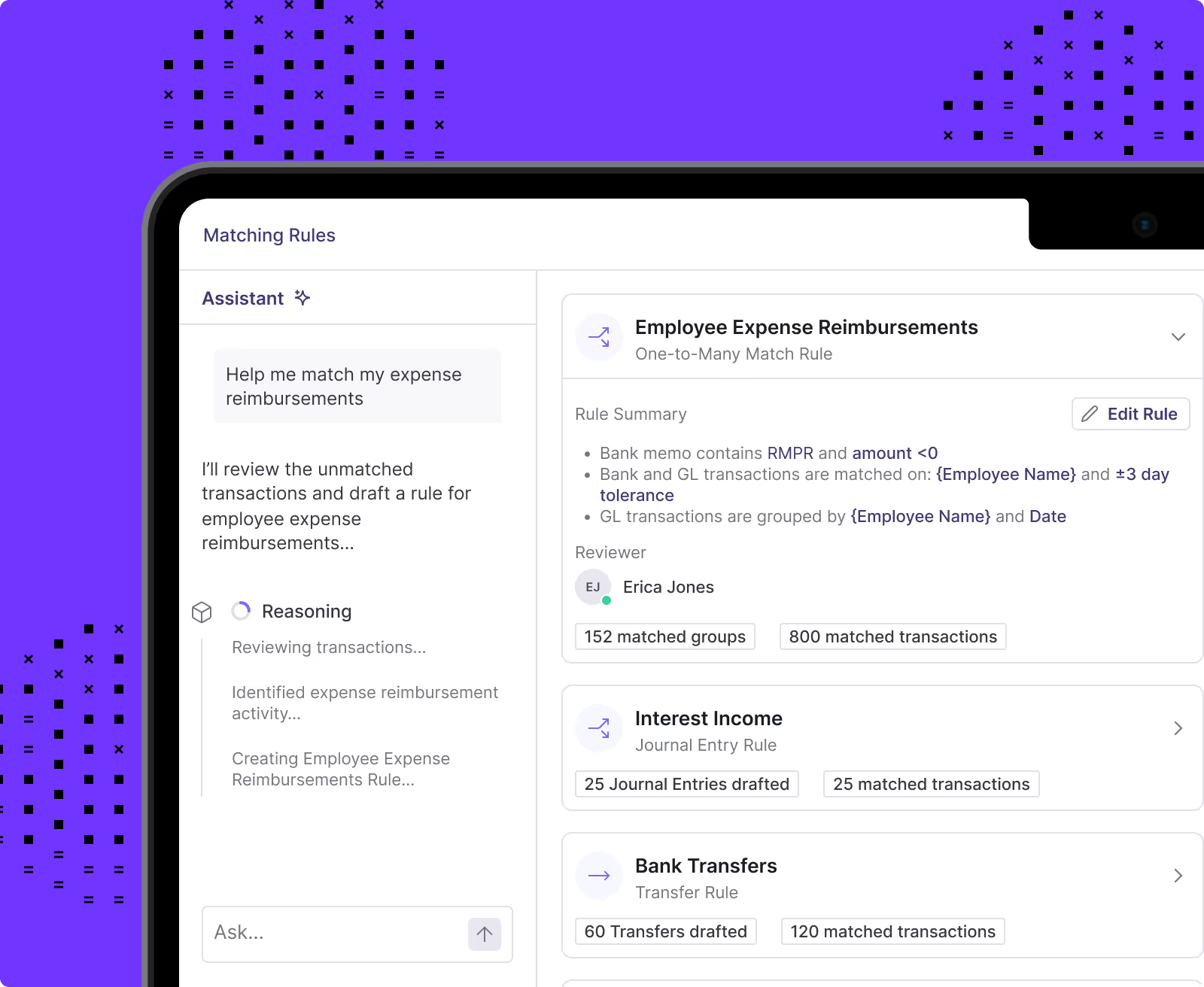
The proof is in the timeline. Brex came to Numeric with a cash reconciliation problem: their previous tool was automating roughly 30% of bank recs across 100+ accounts, leaving an offshore team doing daily manual matching to cover the gap. With Numeric's Cash Management, they now automate 95%+ of those reconciliations — and compressed their close from six business days to four in the process, without standing up a dedicated administration function.
Generally, BlackLine is priced and built for organizations that can absorb a long runway and a dedicated administrator. Numeric is built for high-growth teams that need that level of capability without the enterprise tax.
BlackLine Pricing: Bottom Line
BlackLine can be the right call for large, often public companies running SAP, managing multi-entity complexity, and staffed to own a deep, control-heavy platform. For those teams, the cost buys real capability.
But BlackLine's pricing model bundles recurring subscription fees with substantial one-time professional fees. It also assumes you have the people and the timeline to implement and maintain the platform.
If your team needs that depth of reporting and reconciliation but can't justify dedicated administration or a six-figure commitment, a lighter platform will get you a faster close for less. Book a walkthrough, and we will show you how a team your size gets a faster, cleaner close, without a dedicated administrator or the enterprise price tag.
Frequently Asked Questions
Related Content
.png)
ERP for SaaS: How to Choose an Accounting System Built for Subscription and Usage Revenue
A guide to choosing an ERP for SaaS, covering ASC 606 revenue recognition, usage-based billing, multi-entity, reporting, and a checklist for vendor demos.
.png)
Numeric vs. Maxima: Which AI Close Platform Fits Your Team?
Numeric and Maxima both automate close work. Compare how each handles reconciliations and cash matching, who owns the rules, and when each one fits.
.png)
7 NetSuite Reporting Tools, and When to Just Replace NetSuite
Compare 7 NetSuite reporting tools by use case and cost, and learn when replacing NetSuite solves reporting problems at the source.