5 Questions to Answer Before You Make the Switch to a Usage-Based Pricing Model

Switching to a usage-based pricing model can seem like a slam dunk, for businesses and customers alike. And as more teams incorporate AI into their products, it can also feel inevitable.
But if done carelessly, making the switch to usage-based can actually reduce your overall revenue.
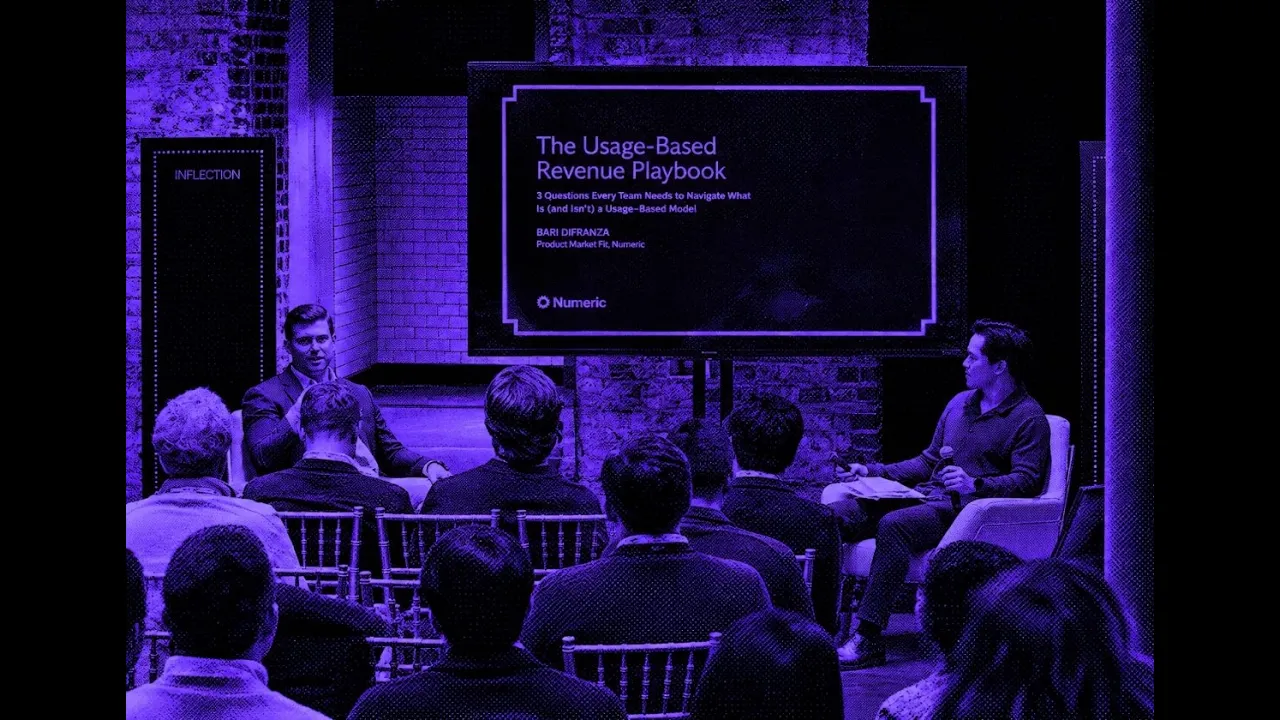
That’s one of the tradeoffs Ben Sheridan, Product Manager at Numeric, explored in his Inflection 2026 session, The Usage-Based Revenue Playbook. Drawing on his experience helping build Snowflake’s usage-based revenue accounting engine, Ben walked through five questions teams need to answer before implementing a usage-based model.
The opportunity is compelling: align pricing with customer value, make adoption easier, and grow revenue as usage expands. Getting there requires coordinated decisions across sales, engineering, finance, and business operations.
Top takeaways
- Start with the business case. Usage-based pricing needs to improve your commercial model enough to justify the forecasting, cash flow, and operational complexity.
- Define what sales can sell. Discounts, rollovers, and contract exceptions can change the accounting requirements.
- Treat metering as shared infrastructure. The same usage data supports customer experiences, invoices, and revenue recognition.
- Keep billing and revenue distinct. What customers consume, what you invoice, and what you recognize can differ.
- Choose a system your team can sustain. Building metering internally and building an entire billing and revenue engine are very different commitments.
1. Does usage-based pricing make sense for your business?
This isn’t a decision where you want to “let the accounting tail wag the dog,” as Ben states.
Teams should align on the commercial impact they want from adopting usage-based pricing, before thinking about the accounting effects.
Ben pointed to several potential benefits from switching to usage-based: stronger net dollar retention, improved win rates, and pricing that better reflects the value customers receive.
A self-service consumption model can create a natural path from adoption to expansion. Customers start using the product, see its value, and eventually commit to a larger contract in exchange for better pricing.
But the model also introduces questions that a fixed subscription can make easier to answer.
Can you forecast consumption? Can you secure upfront commitments? If customers pay monthly in arrears, can your team manage the collections workload and cash flow exposure?
Product decisions enter the equation, too. As Ben explained, an efficiency improvement can lower the resources customers consume—and therefore the amount you charge them.
The readiness test extends beyond finance. Sales needs to understand the commercial model. Engineering needs to support usage measurement. BizOps needs reliable contract data.
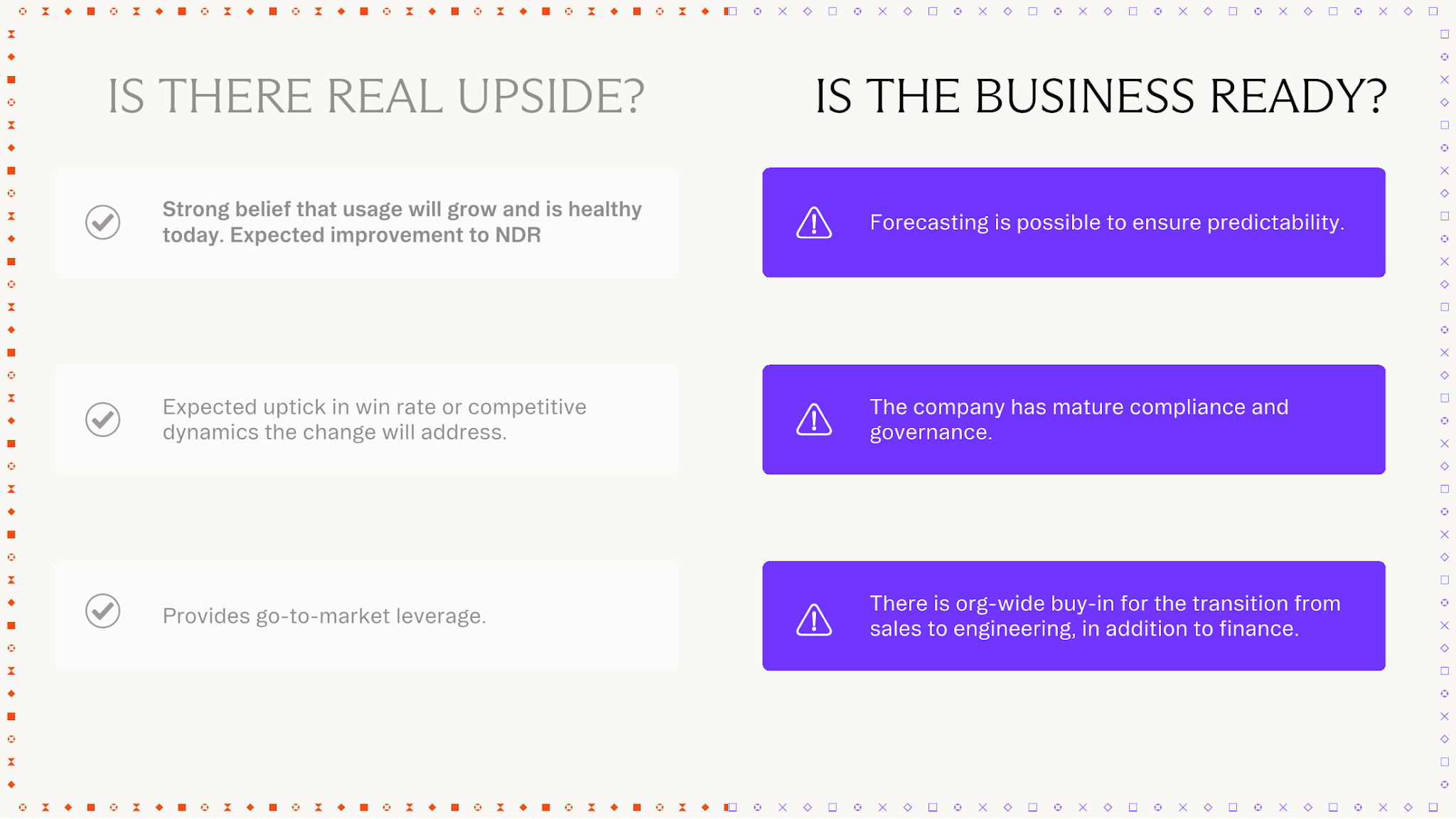
The transition to a different commercial model can easily exceed a year, depending on the company’s scale and starting point. The work includes adopting policies, restructuring contract data, building the accounting infrastructure, and governing the process as it grows.
The first decision is whether the commercial upside warrants that investment.
2. What will your bookings policy allow?
One of the session’s clearest points?
“Every sales decision is an accounting decision and vice versa.”
A bookings policy defines which deals your business can support and how exceptions get approved.
That includes questions such as:
- Can customers roll unused credits into a renewal?
- Can sales offer free credits, discounted rates, or both?
- Can discounts change when customers reach usage thresholds?
- How do cancellations and credits work?
- Which departures from standard terms require finance approval?
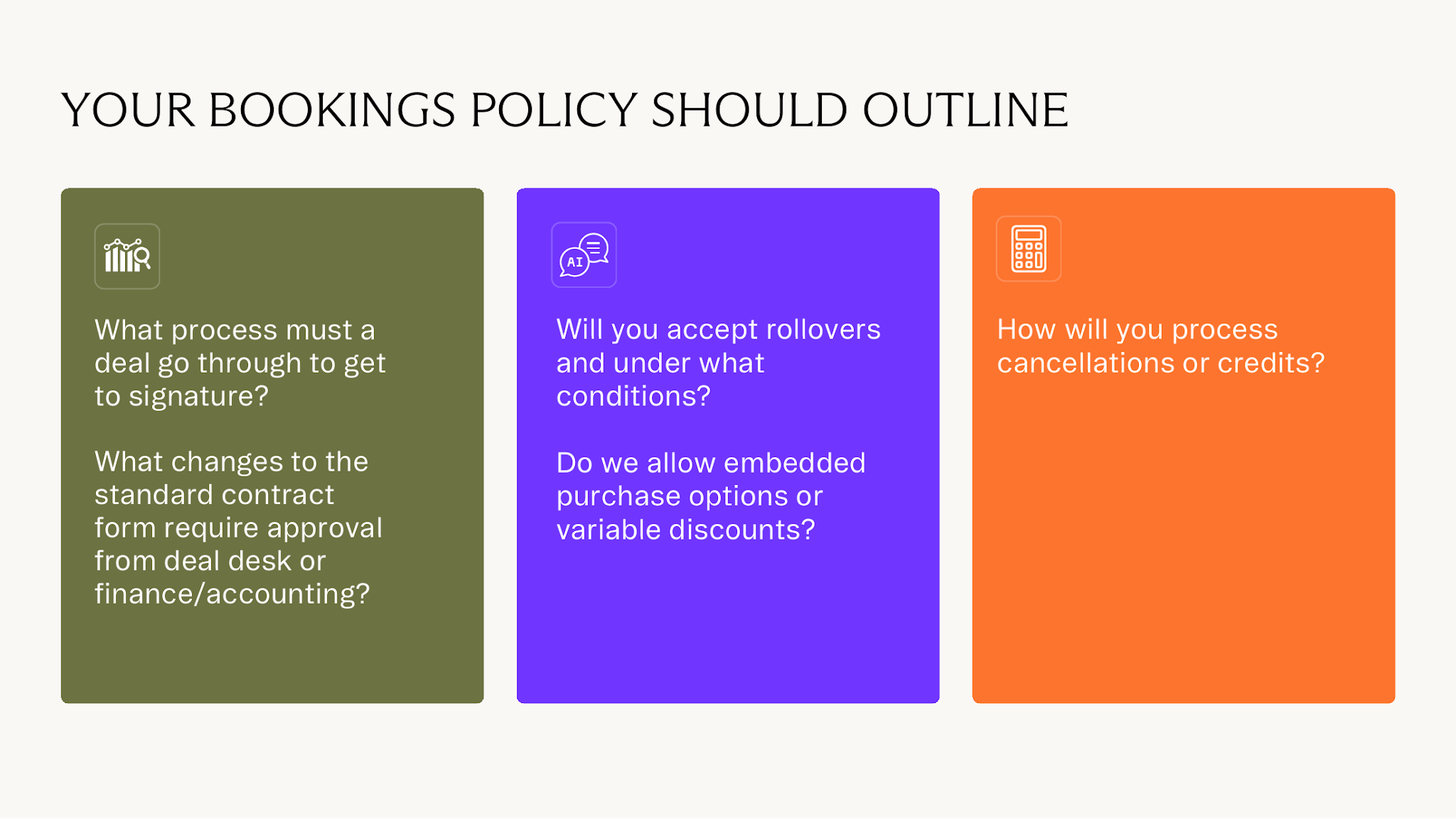
These decisions can look small during a negotiation and become substantial downstream.
Ben gave the example of a discount that increases after a customer passes a usage threshold. That incentive may make commercial sense, but it can also introduce uncertainty into the accounting calculations.
Rollovers create another tradeoff. A customer who buys more capacity than they need may accumulate deeply discounted credits and draw them down slowly across future periods. The initial deal can continue affecting the economics long after signature.
These policies also need enforcement, if the switch to usage-based is to be successful. Ben described how unsupported pricing arrangements can push accounting teams back into spreadsheets, leaving hundreds of customer calculations to close manually each month.
His recommendation was to require a conversation between deal desk and finance before accepting terms that existing systems cannot handle.
The goal is to give the business a path to support valuable deals—with the process and infrastructure those deals require.

3. How will you meter usage?
Capturing product activity is the starting point. Turning it into usable billing and accounting data takes additional work.
Ben broke the process into several steps:
- Capture events: What happened, who did it, and when?
- Transform and enrich the data: Which customer, contract, region, or deployment does the activity belong to?
- Aggregate it: Does the business need usage by day, week, month, or another interval?
- Apply the relevant rates and rules: What does that activity mean for billing and revenue?
Those rules can become intricate. A customer might have a commitment, receive invoices in arrears, and have free credits that apply only at a particular point in the contract.
The data also serves different audiences.
A customer approaching a usage limit may need an immediate alert. Finance may need a monthly calculation with a clear audit trail. Customers may want usage detail alongside their invoices so they can understand the charges.
Those requirements shape the build-versus-buy decision.
Ben favors building metering internally when it closely controls the product experience: overage alerts, service cutoffs, or shared usage limits. Where those needs are less immediate, a third-party solution may reduce the engineering and maintenance burden.
The right choice depends on what metering needs to do for your customers as well as your back office.
Ben also highlighted metering as an area auditors scrutinize closely: how events are captured, how they are transformed, and how the company establishes completeness. Estimates and unusual contract terms introduce further review.
4. How will you account for the revenue?
Knowing what a customer consumed doesn’t automatically tell you how much revenue to recognize.
Usage needs to map to the right contract and contract line. Discounts, commitments, free credits, and modifications can all affect the calculation.
Ben used three simplified scenarios to illustrate how the requirements change:
| Model | How Ben described it | Data the system needs |
|---|---|---|
| Pre-commit | Revenue is released as customers consume their entitlement, using the amount allocated to that usage. | Contract dates, entitlement, discounts, allocated amount, and consumption |
| Pay as you go | In the simpler cases discussed, billing and revenue follow usage together. | Usage, applicable rates, and relevant contract terms |
| Monthly minimum | In the example presented, charges reflect the greater of the monthly minimum or actual usage. | Usage, rates, minimum amount, and reset period |
The important distinction is that each model requires different information upstream. A system cannot apply a monthly minimum correctly if that minimum never made it out of the contract and into structured data.
Contract changes make that dependency especially visible.
Ben described a failure scenario in which a revenue engine correctly processes usage and recognizes unused balances at expiry—but deal desk separately promises the customer a rollover by email.
If the system follows its configured rules, but the commercial agreement has changed outside it, then that disconnect can create a material error.
Reliable revenue accounting depends on keeping contracting, metering, and accounting connected.
5. How will you build a system that scales?
Ben outlined four approaches, each with different tradeoffs.
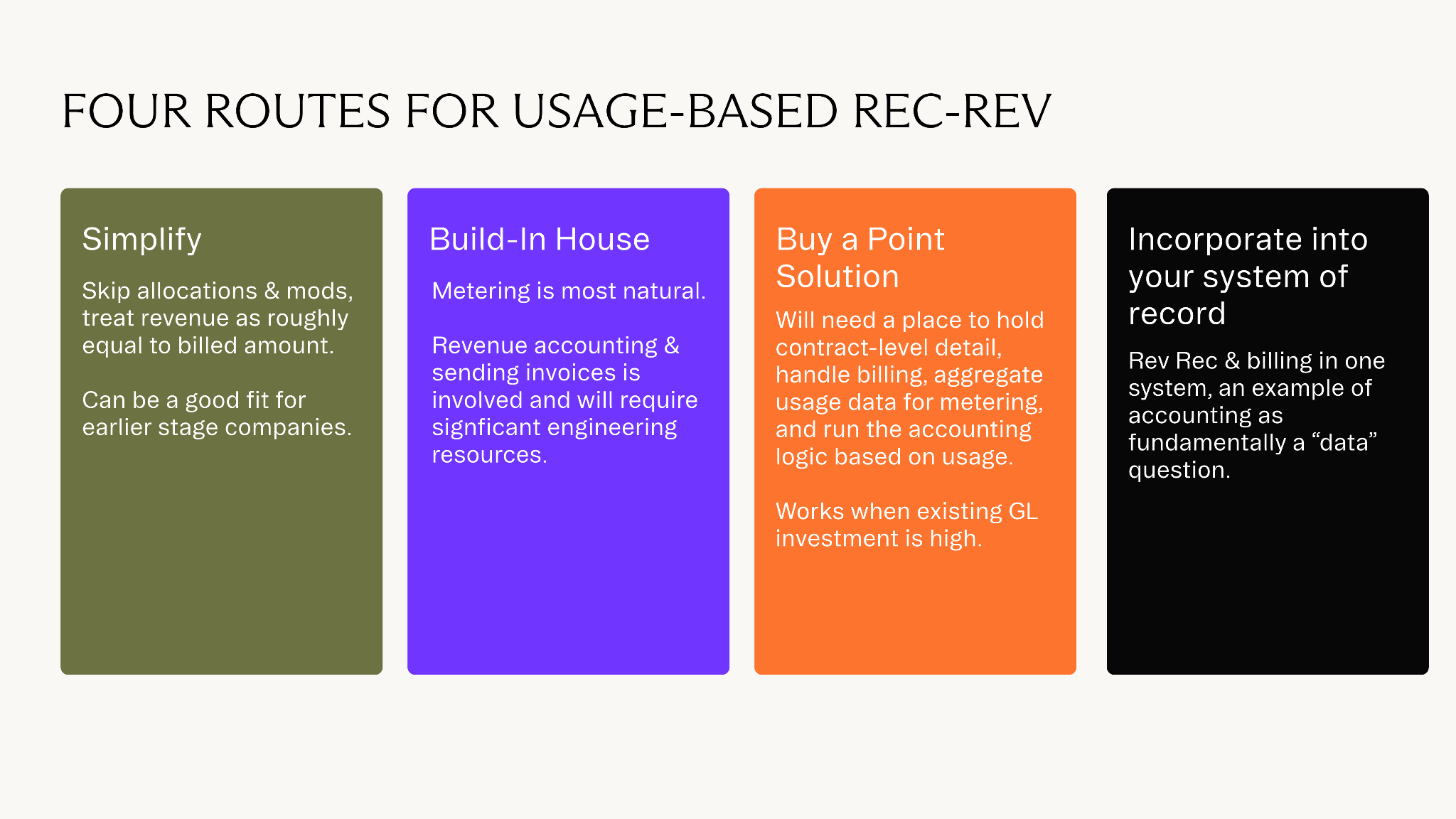
A simple approach for smaller companies
For early-stage companies whose immediate reporting centers on cash and burn, with no near-term audit requirement, a simpler revenue process may fit the business better than investing immediately in a fully automated engine for allocations and contract modifications.
The scope should follow the reporting requirements the company actually has. Before committing to a larger implementation, understand which calculations you need today, how much manual work they create, and where the current process becomes difficult to explain or maintain.
Even while keeping the process simple, capture the contracts, usage, and amendments a future system will need. As Ben explained in the Q&A, reshaping historical agreements into structured records can become one of the hardest parts of a transition.
Then define what will trigger the next investment: more negotiated enterprise contracts, frequent pricing changes, a growing close workload, or more demanding reporting and audit requirements. A simpler starting point works best with a clear plan for when to move on.
Build internally
Metering can be a natural internal investment because it supports the customer experience. Numeric CTO Andrew Bihl extends this point in his writing on billing architecture for AI companies: usage measurement, pricing, and live balances form a fast feedback loop that the product depends on.
When a customer approaches a spending limit, the product needs current information to decide whether to warn them, stop service, or allow overages. Enterprise customers may also need shared credit pools and spending controls by team. Owning that infrastructure gives engineering control over how those experiences evolve.
Ben cautioned that extending the internal build into invoicing and revenue accounting introduces substantial engineering work. Andrew recommends using specialist software for those functions, ideally keeping invoicing and revenue recognition together.
Buy a point solution
A dedicated billing or revenue tool can make sense when a company already has a substantial investment in its general ledger or broader enterprise systems.
Integration work still matters. In the Q&A, Ben highlighted the challenge of keeping multiple systems aligned on data granularity, accuracy, and timing.
Buying a tool leaves the team responsible for those connections.
Integrate billing and revenue into the system of record
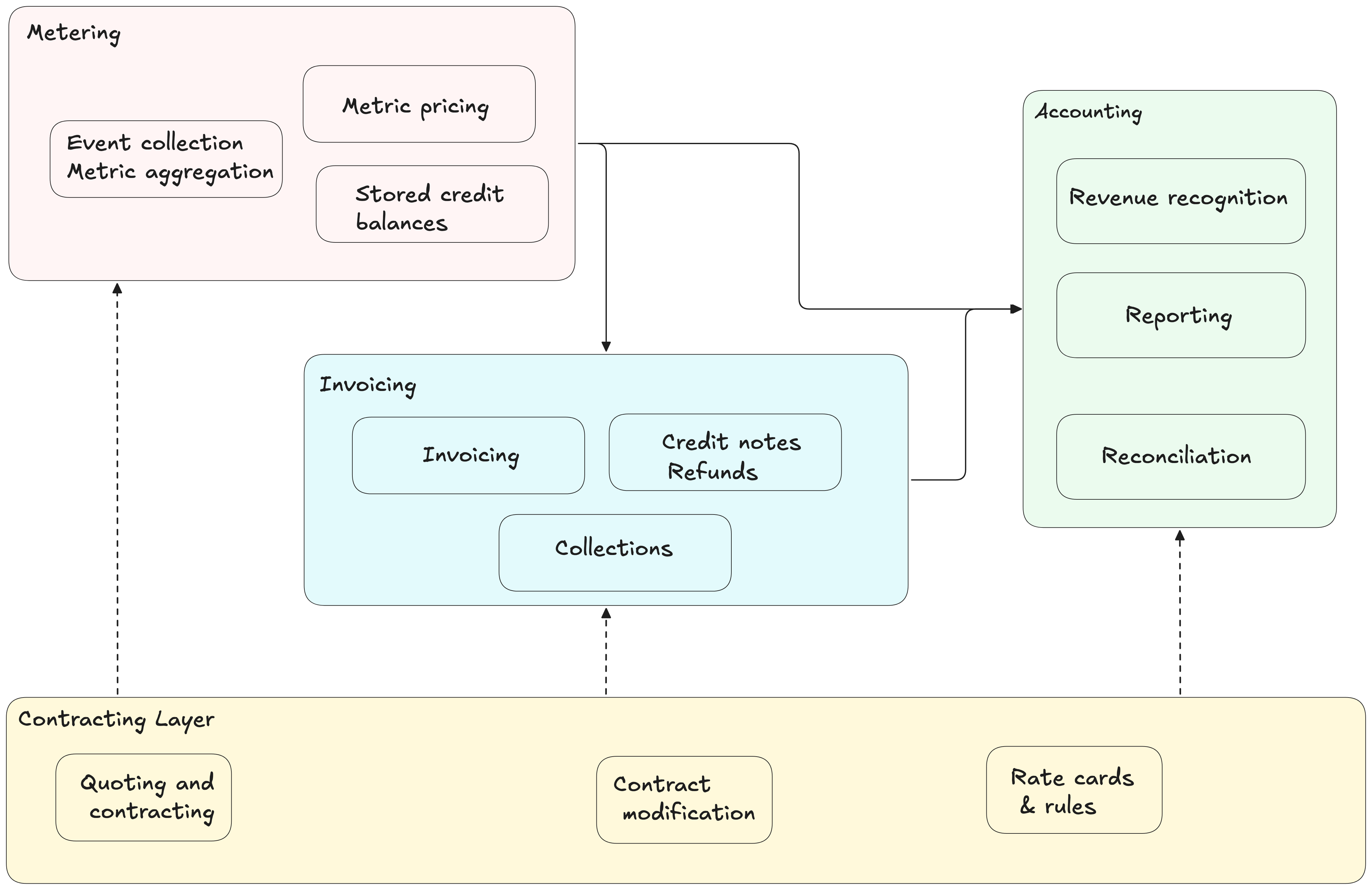
Ben’s preferred approach brings billing, revenue, and the rest of accounting into a shared data model. A credit note illustrates why: an action commonly treated as a billing operation can also affect revenue. Keeping the two connected helps the system reflect that relationship.
Andrew adds a specific requirement for connecting that back office to customer-facing metering: a shared model of the customer agreement.
Finance and accounting interpret the full contract, including discounts, bundled services, and modifications. Metering receives the terms it needs to apply prices and manage balances. Both sides work from the same agreement rather than reconstructing it independently.
As the business grows, teams also need to reconcile bookings, billings, recognized revenue, and collections—and identify usage events that never received a price. Those controls help the system remain explainable as pricing and contracts become more complex.
Shared data can also support richer reporting, such as connecting bookings, billings, and revenue by sales representative or analyzing customer usage across geographies and business units.
Bring billing and revenue onto the same foundation
Numeric’s Billing & Revenue product puts contract terms, rate cards, and usage events into a shared model, so invoices and revenue schedules are generated from the same underlying data. It supports tiered usage, overages, and minimum true-ups, flags usage events that do not match a rate card, and applies allocation and contract-modification logic consistently.
For teams keeping customer-facing metering in-house, Andrew describes how Numeric can own the back office and coordinate the agreement layer. Engineering retains control over the product experience, while finance manages the contract interpretation and downstream billing and revenue work.
Today? Start with the contracts and data you already have
During the Q&A, an audience member asked what makes the transition especially difficult.
Ben pointed to data transformation.
A company may have thousands of active contracts written before anyone contemplated the new system. Those agreements need to become structured records that the billing and revenue engine can use.
He described AI as increasingly useful for reading documents, identifying missing fields, and helping reshape that data. Review, validation, and reconciliation remain part of the process.
That work offers a practical starting point: define the contract information your future system requires, compare it with what you capture today, and identify the gaps.
The five questions ultimately connect. Your business model shapes your contract terms. Those terms determine what you need to meter and calculate. And those requirements determine the system you need to build.
Related Content
5 Questions to Answer Before You Make the Switch to a Usage-Based Pricing Model
Five questions from Ben Sheridan's Inflection 2026 session to answer before switching to usage-based pricing, from bookings policy to revenue accounting.
AI companies should own their metering, not the entire billing stack
Andrew Bihl, Numeric's CTO, explains why AI companies should build metering in-house and buy invoicing and revenue recognition, with one shared contract model connecting the two.

NetSuite Alternatives: 10 Options for Finance Teams in 2026
Compare 10 NetSuite alternatives by fit, cost, and implementation, and see how Numeric's ERP replacement consolidates your ERP and point solutions.