NetSuite Alternatives: 10 Options for Finance Teams in 2026


Most NetSuite alternatives record activity the same way NetSuite does, as journal entries against a chart of accounts. They differ in scope, pricing, and how much operational coverage they include. Some go deeper on dimensions and multi-entity. Others add AI-driven automation or a cleaner interface. A few cover inventory, manufacturing, and supply chain alongside the financials.
Those differences matter when choosing a system, but the underlying architecture stays the same. Revenue schedules still live in spreadsheets, dimensions are still locked at write time, and tracing a number back to its source still takes a workbook.
This post covers 10 NetSuite competitors, including conventional options and an ERP replacement that keeps every business event as an object and derives the accounting from it.
Key Takeaways
- Teams look for NetSuite alternatives when module costs, workbooks, and point solutions keep growing while the close stays the same length.
- The right alternative depends on where your complexity lives, whether that is entities, revenue model, operations, or reporting.
- Most alternatives, including newer AI-native ones, still record activity as journal entries against a chart of accounts, so the same close work follows you from one system to the next.
- Total cost includes licenses, modules, implementation, admin, and the point solutions you still need, and varies widely by company size and scope.
- Numeric's ERP replacement, the Financial Data Platform, replaces NetSuite and the tools around it with one system, often for the same cost or less.
Why Finance Teams Look for NetSuite Alternatives
NetSuite may still be the right choice if you need inventory, warehouse management, manufacturing, ecommerce, and CRM running alongside financials in one system, or if you have deep SuiteScript customizations tied to core operations. But five problems come up most often when finance teams start looking elsewhere.
- Costs that rise at every renewal. Modules, user licenses, and partner fees keep growing. NetSuite's annual recurring cost ranges from roughly $25,000 for a Starter Edition to over $250,000 for an Enterprise Edition, with per-user fees of $99 to $199 per month on top (and plus implementation fees, too).
- Revenue schedules kept in workbooks. Subscription and usage contracts get tracked alongside the ERP and updated by hand, because the contract details and the accounting live in separate places.
- Reporting cuts that need exports. When leadership asks for a view the chart of accounts and segments cannot produce, your team exports to spreadsheets and ties the numbers back to the GL. NetSuite reporting limitations are a common driver.
- An admin or partner for every change. Small workflow or revenue rule updates turn into a scoping call and an hourly consulting bill.
- Point solutions layered on top. Billing, revenue, close management, and reporting tools get added around NetSuite, each with its own integration to maintain. The difference between what the ERP stores and what you actually need is why point solutions multiply.
NetSuite Alternatives and Competitors at a Glance
Every option on this list fits a different kind of company. This table puts the key differences side by side before the detail below.
Numeric's ERP Replacement
A platform that changes how the accounting is produced, keeping every business event as an object and deriving the accounting from it.
1. Numeric's Financial Data Platform

Best fit: Complex finance teams, especially SaaS, fintech, and usage-based revenue businesses, with multiple entities and reporting needs that change as the business grows.
Numeric's Financial Data Platform replaces NetSuite and the point solutions layered around it with one system. Where NetSuite runs on a traditional ERP model, the Financial Data Platform uses data-centric accounting. It keeps each business event (the contract, the invoice, the usage event) as an object and derives the accounting from it.
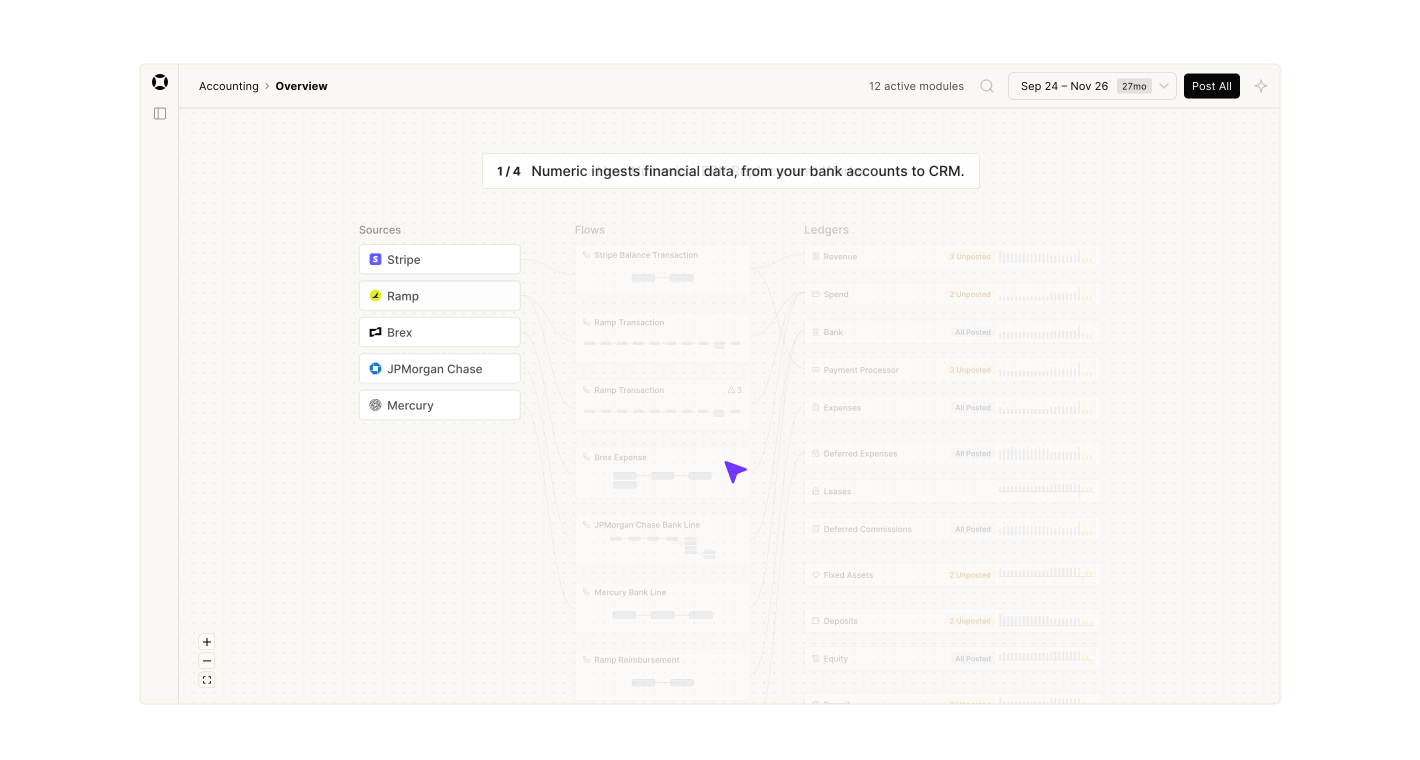
Built moved from NetSuite to Numeric's Financial Data Platform, freed up 2 FTEs worth of bandwidth from billing and revenue work, and delivers invoices 4 business days earlier. As Asia McKnight, Controller at Built, puts it, "I'd say Numeric is an operating engine. It's not a legacy ERP system. It takes data from all the other operating platforms your business is using, puts that into day-to-day accounting in a way that's super flexible and easy to configure by any accountant, and gives the whole business a way to run accounting and finance the same way we run the rest of the business."
AI-Native Platforms
Newer platforms with modern interfaces, faster setup, and automation features, built on the journal-entry model.
2. Rillet
G2: 4.9/5 (97 reviews)
Best fit: VC-backed startups that want a modern GL with faster implementation than NetSuite.
Rillet gives you a cleaner interface, faster setup, and stronger automation than most legacy ERPs. See Rillet vs Campfire and Rillet pricing for more.
Rillet still runs on the traditional ERP model, so a reporting cut the chart of accounts wasn't built for still means restructuring.
3. Campfire
G2: 4.7/5 (51 reviews)
Best fit: Early-stage accounting teams that want strong automation and a modern interface.
Campfire is an AI-native accounting platform with a focus on automation and a modern user experience. Early-stage teams that do not need a broad ERP will find it fast to set up. Our Rillet vs Campfire comparison covers how the two differ.
Campfire still runs on journal entries and a chart of accounts, so the same structural limits apply when the revenue model gets complex or leadership asks for reporting cuts the original chart of accounts cannot produce.
Traditional ERPs
Established systems that compete with NetSuite on similar terms, with modular scope, partner ecosystems, and implementations measured in months.
4. Sage Intacct
G2: 4.3/5 (4,523 reviews)
Best fit: Finance-led mid-market companies that want strong core accounting, dimensions, and multi-entity without the broader ERP footprint.
Sage Intacct is the finance-first alternative to NetSuite, and Sage's product documentation describes these core capabilities.
- 14 standard dimensions out of the box (Location, Department, Class, Customer, Vendor, Employee, Item, Project, and more) plus user-defined dimensions
- Multi-entity accounting with consolidation across entities and intercompany eliminations
- Order Entry, Purchasing, and Inventory Control modules, though operations-heavy companies often find NetSuite's scope broader
- Contract and revenue management module for complex revenue recognition
Dimensions are fixed when entries post, so when the reporting structure changes, historical data does not move with it. Sage Intacct dimension issues covers the details.
Sage quotes pricing on request. Vendr reports a median annual contract value of $60,000.
5. Microsoft Dynamics 365 Business Central
G2: 4.0/5 (917 reviews)
Best fit: Companies already on Microsoft tools that want accounting plus light operations, with Power BI and Power Automate connecting natively.
Business Central fits mid-market companies that want their accounting, inventory, and light manufacturing inside the Microsoft ecosystem. Power BI connects natively for reporting, and Power Automate handles workflow. Per-user pricing starts at $80 per month for Essentials and $110 per month for Premium, with Team Members at $8 per month for limited access, all billed annually, according to Microsoft's pricing page.
Implementation runs through partners, so your experience depends heavily on which partner you choose, and customization follows the same model.
6. Acumatica
G2: 4.4/5 (2,050 reviews)
Best fit: Operations-heavy mid-market companies in distribution, manufacturing, and construction.
Acumatica's resource-based pricing lets large operations teams have access without per-user fees, which makes it a natural fit for companies with many warehouse, field, or shop-floor users who need system access. The platform covers financials, distribution, manufacturing, construction, and field service. Implementation runs through partners and usually takes 4 to 12 months depending on scope.
Revenue recognition capabilities are more operations-oriented than finance-oriented. If you have subscription or usage-based revenue, check how Acumatica handles those models during the demo.
7. Intuit Enterprise Suite
G2: 4.5/5 (64 reviews)
Best fit: Companies outgrowing QuickBooks Online that want multi-entity accounting and consolidated reporting in a familiar ecosystem.
Intuit Enterprise Suite is Intuit's platform for mid-market businesses that need more room than QuickBooks Online provides. If you are weighing NetSuite vs QuickBooks, the path from QuickBooks to Intuit Enterprise Suite is easier than most migrations, since your team is already working in the Intuit ecosystem. Multi-entity accounting and consolidated reporting are included. Intuit quotes Enterprise Suite pricing on request.
Intuit Enterprise Suite still records activity as journal entries against a chart of accounts, so revenue schedules and new reporting cuts can still end up in spreadsheets for complex revenue models.
8. Odoo
G2: 4.2/5 (359 reviews)
Best fit: Cost-conscious companies that want broad operational coverage and are comfortable configuring a modular system.
Odoo is an open-source, modular business suite with accounting alongside apps for inventory, sales, CRM, HR, and more. The draw is the breadth of apps at published pricing. Odoo's pricing page lists Standard at $24.90 per user per month, including all apps, and Custom at $37.40 per user per month, which adds the external API, Odoo Studio, and multi-company support.
Multi-entity consolidation and complex revenue recognition often need configuration or a partner, and the depth of each module varies. Odoo still records activity as journal entries against a chart of accounts.
9. Workday Financial Management
G2: 4.2/5 (513 reviews)
Best fit: Large enterprises that already run Workday HCM and want finance on the same platform.
Workday Financial Management brings accounting, planning, and analytics into the same platform as Workday's HR and payroll suite. For enterprises already on Workday HCM, consolidating finance onto the same system simplifies integrations and gives leadership a single data model across people and money.
The tradeoff is enterprise pricing and implementation timelines, which usually run 6 to 18 months. Vendr reports a median annual contract value of $55,000 for Workday, though enterprise contracts often run significantly higher depending on modules and headcount.
10. Oracle Fusion Cloud ERP
G2: 4.0/5 (122 reviews)
Best fit: Global enterprises with complex operations, multiple business units, and deep Oracle ecosystem investment.
Oracle Fusion Cloud ERP is Oracle's enterprise platform for companies that need financials, procurement, project management, and supply chain in one global system. Implementation runs 9 to 18+ months with a systems integrator.
Oracle Fusion fits companies with the scale, budget, and IT team to support a large enterprise deployment. Oracle quotes pricing on request.
Best Alternatives to Try by Company Type
Where to start depends on your team's size, revenue model, and operational needs.
- Startups and small businesses. Odoo for small businesses that want broad apps at low cost, Intuit Enterprise Suite if you are already on QuickBooks, or Rillet and Campfire for a modern GL with fast setup.
- SaaS and usage-based revenue businesses. Numeric's ERP replacement leads here, since revenue recognized from the contract, reporting on any dimension, and consolidation in one system are built for this model. Sage Intacct and Rillet are common shortlist additions.
- Multi-entity mid-market companies. Numeric's ERP replacement if your complexity is in entities, revenue, and reporting. Sage Intacct for finance-led groups that want strong dimensions. Business Central if you are already on Microsoft.
- Operations-heavy companies. Acumatica for distribution, manufacturing, and construction, with resource-based pricing for large teams. Odoo for broad operational modules at published per-user pricing.
- Large enterprises. Workday Financial Management for companies already on Workday HCM. Oracle Fusion Cloud ERP for global companies with complex operations and the IT team to support a large deployment.
What Most NetSuite Alternatives Have in Common
Nearly every option on this list, whether it is an established ERP or an AI-native platform, records activity the same way NetSuite does. Journal entries against a chart of accounts, with dimensions or segments fixed when the entry is written. The contract, the usage event, and the business reason behind a number live in other systems.
That means the same close work follows you to a new system each month.
- Pull contract and usage data into a workbook to build the revenue recognition schedule, because the contract terms and the accounting live in separate places.
- Rebuild the view leadership asked for when a new reporting cut does not match the dimensions that were set up at implementation.
- Tie every consolidated number back to the GL to make sure eliminations, translations, and adjustments all reconcile.
- Pull together documentation when the auditor asks how a number was produced, tracing from the report back through the workbook to the source system.
How Traditional ERPs, AI-Native Platforms, and the Financial Data Platform Compare
This table shows how the three categories differ on the work that matters most during the close.
Switching systems is the moment to decide whether the accounting model changes too.

Why Your Team Should Consider Numeric's Financial Data Platform
The traditional ERP model locks in decisions that do not flex as the business changes. Dimensions are fixed at write time and revenue lives in schedules outside the system, so a reporting cut that doesn't match the original chart of accounts means a reclassification project or a spreadsheet. The Financial Data Platform replaces the ERP entirely, often with more functionality for less cost.
Here is how the Financial Data Platform handles the areas finance teams weigh most when choosing a new system.
- Revenue model fit. Revenue schedules come from the contract's performance obligations, and when terms change, the schedule updates from the contract without manual correcting entries or off-ledger spreadsheets.
- Multi-entity and consolidation. Entities and consolidation run in one system, with intercompany handled as part of the data model.
- Reporting flexibility. You can add new reporting dimensions to data the Financial Data Platform already holds, and history moves with the new structure, so there's no reclassification project.
- Traceability and audit. Every number drills back to the contract, invoice, or usage event that produced it. Auditors get a clean, traceable trail without audit-prep season work.
- Integrations. The Financial Data Platform connects to Stripe, HubSpot, Salesforce, Ramp, Brex, and your banks, and pulls usage data from warehouses like Snowflake.
- Total cost. The Financial Data Platform often costs about the same or less than NetSuite plus the point solutions you add around it, with more functionality included.
- Migration path and support. Moving off NetSuite is the biggest risk in any switch, so the Financial Data Platform doesn't require a single cutover. You can move module by module, run it in parallel with NetSuite, and cut over once the numbers match. Numeric's team works hands-on through each phase.
- Readiness for AI and agents. The Financial Data Platform keeps full context about each transaction, so AI tools like Claude can reason on accurate, traceable data through the Numeric MCP. Your team can also build small internal apps on the same data with App Studio.
For Built, the change shows up in the first days of each month. "Today is the second day of the month, and I already have events live for this month coming in," says Asia McKnight, Controller at Built. That means she can tell the business before mid-month whether it's on track.
See the Financial Data Platform in action. Book a demo with our team to walk through how it works.
The Bottom Line
Most NetSuite competitors improve the interface but keep the same accounting architecture underneath. If your pain points are cost and usability, that may be enough. If the problem is the close work itself, look at whether the system you are moving to actually changes how that work gets done.
Numeric's Financial Data Platform is the only option on this list that changes how the accounting gets produced. It keeps every business event as an object, derives the accounting from it, and lets you add reporting dimensions after the fact without reclassifying history. And switching to Numeric is straightforward. You can move module by module, run in parallel with NetSuite, and cut over once the numbers match.
If your team is evaluating what comes after NetSuite, schedule a demo to see Numeric's ERP replacement.
Frequently Asked Questions About NetSuite Alternatives
The best NetSuite alternative depends on where your complexity lives.
- Numeric's ERP replacement fits complex finance teams with changing revenue and reporting needs.
- Sage Intacct fits finance-led companies that want strong dimensions.
- Business Central fits Microsoft shops.
- Acumatica fits operations-heavy companies.
- Rillet and Campfire fit startups that want a modern GL.
Total cost includes more than the license. Modules, implementation, admin, and point solutions all factor in. Numeric's ERP replacement often costs about the same as or less than NetSuite plus the point solutions you add around it, with more functionality included. Odoo and Business Central offer lower entry points, though the total rises with modules and customization.
Timeline depends on entities, history, open contracts, and integrations. NetSuite implementations and other traditional ERP migrations usually take 3 to 18 months depending on the system. A staged approach with a parallel close reduces risk by letting you verify numbers in both systems before cutting over.
AI-native platforms like Rillet and Campfire offer a better interface, faster setup, and stronger automation features. They still record activity as journal entries against a chart of accounts, so the underlying accounting model is the same. The experience improves, but the close work that comes from the journal-entry architecture still follows.
NetSuite fits companies that need inventory, warehouse management, manufacturing, ecommerce, and CRM alongside financials in one system across many subsidiaries, and companies with deep SuiteScript customizations tied to core operations.
Numeric's ERP replacement, the Financial Data Platform, replaces NetSuite's general ledger, revenue recognition, billing, and reporting with one system. You can move module by module, run in parallel with NetSuite, and cut over once the numbers match.
Related Content
AI companies should own their metering, not the entire billing stack
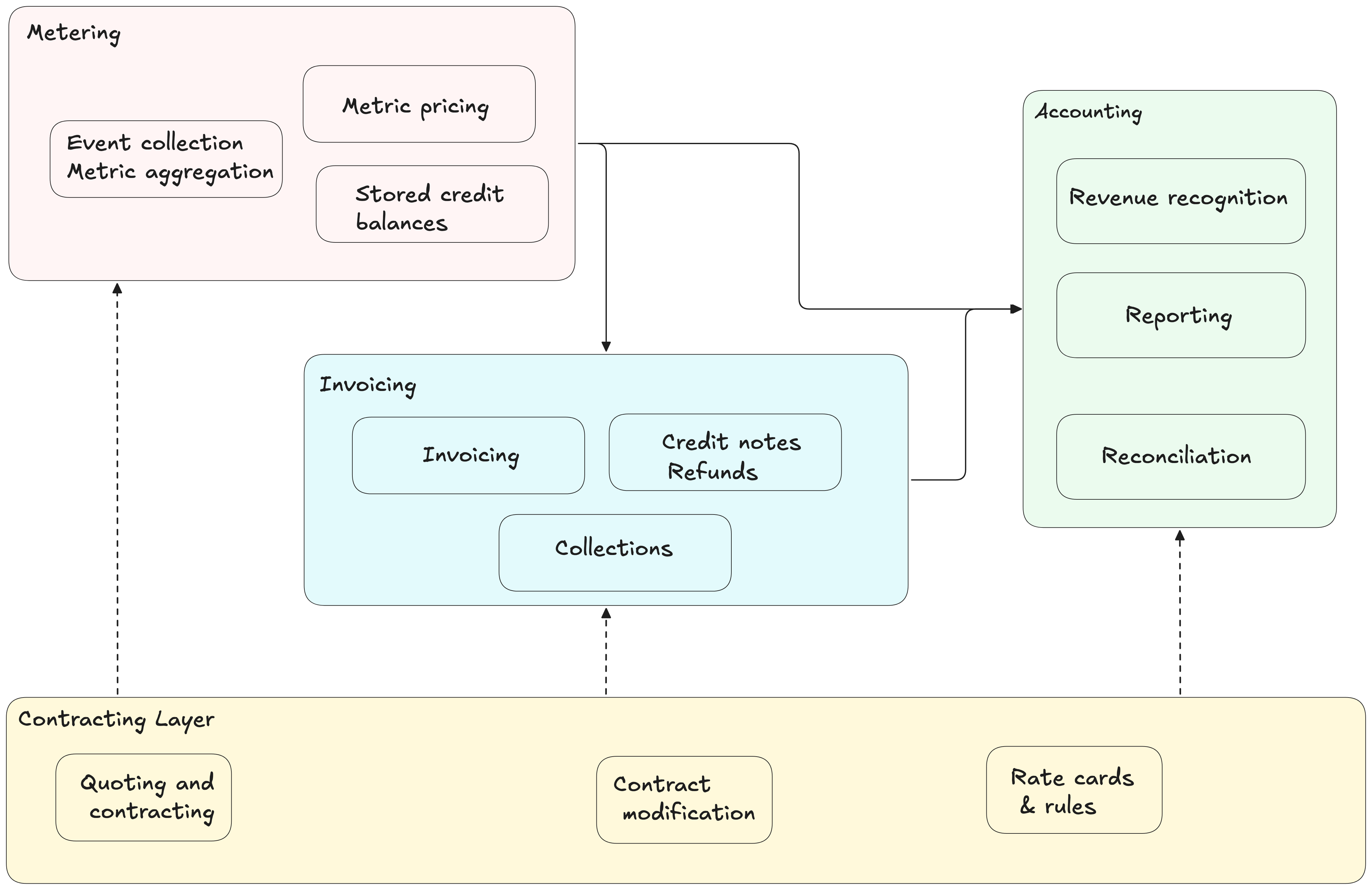
Andrew Bihl, Numeric's CTO, explains why AI companies should build metering in-house and buy invoicing and revenue recognition, with one shared contract model connecting the two.
NetSuite Alternatives: 10 Options for Finance Teams in 2026
Compare 10 NetSuite alternatives by fit, cost, and implementation, and see how Numeric's ERP replacement consolidates your ERP and point solutions.

NetSuite vs. Sage Intacct: Which Fits Your Finance Team?
Compare NetSuite vs Sage Intacct on multi-entity, dimensions, revenue, reporting, and cost, and see where Numeric's ERP replacement fits for complex teams.