Sage Intacct Dimension Issues: Why They Break at Scale

.png)
When your CFO asks for performance by product line across every entity, what should be a filter can turn into a week of reconciling tags because Location means something different in three of your subsidiaries. Reports that took ten minutes last year now take an afternoon, and nobody can point to the moment it changed.
It’s easy to treat Sage Intacct dimension issues as something you did wrong with the configuration. Your team might tighten the naming conventions, write a governance doc, appoint dimension owners, only for the drift to come back two quarters later.
This comes back because dimension values get locked onto a journal entry at the moment it's written, and changing them afterward means reversing or reclassing the entry. Better discipline slows the drift, but it doesn’t remove the property that causes it.
In this post, we’ll break down what dimensions actually are, why they drift and stiffen as you scale, what teams try first and where those fixes plateau, and what a structurally different approach looks like.
Key Takeaways:
- Sage Intacct dimension issues follow predictably from how a tagged-GL system stores dimension values.
- Drift and reporting rigidity compound as entity count and reporting demands grow.
- Historical dimension changes can't apply retroactively, because values lock to a journal entry when it's written.
- Naming conventions, governance docs, and more custom reports help for a while, and none of them fix the underlying structure.
- Numeric's ERP replacement, the Financial Data Platform (FDP), keeps every business event as a full object instead of a journal entry, so dimensions can change without a reclass project.
What Are Sage Intacct Dimensions, And What Are They Supposed To Solve?
Dimensions are tags attached to transactions that let you slice financial data without maintaining a separate account for every possible combination. Instead of building accounts for Marketing-Boston and Marketing-Austin and Sales-Boston, you keep one Marketing Expense account and tag each transaction with a department and a location.
The promise is a chart of accounts that stays small while your reporting gets rich. You get location performance, project profitability, and business unit breakdowns without the account sprawl that produces them in simpler systems.
Standard Dimensions vs. Custom Dimensions You Add Later
Sage Intacct ships with a set of standard dimensions ready to enable, including Department, Location, Class, Customer, Vendor, Employee, Item, and Project, with others switched on by subscription. Beyond those, you can build user-defined dimensions through Platform Services, each one a custom object enabled as a GL dimension.
Here’s an example of how you can use these dimensions from Sage Intacct:
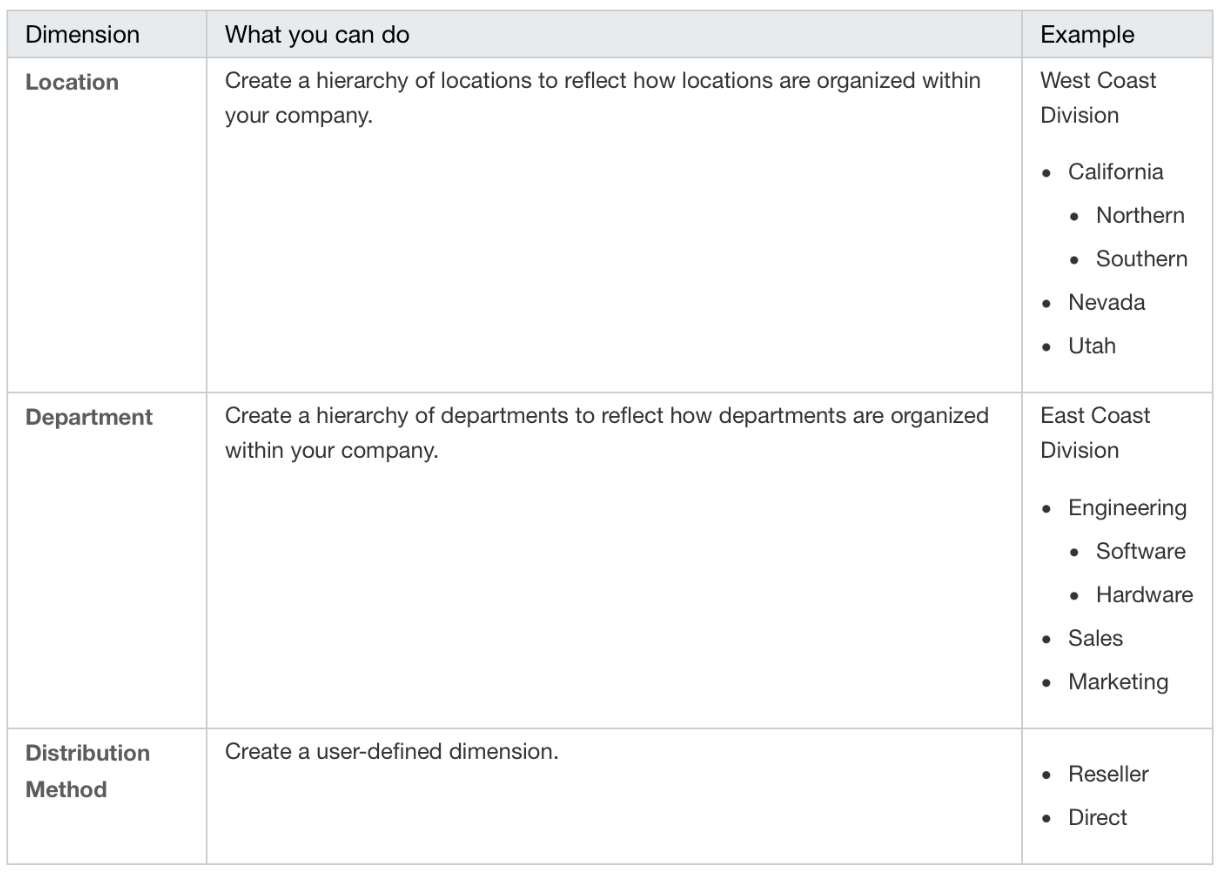
Most teams start lean, turning on Department and Location. They’ll run that way for a year, then add a custom dimension the first time FP&A asks a question the existing structure can't answer. A few years in, the structure reflects a sequence of one-off requests rather than a deliberate design.
Why Sage Intacct Dimensions Work Well Early On
At two or three entities with a handful of dimension values, this design does exactly what it promises. One person knows every value, coding is consistent because the same small team enters everything, and a new dimension takes an afternoon to add and backfill.
The trouble is that the same design behaves differently at 15 entities than it does at three.
Why Sage Intacct Dimension Issues Show Up As Companies Scale
Sage Intacct dimension issues tend to show up in three places. Drift across entities, reporting that stiffens as you grow, and history you can't recast all follow from how the system stores dimension values, which is why they arrive on schedule as you add entities and people.
Why Dimension Values Drift Across Entities
Sage Intacct gives you a shared chart of accounts across entities, and enforcing it is manual governance work. Nothing flags an entity-level user creating an account outside the corporate template, or applying dimension values inconsistently across subsidiaries.
Why Consolidated Reporting Gets Harder As You Add Entities
Vendors who work with large Sage Intacct deployments put the threshold at around 10 to 15 entities, where native consolidation still holds up reasonably well. Past that point, each new entity adds more reconciliation and report-building work than the one before it, and the reporting layer is where that shows first.
Consolidated views across large entity sets need manual aggregation or custom report builds that take hours to configure, and there's no live dashboard surfacing entity-level close status, reconciliation gaps, or variance flags in one view. So teams export CSVs from each entity, pull them into Excel, and rebuild the same picture every close. The more entities you add, the more exports you run.
FP&A feels this most acutely, because the cuts finance needs are rarely the cuts the structure was built for. A breakdown by product line, by customer cohort, or by a business unit that didn't exist eighteen months ago usually can't be produced without a workaround, since your dimensions were defined for the questions the company had at setup. Teams that want those cuts without the CSV round trip often end up building reports outside the ERP entirely.
Drift accumulates in three predictable places:
None of this stays cosmetic for long, because consolidated reporting requires a reconciliation pass before it can even begin, and that pass scales directly with entity count. You've added a step to every close that exists only to make the tags agree with each other, and when the mismatch sits on the intercompany side it becomes an intercompany reconciliation problem that surfaces only at consolidation.
Correcting the drift once you find it carries its own friction. Some users describe Sage Intacct's editing process as rigid, where simple corrections mean reversing entries rather than adjusting them, so every cleanup pass leaves its own trail through the ledger.
Why You Can't Recast Historical Dimension Values
A dimension value is set on a transaction at the moment it's recorded, so changing your dimension structure later does nothing to the history already on the books.
Say you reorganize from geographic regions to product lines. Every transaction booked before the change carries a region tag and no product line. Your new structure works going forward and your history is coded to a model the company no longer uses, which leaves you choosing between a broken time series and a manual remapping project across every affected period.
Neither option is good, and the one you pick usually depends on how soon the board meeting is.
How Teams Try To Fix Sage Intacct Dimension Issues (And Where Those Fixes Stop Working)
Teams usually try three things, roughly in this order, and each is reasonable in its own right. Each also treats a structural property as a discipline problem, which is why they work for a while and then stop scaling.
- Naming conventions and governance docs. A dimension standards doc, a change-request process for new values, a designated owner per entity. This depends on every local team following the standard every time, with no system-level enforcement behind it. One new hire in one subsidiary who never reads the doc reintroduces the drift.
- A dedicated reconciliation step. Teams add a pass before consolidated reporting specifically to catch and fix dimension mismatches. It makes the numbers right, and it adds real time to every close while scaling worse as entity count grows. Reconciliation automation reduces the effort without changing the fact that the step exists.
- More reports on top. Build more custom Sage reports, or pipe data into a BI tool or a spreadsheet layer, to get the cuts native reporting won't produce. This adds another system to maintain and solves the same limitation one report at a time rather than once.
Why Sage Intacct Dimension Issues Are Structural
Finance wants rich dimensions to slice by, and accounting wants a chart of accounts that stays simple and closes fast. In a tagged-GL system both goals land on the same structure, so satisfying one makes the other harder, and that tension is the actual problem no amount of governance resolves.
As Numeric cofounder Anthony Alvernaz put it at Numeric's Inflection Summit, "You cannot solve accounting without solving reporting."
How A Tagged-GL System Like Sage Intacct Works
A tagged-GL system attaches dimension values directly to journal entries at the point they're written, which couples the dimension structure to the account structure permanently.
Adding a dimension therefore means threading it through a structure that also has to stay simple enough to close on time, and changing one means touching data that's already been written. Catching drift means inspecting entries after the fact, because the moment to enforce consistency passed when the entry posted.
The usual escape hatch is to push detail into the chart of accounts instead, which is how a chart of accounts that started clean ends up with hundreds of rows encoding combinations that dimensions were supposed to handle.
The Same Limit Applies To Any Tagged-GL System
Sage Intacct's dimension model is genuinely strong compared to what most mid-market teams came from, and a transaction in it can carry a customer, vendor, project, department, and location at once, where older systems force you to pick one.
The limitation is a property of the tagged-GL model itself, so any system that records a journal entry as its unit of data and hangs properties off that entry inherits the same behavior. That includes newer AI-native ERPs that still run on journal entries and a chart of accounts underneath.
Sage Intacct is simply the clearest example, because its dimensions are good enough that teams build serious reporting on them before they hit the ceiling.

How Numeric's Financial Data Platform Handles Dimensions Differently
The Financial Data Platform changes what gets stored, keeping the business event itself, meaning the invoice, the contract, the vendor bill, as a full object and deriving the accounting from that object automatically. Dimensionality gets added to the object for reporting, so the account structure never has to carry it.
.png)
This is data-centric accounting, and it works as an ERP replacement. The platform performs the same function your ERP does today, with the dimensional constraints removed and more of the close handled inside one system.
Accounting Stays Simple While Reporting Gets Richer
Because dimensions live on the object, your chart of accounts doesn't have to sprawl to capture everything the business might want to report on. Accounting keeps a clean structure that closes fast, and finance gets the dimensional cuts it wants without asking accounting to absorb the complexity. The two goals stop competing because they no longer share a structure.
Recasting Dimensions Without A Reclass Project
When dimensionality derives from the object rather than locking at write-time, changing it doesn't strand your history. A company reorganizing from regions to product lines has its transactions re-derive around the new structure instead of requiring a manual reclass.
The regions-to-product-lines problem from earlier stops being a project and becomes a configuration change.
What This Means For Multi-Entity Sage Intacct Teams
Because dimensions are tagged at the object level rather than at write-time on a journal entry in each entity's ledger, and your policies are defined as rules, every entity follows the same tagging logic. The consistency you were trying to enforce through documentation is enforced by the system instead, and anything that doesn't fit a rule surfaces as an exception for your team to review.
Adopting this doesn't require removing Sage Intacct on day one. Numeric has integrated with Sage Intacct since 2023, so teams can start with close management on their current ERP and expand from there.
Have You Hit A Structural Ceiling With Sage Intacct's Dimension Model?
Plenty of teams on Sage Intacct are well served by dimensions today and should keep going. These signals should let you place yourself without needing a call to figure it out.
If you're in the left column, a naming standard and a change-request process will buy you real time, and this is a good moment to tighten both. If you're in the right column, more discipline will keep producing the same result you've already seen.
What Changes When You Move Off A Tagged-GL Model
The problem sits in the model itself, since a tagged-GL system asks accounting and finance to fight over one structure while locking dimension values to entries the moment they're written, which leaves every fix available inside that model managing the symptom.
Object-level dimensionality removes that conflict entirely, so accounting keeps a structure simple enough to close quickly, finance gets the cuts it needs on any dimension, and changing the model later stops meaning a reclass project.
If your last reorg is still showing up as reclass work, the Financial Data Platform is built for exactly that gap.
Looking for a new solution? You can learn more about our Financial Data Platform here.
Frequently Asked Questions About Sage Intacct Dimensions
Related Content
.png)
NetSuite Reporting Limitations: Why Native Reports Break Down As You Scale
NetSuite reporting limitations come from how the general ledger stores data. See why row limits and manual board packs happen and what fixes them.
Sage Intacct Dimension Issues: Why They Break at Scale
Learn why Sage Intacct dimension issues show up as you add entities, what teams try first, and when better governance is still enough.
.png)
Expense Allocation in Accounting: From Shared Costs to True Margins (and Why the Usual Methods Break)
Learn what expense allocation involves, why it's essential for fully loaded P&Ls and true margins, and why spreadsheet models and aggregate JEs keep failing, plus how to fix the root cause.