General Ledger Posting: A Step-by-Step Guide for Modern Accounting Teams

.png)
Your general ledger (GL) is the foundation of your financial reporting. Every number that ends up on a balance sheet, income statement, or cash flow statement runs through it first. And yet GL posting—the process that keeps that foundation solid—often gets treated as background noise rather than a discipline worth investing in.
The consequences show up predictably, with misclassified expenses that distort variance analysis, entries sitting in the wrong period, journal entries with descriptions so vague they're useless to anyone reviewing the work six months later. By the time close rolls around, you're untangling problems that a cleaner posting process would have prevented entirely.
When done right, GL posting catches errors before they compound, keeps your close on schedule, and gives your team confidence in the numbers they're reporting.
This guide walks through the fundamentals, a step-by-step posting workflow, common scenarios your team will encounter, and how modern accounting teams are using automation to get more control with less manual effort.
Key Takeaways
- The general ledger is the authoritative record that auditors, CFOs, and boards rely on. Poor posting hygiene translates directly into longer closes, more rework, and credibility risk.
- Every GL posting follows the same double-entry foundation, so debits and credits must always keep the accounting equation in balance.
- A clean chart of accounts design with limited account sprawl, clear usage rules, and standardized dimensions is what makes everything downstream faster and more reliable.
- Good journal entries contain everything a reviewer needs without asking questions: date, reference, accounts, amounts, a meaningful description, and links to supporting documentation.
- Segregation of duties around journal entries is one of the most important controls in the close process. The person preparing an entry shouldn't be the same one approving and posting it.
- Modern tools like Numeric sit on top of the GL, surfacing discrepancies and policy violations in real time rather than waiting until month-end to find out something's off.
The General Ledger As The Source Of Truth
Even as ERPs automate more of the mechanics and AI begins to surface insights in real time, the GL remains the definitive record of financial truth. It’s what your board, CFO, and auditors all turn to first.
That means poor posting hygiene is more than an operational inconvenience, ultimately becoming a credibility risk:
- Late entries create timing differences that distort financial statements.
- Undocumented journal entries make audits harder and slower.
- Inconsistent account coding makes flux analysis unreliable and turns routine variance conversations into archaeology projects.
The good news is that most of these problems are entirely preventable with a disciplined, repeatable process.
How General Ledger Posting Has Evolved
The biggest shift in GL posting over the past decade is the move toward real-time posting. Modern ERPs sync sub-ledger transactions automatically.
Tools like Numeric sit on top of the GL, pulling in every transaction and refreshing trial balance data as soon as it hits your books, so you're not finding out something's off in the last week of the month.
When you add in continuous accounting practices and transaction-level monitoring, your month-end close checklist looks fundamentally different than it did five years ago.
Finally, audit trails have gotten only more important, with regulators and auditors expecting to see exactly who posted what, when, and why.
General Ledger Fundamentals: Structure, Purpose, And Key Concepts
Before diving into the general ledger reconciliation process, it helps to make sure everyone on the team is working from the same foundation. These concepts are the building blocks behind every journal entry your team posts.
The Accounting Equation and Double-Entry Mechanics
Every GL posting rests on the same foundation: Assets = Liabilities + Equity.
Under double-entry bookkeeping, every transaction touches at least two accounts. Debits on one side, credits on the other, and the equation must always balance.
The total dollar amount of debits must equal the total dollar amount of credits. The number of debit and credit entries, however, does not have to be equal.
Journals, Sub-Ledgers, and the General Ledger
Source documents such as invoices, contracts, bank statements, payroll files flow into journals, which then roll up to the GL. Sub-ledgers for AP, AR, fixed assets, and inventory feed into control accounts in the GL.
In modern ERPs, much of this happens automatically. Understanding these layers is what lets you trace errors quickly and design controls that actually hold up under scrutiny.
Chart of Accounts (COA) Design and Its Impact on Posting
A well-structured chart of accounts is the foundation everything else is built on. Account sprawl (which is too many accounts with overlapping purposes) makes reporting messy and reconciliation slow.
Current best practices for COA design include:
- Limit accounts to what you'll actually report on. If you can't point to a report or analysis that needs a given account, it probably shouldn't exist. Extra accounts create noise, complicate reconciliations, and make it harder to spot anomalies.
- Define clear usage rules for each account. Document what belongs in each account and what doesn't. Without written guidance, preparers make their own calls, and over time, the same cost ends up in three different places depending on who posted it.
- Standardize dimensions like department, location, entity, and class. Dimensions let you slice data without multiplying accounts. A single "Software Expense" account tagged by department and entity gives you far more flexibility than separate accounts for every team.
Consistent COA design is also what makes tools like Numeric more effective. When GL data is clean and logically organized, reconciliations are faster, flux analysis is more meaningful, and anomaly detection is more reliable.
Step-By-Step General Ledger Posting Process
Here's a practical, repeatable workflow from transaction capture to trial balance. It’s applicable whether your team is working manually in an ERP or is already operating in a more automated (or even AI-driven) environment.
Step 1: Capture and Analyze The Transaction
Before anything gets posted to your general ledger, someone needs to understand what actually happened. That means reviewing source documents for date, counterparty, amount, payment terms, and business context.
Determine which accounts are affected and what the economic substance is. A few questions worth asking before posting:
- Expense or prepaid? If the payment covers a future period (like an annual insurance premium), it should hit Prepaid first and be expensed over time — not hit the P&L in full on day one.
- CapEx or OpEx? Costs that extend the useful life of an asset or create a new one should be capitalized, not expensed. Misclassifying here overstates expenses in one period and understates them in future periods.
- Which entity, department, or class? In multi-entity or multi-department environments, getting the dimensions right at posting time is far easier than correcting them after the fact during reconciliation.
- Which period does this belong to? A December invoice paid in January should generally accrue to December. Posting to the wrong period is one of the most common sources of timing differences that haunt the close.
Flag the gray areas early, such a thresholds for capitalization or materiality cutoffs for accruals. It’s important to make sure your policies are documented so preparers aren't making judgment calls in a vacuum every month.
Step 2: Prepare The Journal Entry
A good journal entry has everything a reviewer needs without having to ask follow-up questions, including:
- Date
- Reference number
- Accounts
- Debit and credit amounts
- A clear description
- Links to supporting documents
Avoid cryptic one-liners like "accrual, misc." They're useless to anyone who wasn't in the room when the entry was made. Opt for something more specific, like:
“A $12,000 rent payment. Debit Rent Expense $12,000, Credit Cash $12,000. Description: "Monthly office rent, 123 Main St, November 2025. Ref: Invoice #456."
Standardizing description formats across the team cuts review time significantly and makes audit prep much less painful.
Step 3: Review and Approve The Entry
Segregation of duties around journal entries is one of the most important controls in your close process.
The person who prepares an entry shouldn't be the same person who approves and posts it, especially for high-risk accounts involving cash, revenue, or estimates.
Reviewers should check that the entry ties to supporting documentation, follows policy, hits the correct period, and uses the right accounts and dimensions.
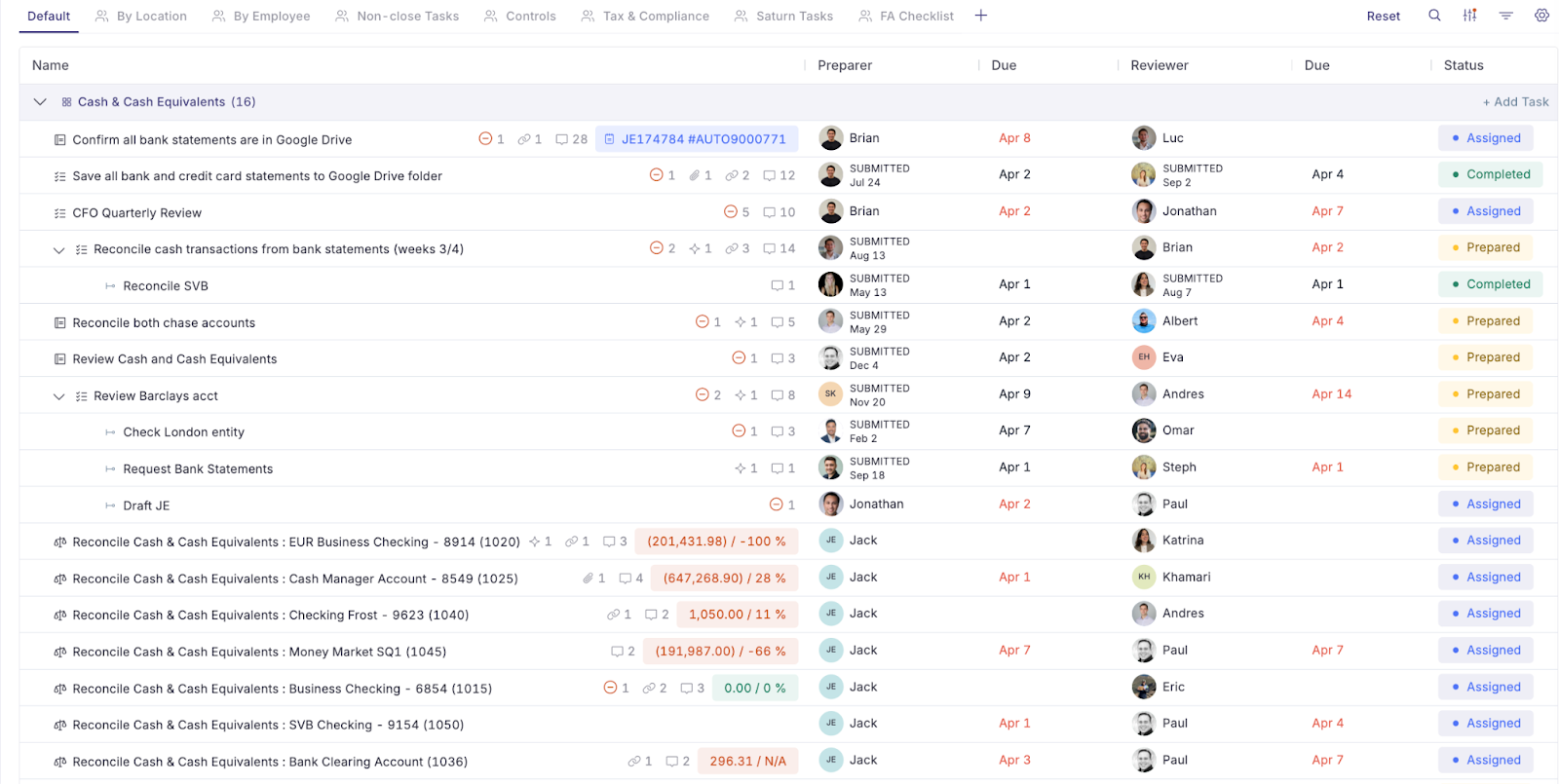
Numeric's Close Checklist supports journal entry tracking and connects directly to NetSuite, keeping approvals and context in one place and creating a defensible audit trail.
Step 4: Post To The General Ledger
Posting works differently depending on where the entry originates, and understanding that distinction is important for designing the right controls.
Manual posting happens when a preparer submits a journal entry directly through the ERP's JE module. This is the path for most month-end accruals, adjustments, and one-off entries.
Because these processes are human-initiated, they carry more risk. They're where segregation of duties, review workflows, and documentation requirements matter most.
Automated posting, meanwhile, happens when sub-ledgers and integrated systems push transactions to the GL without manual intervention. AP invoices, payroll runs, revenue recognition schedules, and bank feeds often post this way.
The risk profile is different with automation. The entries are more consistent, but errors in the underlying rules or integrations can propagate at scale before anyone notices.
Document your posting rules clearly for both paths, including which systems auto-post, which require manual review, and any thresholds that trigger escalation to a senior reviewer. Teams that skip this documentation end up with no clear owner when something goes wrong.
Finally, posting to the correct accounting period is one of the most consistently underestimated controls. Period-open and period-close rules exist for a reason — late postings distort the financials for two periods at once, and they're one of the most common causes of restatements.
Step 5: Update Balances and Run a Trial Balance
Once entries are posted, the GL updates each account's running balance. A trial balance confirms that total debits equal total credits, and this is your first line of defense against posting errors.
Scan for obvious anomalies, including negative revenue balances, accounts that should be zero but aren't, balances that look off. These are the things that will cost you hours at close if you don't catch them now.
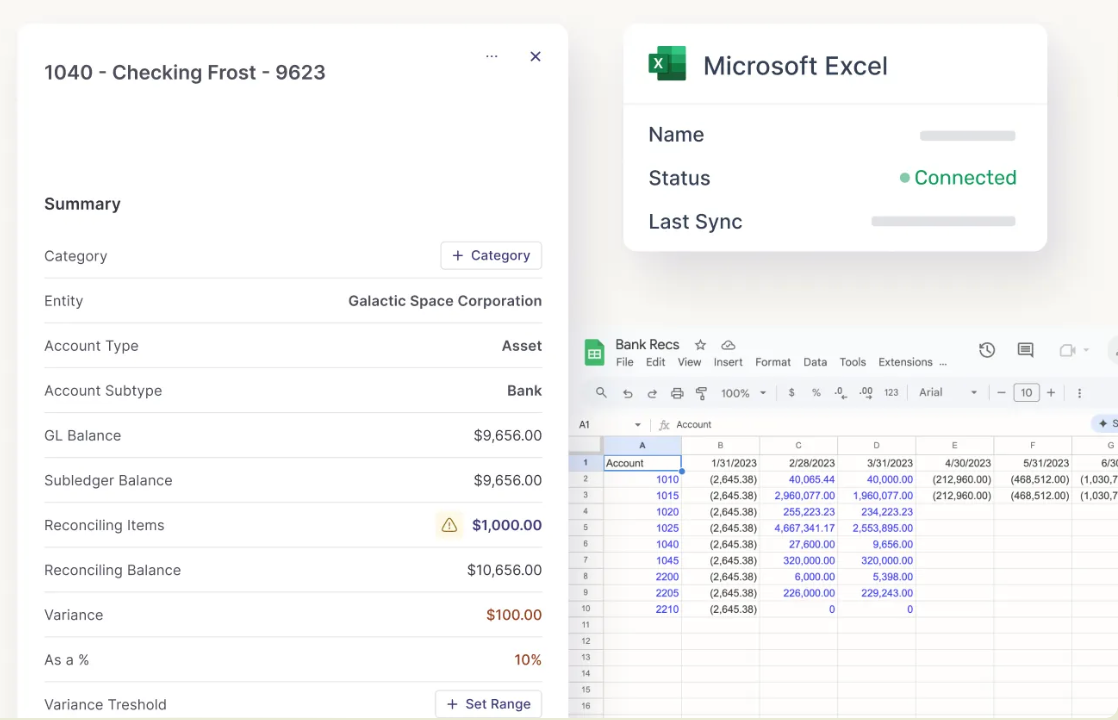
Numeric’s reconciliation module ingests trial balance data directly from your ERP and refreshes it automatically as new transactions hit the GL, so reconciliations and flux analysis don't require a manual export-and-import cycle every time.
Step 6: Reconcile and Adjust
Reconciliation is where you confirm that GL balances are supported by external evidence. Bank statements, AR/AP aging reports, fixed asset registers, and sub-ledger data all get compared against GL control accounts.
Discrepancies point to posting errors, timing differences, or missing entries that need adjusting journal entries.
Because teams can bring their external evidence and subledger data directly into Numeric, account reconciliation can be easier than ever. When accounts don't reconcile, Numeric surfaces the specific transactions causing the discrepancy, so teams know exactly what needs to be corrected.
Examples Of General Ledger Posting Scenarios
Here are the posting scenarios your team is likely to encounter every month-end, and what to watch for in each.
- Routine Operating Expense Posting. Debit the expense account and credit AP or Cash when the invoice is received. For prepaid expenses like an annual software contract, record the full amount to Prepaid first and amortize it monthly over the coverage period.
- Revenue and Accounts Receivable. When an invoice goes out, Debit AR and Credit Revenue; when payment arrives, Debit Cash and Credit AR. For subscription businesses, ASC 606 requires separate deferred revenue accounts and periodic recognition entries.
- Payroll and Benefits. Record gross wages to a Wages Expense account, with offsetting credits to Payroll Tax Liability, Benefits Payable, and Cash or a clearing account. Because payroll involves large, sensitive amounts, strong review controls and regular reconciliation of liability accounts are non-negotiable.
- Accruals, Deferrals, and Period-End Adjustments. Month-end accruals follow the same structure: Debit Expense, Credit Accrued Liabilities, with a reversal in the following period. Missed or compounding accruals are among the most common causes of restatements.
- Fixed Assets, Depreciation, and Disposals. Acquisitions debit Fixed Assets and credit Cash or AP; monthly depreciation debits Depreciation Expense and credits Accumulated Depreciation. Your capitalization policy should be clearly defined so preparers aren't making judgment calls at posting time.
- Advanced Scenarios like Multi-Currency, Intercompany, and Emerging Areas. Multi-currency postings require documented exchange rate policies and periodic revaluation entries; intercompany transactions require eliminations in consolidation. Planning your COA for ESG tracking now avoids a costly redesign later.
Controls, Compliance, And Audit Readiness For General Ledger Posting
Clean posting is only half the equation. The controls around how entries get prepared, reviewed, and documented are what make your GL defensible when auditors come knocking. Here's how to design a process that holds up.
Segregation Of Duties And Role Design
No single person should be able to initiate, approve, and post a high-risk journal entry entirely on their own. For cash, revenue, and estimate-based accounts, the segregation of duties is foundational.
For small teams where full segregation isn't practical, compensating controls help. This may include a post-close independent review of manual JEs, or periodic sampling by a senior team member. Tie role definitions to ERP permissions so access reflects responsibility, and close workflows in tools like Numeric for improved visibility and accuracy.
Documentation, Policies, And Audit Trails
Every journal entry needs attached supporting documentation and a description.
Codify posting policies in an accounting policies manual, covering:
- Capitalization thresholds. Define the dollar amount above which costs are capitalized as assets rather than expensed, so preparers aren't making that call differently every month.
- Standard description formats. Require a consistent structure for every entry — vendor name, period, invoice reference, and business purpose — so any reviewer can understand an entry without having to track down the preparer.
- Required support for different entry types. Specify what documentation is expected for each category of entry: invoices for AP accruals, payroll reports for compensation entries, amortization schedules for prepaids, and so on.
System-level audit trails (which include timestamps, user IDs, change logs) are table stakes. Numeric maintains a complete record across close tasks and reconciliations, which makes audit prep considerably faster.
Compliance With GAAP/IFRS And Internal Control Frameworks
Accurate GL posting is foundational to compliance with GAAP and IFRS reporting requirements. For public companies, it’s also central to internal control frameworks that are needed for SOX compliance.
Controls around journal entries are a standard area of SOX testing, including pre-posting review, post-posting analytics, and periodic control testing. Modern close software reduces SOX testing pain by centralizing evidence, approvals, and reconciliations in one place.
Real-Time Monitoring And Continuous Accounting
The traditional approach to general ledger quality control comes down to reviewing everything at month-end. And unfortunately, it’s reactive by design. Teams end up spending the first week of close cleaning up problems that had accumulated over 30 days.
Transaction monitoring flips that model. With Numeric, teams can set up real-time transaction monitors on their GL data that flag unusual entries, policy deviations, and coding errors as they occur throughout the month. This way, the close process starts from a cleaner ledger.
This is the practical foundation of continuous accounting, shifting from reactive cleanup to proactive error prevention. This saves your team time, reduces errors, and improves comfort control for auditors.
Automating General Ledger Posting
Most accounting teams know they're doing more manual work than they should. The question is where to start when they’re ready to invest in automation.
Understanding the limits of your current setup is the first step toward building something more scalable — without boiling the ocean.
The Manual Workflow and Its Limits
The typical manual GL workflow involves spreadsheets for tracking entries, CSV exports and imports to move data between systems, ad hoc JE templates that vary by preparer, and email chains standing in for a real approval process.
That’s a lot, and the drawbacks compound quickly:
- Higher error risk from manual data entry and inconsistent templates
- Weak audit trails when approvals live in inboxes instead of a system of record
- Difficulty scaling across multiple entities without proportionally increasing headcount
- Close timelines that stretch into double-digit days as volume and complexity grow
Many teams are still here today, and that's okay. The goal isn't to overhaul everything at once, but instead to identify the highest-friction points and modernize incrementally. You need a realistic path to modernize.
Native ERP Automation And Its Limits
ERPs do a lot well out of the box, including sub-ledger posting, basic JE templates, recurring entries, and simple approval flows. For smaller teams with straightforward close processes, this can be enough.
But as transaction volume, entities, and complexity grow, the cracks show:
- The close checklist lives in Asana.
- Workpapers are in Google Drive.
- Reconciliations involve exported CSVs.
- Flux requires another export.
To top it all off, there's minimal real-time anomaly detection and almost no analytics built into the workflow.
The result is a maze of offline processes that's hard to audit, hard to hand off, and even harder to scale.
How Platforms Like Numeric Extend The GL
Numeric functions as an intelligence and control layer on top of the GL. It pulls every transaction from your ERP and auto-refreshes trial balances. As a result, our platform centralizes close tasks, reconciliations, and flux analysis in one platform.
For GL posting specifically, this shows up in a few concrete ways:
- Reconciliation and mismatch detection. Numeric surfaces exactly which transactions are keeping an account from reconciling, giving teams a clear starting point for making the necessary GL postings to resolve the issue.
- Transaction and policy monitoring. Flag unusual journal entries or policy deviations — including entries coded to the wrong account, missing dimensions, outlier amounts — before they make it to close.
- AI-drafted flux explanations. Automatically surface missing accruals or mispostings by analyzing what's changed since prior periods. That way, teams can investigate and correct before the numbers are locked.
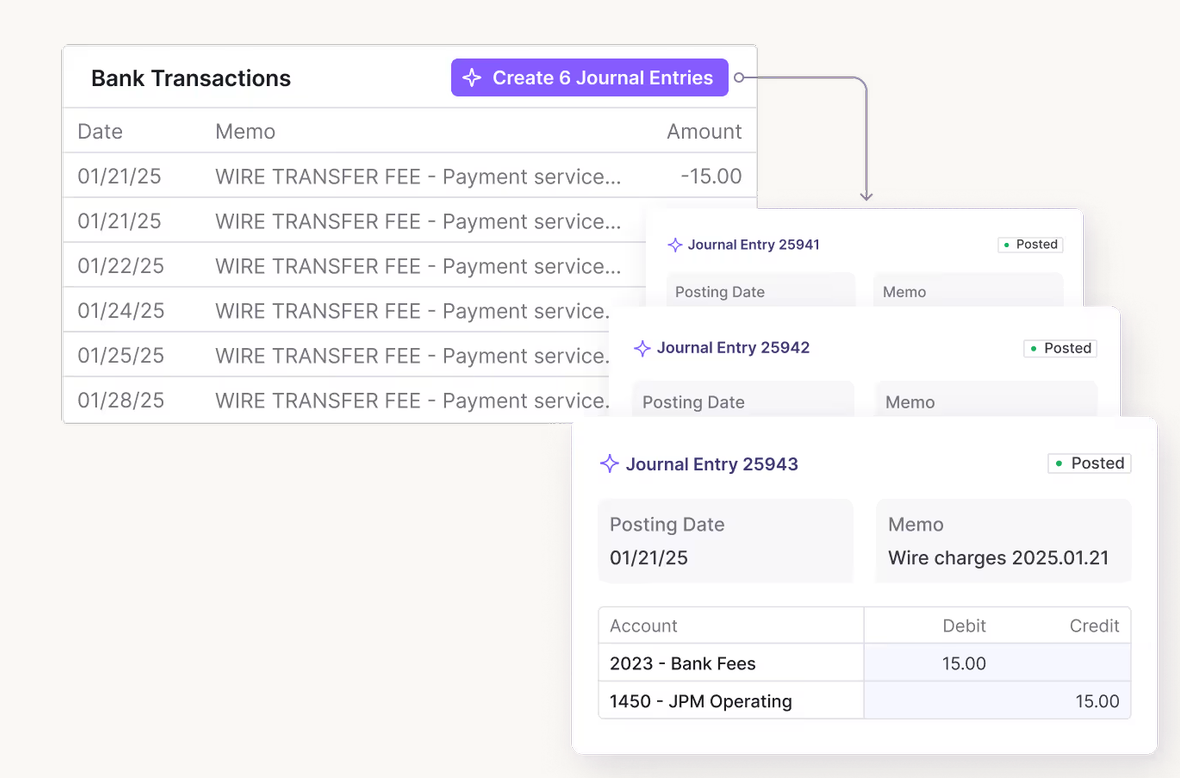
For cash transactions specifically, Numeric's journal entry automation module can draft and post JEs directly to NetSuite. The goal isn't to bypass the GL. It's to make GL data cleaner, more trustworthy, and easier to interpret.
Building a Business Case For Automation
If you're making the case internally for investing in GL posting automation, start by quantifying the pain. The numbers tend to make the argument on their own.
Ask these questions to determine the value automation can offer:
- How many days does your close currently take, and how many of those are spent cleaning up posting errors?
- How many hours per month does your team spend on reconciliations, and how much of that is manual matching?
- How many post-close adjustments do you average each month?
- How many audit findings in recent years have been tied to documentation gaps or posting errors?
Remember, faster reporting means fewer surprises for FP&A, fewer post-close adjustments means a more reliable close calendar, and less time on manual work means more time for the analysis leadership is actually asking for.
General Ledger Posting In A Modern Finance Team
Getting the mechanics right is necessary, but it's not the whole picture.
How GL posting fits into your broader close process and long-term finance strategy is the difference between teams that are always catching up from teams that can stay ahead.
From Daily Postings To The Month-End Close
Every journal entry posted during the month is either making your close easier or harder. Clean, timely, well-documented postings mean reconciliations go faster, variance explanations make sense, and disclosure prep is straightforward.
The inverse is equally true. Teams that treat close as the moment to reconcile 30 days of questionable postings are setting themselves up for late nights and last-minute adjustments. Consistency throughout the month is the only way to avoid the scramble.
Moving Toward Real-Time Reconciliation And Monitoring
Real-time ERP data sync changes what's possible. When your ledger’s balances refresh automatically, reconciliations don't have to wait until period-end. Teams can set materiality thresholds and auto-submit accounts that tie out, reserving manual effort for accounts with actual discrepancies.
This is what "closing fast" actually means. It’s not about cutting corners, but front-loading the work so the official close period is confirmation rather than discovery. Exploring general ledger reconciliation best practices is worth the time for any team looking to shorten its close timeline, because it increases confidence in the GL and makes continuous accounting more than just a buzzword.
Data Quality, Analytics, And Strategic Insight
High-quality GL data makes everything downstream more valuable. Reliable variance analysis, accurate forecasting, and meaningful decision support for leadership all depend on the ledger being clean, consistent, and properly coded.
Numeric's reporting and analytics suite effectively turns the GL into an intelligence asset rather than just a compliance artifact. Teams can build flexible reports, drill down to the transaction level, and surface insights without needing to be a NetSuite expert or pull a single export.
Controllers who've built tight posting processes describe the same outcome: accounting stops being a function that just reports on the past and starts being one that informs the future. That shift starts with AI accounting tools built on clean, trustworthy GL data.
See how accounting teams use AI in the month-end close
.png)
Elevate and Modernize General Ledger Posting
Strong GL posting starts with fundamentals: chart of accounts design, double-entry mechanics, and a disciplined posting workflow. It builds from there through well-designed controls and the right automation.
Every piece connects. The quality of your postings determines the quality of your reconciliations, which determines the quality of your close, which determines the quality of your financial reporting.
For teams ready to modernize their GL-driven close process, Numeric’s accounting automation software brings reconciliations, transaction monitoring, flux analysis, and close management into one platform, keeping your general ledger accurate, audit-ready, and close-ready.
Related Content
.png)
Automated ASC 842 Lease Accounting: From Lease PDF to Audit-Ready Schedule
How to automate ASC 842 lease accounting, from extracting lease terms to the ROU asset, lease liability, and journal entries your auditors can trace.
.png)
ERP for SaaS: How to Choose an Accounting System Built for Subscription and Usage Revenue
A guide to choosing an ERP for SaaS, covering ASC 606 revenue recognition, usage-based billing, multi-entity, reporting, and a checklist for vendor demos.
.png)
Numeric vs. Maxima: Which AI Close Platform Fits Your Team?
Numeric and Maxima both automate close work. Compare how each handles reconciliations and cash matching, who owns the rules, and when each one fits.