Revenue Recognition for SaaS: The ASC 606 Guide That Holds Up Under Audit

.png)
At some point, every SaaS accounting team hits the same wall. The business is growing, contracts are getting more complex, and what used to be a simple "did they pay? great, book it" process is now requiring a level of precision the old one wasn't built for.
Bundled SKUs, annual contracts paid upfront, mid-period upgrades, free trials that convert — every new pricing variation adds another layer to the question of when revenue is actually earned.
That question has a formal answer: ASC 606, the revenue recognition standard that governs how SaaS companies recognize revenue today. Knowing the standard exists is the easy part. Applying it cleanly, every month, in a way that holds up under audit, is where most teams struggle.
This guide will walk you through ASC 606 applied to SaaS contracts, deferred revenue mechanics, journal entries, and what a clean financial close process looks like in practice, including how much of the posting and schedule work here can run as an automatic output of your data instead of something your team rolls forward by hand every close.
Key Takeaways
- Revenue recognition and the contract that generates it don't have to live in two separate systems. Numeric's Billing and Revenue captures the contract with its full terms and derives the recognition schedule from it.
- SSP documentation is where bundled deal audits are won or lost — most teams underinvest until it's too late.
- Modification classification errors don't announce themselves. They compound quietly in the deferred revenue schedule until a restatement conversation starts.
- The deferred revenue roll-forward is only as reliable as the contract decisions made upstream.
- Audit readiness isn't a year-end project. The teams that handle due diligence cleanly built the infrastructure months before anyone asked for it.
What Is Revenue Recognition for SaaS?
Revenue recognition for SaaS is the accounting process that determines when and how much subscription revenue a company records in its financial statements. Under ASC 606, revenue is recognized when — and only when — performance obligations are satisfied: meaning the software service has been delivered to the customer for that period. Not when payment is received. Not when an invoice is issued.
Why Cash Received Is Not Earned Revenue
When a customer pays $12,000 upfront for a 12-month subscription, that cash hits the bank but is recorded as deferred revenue on the balance sheet. Only $1,000 gets released to the income statement each month as service is delivered. Conflating cash timing with earned revenue overstates income, violates GAAP, and is the kind of misstatement auditors flag.
ASC 606 vs. IFRS 15 — What SaaS Companies Need to Know
ASC 606 governs U.S. GAAP reporting; IFRS 15 governs international reporting. Both share the same five-step model and core recognition principle, making compliance logic largely portable for SaaS companies. The operational differences — primarily variable consideration constraint thresholds and disclosure requirements — are procedural but meaningful. Multinational teams need policies that explicitly address both frameworks.
Learn to automate your accounting for 5.5 free CPE credits. Take the Finance Engineer Course.
The ASC 606 Five-Step Model — Applied to SaaS Contracts
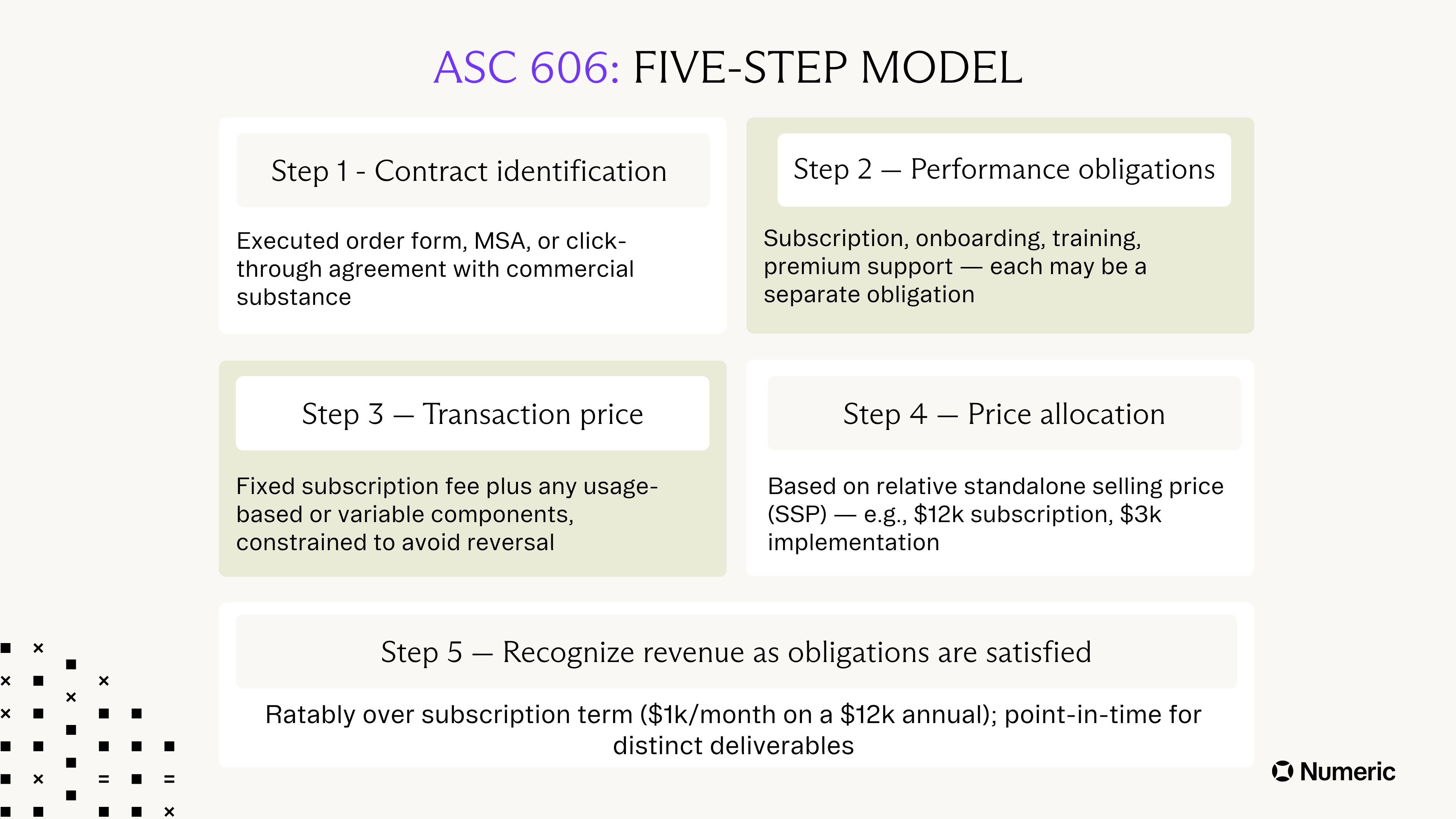
The five-step model is the standardized framework that governs SaaS revenue recognition. Every dollar of revenue a SaaS company records must pass through all five steps. And where those steps get applied — subscription terms, bundled contracts, mid-cycle modifications — is exactly where SaaS accounting gets complicated.
The model's numbered simplicity is misleading: Steps 2 and 4, in particular, involve judgment calls on performance obligation identification and standalone selling price (SSP) allocation, which are among the most frequently cited issues in SaaS audits.
| Step | ASC 606 Requirement | SaaS Application |
|---|---|---|
Step 1 |
Identify the contract | Executed order forms, MSAs, and click-through agreements |
Step 2 |
Identify performance obligations | SaaS license, implementation, professional services, support tiers |
Step 3 |
Determine the transaction price | Fixed fees plus variable/usage-based components |
Step 4 |
Allocate price to each obligation | Using the standalone selling price (SSP) for each element |
Step 5 |
Recognize revenue as obligations are satisfied | Ratably over subscription term; point-in-time for distinct setup deliverables |
Step 1 — Identifying the Contract
A contract exists under ASC 606 when both parties have approved it, identified the rights and payment terms, established commercial substance, and confirmed collection is probable. Verbal commitments, unsigned proposals, and letters of intent don't clear this threshold — a common audit risk at SaaS companies that begin revenue recognition before paperwork is finalized.
Step 2 — Identifying Distinct Performance Obligations
This is the step that most frequently breaks down in practice. A single contract bundling a SaaS subscription, onboarding, a training package, and premium support may represent four separate performance obligations — each with its own recognition timeline. Getting that separation wrong means your recognition schedules are off from day one — and that error sits in the schedule, growing harder to unwind with each subsequent record to report.
A good or service is distinct if the customer can benefit from it independently and it is separately identifiable from other contract promises. You can combine highly interdependent elements into one obligation, but you need documentation to support that decision.
Step 3 — Determining the Transaction Price
The transaction price is the total amount the company expects to receive, including both fixed and variable components.
For straightforward subscriptions, that's a clean number. For usage-based or discounted arrangements, the team has to estimate — and those estimates carry real audit risk.
You must estimate variable consideration — usage-based fees, volume discounts, refund provisions — using either the expected value method or the most likely amount method, and you can only include it to the extent that a significant revenue reversal is highly unlikely.
Step 4 — Allocating the Transaction Price Using SSP
Once you identify the obligations, you allocate the contract's total price based on each element's relative standalone selling price — what you would charge for that element sold independently.
This is where bundled deals get complicated. A single contract price has to be broken down across every obligation, and the split has to be defensible.
A bundled deal at $15,000 might allocate $12,000 to a subscription and $3,000 to implementation if those SSPs are observable from standalone transactions. When SSP isn't directly observable, teams use estimation methods — adjusted market assessment, expected cost plus margin, or the residual approach — each of which requires consistent application and written documentation to survive an audit.
Step 5 — Recognizing Revenue as Obligations Are Satisfied
You recognize SaaS subscription revenue ratably over the subscription period — $1,000 per month on a $12,000 annual contract — because the customer receives and consumes the benefit as service is delivered. One-time setup fees or implementation services may qualify for point-in-time recognition if they represent a distinct, fully transferred deliverable. If they don't meet the distinctness test, they fold into the subscription and are recognized ratably alongside it.
Working through the five-step model for every active contract produces one direct output: a deferred revenue balance that your team must actively manage, accurately classify, and release through journal entries each period. Teams looking to automate that workflow can see how revenue recognition automation handles the allocation and posting layer.
Deferred Revenue Accounting in SaaS — The Balance Sheet Liability You Can't Ignore
Deferred revenue in SaaS is a balance sheet liability representing cash collected for services not yet delivered. It is not revenue. That separation has to hold in your books every single month.
Under ASC 606, every dollar of deferred revenue must be released to the income statement on a schedule tied to performance obligation fulfillment. That makes the deferred revenue roll-forward one of the most consequential reconciliations in a SaaS close.
It's also a direct downstream consequence of every contract decision made upstream in the order-to-cash process, and the one most likely to break when contract volume grows and the schedule lives in a spreadsheet. The more durable approach ties the schedule directly to the contract that generates it, so it reflects revenue recognition as it happens rather than as a task someone repeats manually. Numeric's Billing and Revenue works this way: the recognition schedules derive from the contract, and any changes flow through the schedule automatically.
Revenue Recognition Journal Entries — Step by Step
When a SaaS company collects a $12,000 annual subscription upfront, the full amount is recorded as deferred revenue. Each month, $1,000 moves from deferred revenue to the income statement as service is delivered.
| Transaction Event | Debit | Credit | Amount |
|---|---|---|---|
Cash received upfront |
Cash | Deferred Revenue | $12,000 |
Month 1 service delivered |
Deferred Revenue | Revenue | $1,000 |
Month 2 service delivered |
Deferred Revenue | Revenue | $1,000 |
Month 12 service delivered |
Deferred Revenue | Revenue | $1,000 |
Full recognition complete |
— | — | $12,000 total recognized |
The entries above follow from that same schedule. Once it exists, each one is a function of the contract rather than a decision made from scratch every month, which is why data-centric accounting derives these entries for you.
Current vs. Long-Term Deferred Revenue — Getting the Classification Right
A two-year subscription paid upfront requires deferred revenue to be split: year one sits in current liabilities, year two in long-term liabilities. The classification has to be recalculated every time a contract is modified, renewed, or extended.
That recalculation is exactly where manual error creeps in, since every renewal or modification means redoing the split by hand. A schedule tied directly to the contract, one that updates automatically as terms change, is the safest way to keep the classification right.
Misclassifying the long-term portion as current overstates near-term obligations and distorts working capital metrics that investors, lenders, and acquirers scrutinize closely. In a due diligence process, a deferred revenue misclassification tells auditors something broader about the quality of your financial controls.
Put Your Team on the Road to IPO

Contract Modifications — How to Handle Upgrades, Downgrades, and Mid-Term Changes
Contract modifications are among the most audit-sensitive transactions in SaaS revenue recognition because they require a classification decision before any accounting can occur. Get that classification wrong and everything downstream is off — the recognition schedule, the deferred revenue balance, and ultimately the numbers your auditors are reviewing.
Any approved change to a contract's scope or price — an upsell, a seat addition, a downgrade, an early renewal, an early termination — must be routed through a three-scenario framework. The revenue timing follows from that decision, and so does any restatement risk.
Treating a Modification as a New Separate Contract
When added services are distinct and priced at or above the standalone selling price, the modification is treated as an entirely new contract — independent of the original. Previously recognized revenue stays intact; the new contract starts its own recognition schedule from the modification date. This is the cleanest treatment operationally, but it requires robust SSP documentation asserting that the pricing reflects standalone value.
Prospective and Cumulative Catch-Up Adjustments
Prospective treatment applies when a modification adds distinct goods or services at a price below SSP — common in discounted expansion deals. Recognition schedule updates run forward without reopening historical periods. Choosing the wrong treatment means your recognized revenue is off from the modification date forward — and that error compounds every month until someone catches it.
Cumulative catch-up applies when the modification results in goods or services that are not distinct from what's already been partially delivered — most downgrades fall here. A catch-up requires recalculating recognized revenue as of the modification date and recording a one-time adjustment to bring the books current.
Both treatments require a documented modification memo covering the original contract terms, the change, the SSP analysis, and the accounting rationale. That memo is easier to produce when the modification is recorded against the same contract object the original terms live on, since the original terms, the change, and the reasoning behind it stay connected rather than scattered across a deal desk email and a spreadsheet tab.
Variable Consideration and Usage-Based Revenue — How to Estimate Without Overstating
Usage-based SaaS revenue — billed per API call, per active user, per GB processed, per transaction — falls under ASC 606's variable consideration rules. Variable consideration must be estimated and included in the transaction price only to the extent that a significant revenue reversal will not occur when the uncertainty resolves. That constraint forces finance teams to be deliberately conservative in early-period estimates for customers with unpredictable usage trajectories.
Expected Value vs. Most Likely Amount — How to Choose the Right Method
The expected value method calculates a probability-weighted average across all possible usage outcomes. It works best when a company has a large population of similar contracts with observable historical patterns. When that historical data doesn't exist — or when the range of outcomes is narrow — a different approach is needed.
The most likely amount method selects the single most probable outcome from a range of possibilities. It suits binary or narrow-range scenarios — for example, whether a customer will cross a volume threshold that triggers a discount tier. The method selected must be applied consistently within a contract type and documented to support audit review.
The Usage-Based Practical Expedient
ASC 606 provides a narrow expedient for certain output-based and sales-based fees. If variable consideration is allocated entirely to a single distinct performance obligation and the allocation terms are consistent with the overall allocation objective, the company can recognize revenue as usage occurs rather than relying on upfront estimates. This as-invoiced approach simplifies recognition for pure usage-based products. It only applies when specific criteria are met, and the election must be documented in the accounting policy.
Applying all of this across hundreds or thousands of active contracts, every close cycle, is where the technical accounting challenge becomes a daily operational one. The standard doesn't change — what changes is the volume of judgment calls your team has to execute correctly, every month. At that scale, the difference between an audit-ready close and an audit-exposed one isn't how well your team knows the standard. It's whether your processes can execute it reliably, without error accumulating in the background.
The most reliable way to guard against that error is better inputs to estimate from. Object-based data ingestion, pulling usage and contract terms directly from source instead of a manual export, removes the error that creeps in before anyone even applies judgment to the numbers.
Building an ASC 606-Ready Close Process — Best Practices for SaaS Finance Teams
ASC 606 compliance is a continuous operational discipline. And SaaS companies that treat revenue recognition as a monthly checkbox are most likely to face restatements, audit adjustments, or investor scrutiny during due diligence. The gap lives in process — specifically, whether the infrastructure exists to apply that knowledge consistently at volume.
For teams navigating IPO readiness or first-time audits, infrastructure gaps tend to surface at the worst possible moment.
A best-practice close process for revenue recognition has several non-negotiable components:
- Every contract carries its full terms, the order form, and any modification records in one place
- The recognition schedule updates itself when a contract is renewed
- SSP methodology is documented and applied consistently for each product and service
- Usage data reaches the estimate already matched to the right contract
- Each performance obligation on a contract, the subscription, the implementation, the support tier, keeps its own recognition treatment without anyone manually splitting a bundled deal into separate schedules
- Every journal entry, modification, and schedule change is traceable back to the transaction that caused it the moment it happens
Numeric's Billing and Revenue covers most of this from one system, since each of these components traces back to the same source, the contract itself. The schedule, the journal entries, and the audit trail all come from the same object rather than six separate to-do items spread across six different tools.
When Manual Processes Start Costing You Close Time and Audit Credibility
Spreadsheet-based recognition schedules create compounding risk at scale. A single formula error in a deferred revenue waterfall can cascade across an entire contract cohort, producing misstated revenue figures that survive multiple close cycles before surfacing. And because the error is baked into the schedule, every subsequent month builds on it — by the time someone catches it, the restatement conversation has already started.
SaaS companies managing 200 to 300 active subscription contracts simultaneously often reach the point where manual processes can no longer maintain the accuracy, auditability, or speed required for reliable reporting. Usage-based and consumption pricing add another layer of risk on top of this. Every API call, seat change, or usage tier crossed is a potential adjustment to the transaction price, and a spreadsheet has no way to catch a usage event that never made it into the schedule at all, only the ones that did and turned out wrong. That's the specific failure mode Numeric's Billing and Revenue addresses: usage events are matched against the contract as they happen, and anything that doesn't match gets flagged instead of silently missed.
"Newly public companies probably face the hardest version of compliance due to needing to build up that documentation from scratch. As companies scale, the burden really shifts from creation to maintenance. But if assembling evidence each season is super manual, then the audit season is always going to be a crisis regardless of company size."
Jess Totoni, BDR at Numeric and former PwC auditor
The issue isn't just close time. When auditors request documentation for a contract modification from 14 months ago, "it's in a spreadsheet somewhere" is not a control. Understanding your exposure starts with knowing where your materiality thresholds sit — and whether your current process can defend them.
Reconciling Deferred Revenue Against the GL in Real Time
Once manual processes start breaking down under contract volume, the tie-out between the deferred revenue subledger and the general ledger is usually where the cracks show up first. Numeric's ERP replacement, the Financial Data Platform (FDP), works differently. Instead of starting from a chart of accounts and posting entries into it after the fact, it starts from the events that actually happen, a contract getting signed, a customer's usage crossing a threshold, and builds the accounting directly from those events instead of from a summary of them.
.svg)
For accounting, that changes a few things day to day:
- A modification's deferred revenue impact shows up against the same contract immediately, not after a month-end tie-out across three systems.
- Every journal entry, modification, and schedule change traces back to the event that produced it, captured the moment it happens rather than reconstructed before a fieldwork date.
- Variance explanations for the revenue line point to the specific contract or usage event behind a movement, not just a coded ledger line.
- Transaction-level detail is available directly to FP&A or leadership, without a NetSuite export or a one-off pull.
For accountants, the job moves from documenting the past to making the recommendation, for example, flagging a deferred revenue swing to the board before it's asked about, or a usage pattern that signals a renewal risk or an expansion opportunity.
ASC 606 Compliance Starts Before the Audit Clock Does
Revenue recognition quality is one of the first areas Big Four auditors, growth-stage investors, and M&A buyers examine, and the companies that enter those processes with defensible documentation, clean deferred revenue schedules, and consistent modification memos field fewer follow-up requests. The difference comes down to when the infrastructure gets built.
Numeric's Financial Data Platform, the FDP, rearchitects how accounting is done. If your team is still managing revenue recognition in a spreadsheet or a stack of point solutions, see how the Financial Data Platform handles it instead, from usage-based billing to a deferred revenue schedule and audit trail that stay current on their own.
Frequently Asked Questions About Revenue Recognition for SaaS
Related Content
.png)
Automated ASC 842 Lease Accounting: From Lease PDF to Audit-Ready Schedule
How to automate ASC 842 lease accounting, from extracting lease terms to the ROU asset, lease liability, and journal entries your auditors can trace.
.png)
ERP for SaaS: How to Choose an Accounting System Built for Subscription and Usage Revenue
A guide to choosing an ERP for SaaS, covering ASC 606 revenue recognition, usage-based billing, multi-entity, reporting, and a checklist for vendor demos.
.png)
Numeric vs. Maxima: Which AI Close Platform Fits Your Team?
Numeric and Maxima both automate close work. Compare how each handles reconciliations and cash matching, who owns the rules, and when each one fits.