What is Record to Report: Process, Steps, and Benefits

.png)
Record to Report is the accounting process most organizations rely on without ever naming it. Every financial statement your business produces, every board package, every audit deliverable, starts with a transaction being recorded and ends with that data becoming a report someone can act on. R2R is what connects those two things.
The problem is that for most teams, R2R is slow, manual, and backloaded. The close feels like a sprint because all the real work piles up at month-end. Reconciliations happen after the month closes. Issues surface when there's no time left to address them cleanly. That's not a people problem. It's a process architecture problem, and it's fixable. The month-end close maturity model is a useful lens for understanding where your team sits and what the next stage looks like.
This guide covers how R2R actually works, where traditional approaches break down, and what modern accounting teams are doing to fix it.
Key Takeaways
- Record to Report is the complete cycle from transaction capture to financial reporting and analysis
- The R2R process includes seven core steps, from data collection through strategic review, each building on the one before it
- Traditional R2R workflows are weighed down by manual reconciliations, delayed close activities, and limited visibility into financial data between reporting periods
- Automation and AI have shifted R2R from a reactive, period-end scramble to a continuous process that distributes work across the month
- Modern R2R platforms let lean accounting teams close faster, report with more confidence, and spend more time on the work that actually informs business decisions
What Is Record to Report (R2R)?
R2R is the end-to-end cycle that turns raw transaction data into finalized financial statements. This section covers how the process is defined, what it actually encompasses, and why it matters for modern accounting teams.
Defining the Record to Report Process
Record to Report is the end-to-end finance and accounting process that transforms raw transactional data into finalized financial statements and strategic insights. It covers everything from capturing daily transactions across the business to producing the reports that inform decisions and satisfy regulatory requirements.
You'll also hear it called the financial close cycle or the accounting cycle. R2R is the more precise term because it names both endpoints: the recording of transactions and the reporting on them. Everything in between, journal entries, reconciliations, consolidation, variance analysis, is R2R work.
R2R connects operational activity to financial reporting. It's how a business knows whether it's profitable, compliant, and on track. When R2R runs well, finance has a reliable picture of the business at all times. When it doesn't, that picture arrives late, with gaps, and under close-week pressure.
What R2R Encompasses
The R2R cycle covers several distinct activities:
- Transaction capture: Recording daily financial activities from across the business
- Data validation: Confirming accuracy and completeness before processing
- Account reconciliation: Matching GL balances with subledgers and external sources
- Financial close: Finalizing period-end activities and locking the books
- Consolidation: Combining data across entities, departments, or business units
- Financial reporting: Producing the P&L, Balance Sheet, and Cash Flow Statement for stakeholders
- Analysis and review: Variance analysis, KPI monitoring, and strategic insights for leadership
R2R runs on a cycle, monthly, quarterly, and annually, and each cycle feeds into the next. The quality of a monthly close directly shapes how much remediation the quarter-end requires.
Why R2R Matters for Modern Accounting Teams
R2R sits at the intersection of compliance and strategy. On the compliance side, it ensures the financial records that regulators, auditors, and investors rely on are accurate and complete. On the strategy side, it's the data foundation that FP&A builds forecasts on, that CFOs use for board reporting, and that Controllers need before they can advise the business on anything meaningful.
Efficient R2R is what allows accounting teams to move from reactive reporting to proactive business partnership. Teams stuck in manual, backloaded R2R cycles spend close periods firefighting. Teams that have modernized their R2R process spend that time advising.
Accounting is fundamentally a data problem, and R2R is where that problem either gets solved or gets perpetuated.
From reactive to proactive. See how high-performing teams build a close process that actually scales.
How the Record to Report Process Works
Data moves through R2R in one direction — from source systems like ERPs and bank feeds through reconciliation, close, and reporting. Understanding that flow, and how modern teams have shifted from reactive to continuous, is what makes it possible to improve it.
The R2R Workflow: From Source Systems to Strategic Insights
Data flows through R2R in one direction. Transactions originate in source systems (ERPs, subledgers, bank feeds, payroll platforms) and move through the general ledger, where they get reconciled and closed, rolled into consolidated financials, and ultimately surfaced in reports and variance explanations that go to leadership.
The cycle repeats. Monthly close cycles build into quarterly reporting, which builds into annual reporting and audit. Each one follows the same fundamental pattern: capture, record, reconcile, close, consolidate, report, analyze.
A simple way to visualize the flow:
Source Data → Recording → Reconciliation → Close → Consolidation → Reporting → Analysis
R2R connects every operational transaction (sales, purchases, payroll, vendor payments) to the external financial statements and internal performance metrics that determine how the business understands itself.
Traditional vs. Modern R2R: Reactive vs. Continuous
Traditional R2R treats the close as a discrete event that happens after the month ends. Everything waits: reconciliations start when the period closes, journal entries get reviewed in bulk, variance analysis begins only after the books are locked. That backloading is why close periods feel so compressed, and why the work feels harder than it actually is. It isn't more complex than it has to be. It's just all happening at once.
Modern R2R distributes that work across the month. Teams reconcile accounts on a rolling basis. Monitors flag unusual transactions as they happen rather than at period-end. Issues get resolved when they're still fresh and easy to trace, so by the time the close arrives, most of the real work is already done. The close becomes a finalization rather than a scramble, and the accounting team has actual bandwidth for analysis instead of spending the last week of the month buried in spreadsheets.
The 7 Steps in the Record to Report Process
R2R follows a structured, sequential progression where each step builds on the previous one. Understanding how the steps connect is what makes it possible to identify where a process is breaking down and what to fix first.
1. Data Collection From Source Systems
R2R begins with capturing daily financial activity from across the business: sales transactions, procurement data, HR and payroll records, accounts payable and receivable, bank feeds. That data lives across multiple systems, and getting it into a workable state is the first real challenge of the cycle.
Data quality at this stage determines everything downstream. Transactions that land in the wrong account, carry missing vendor fields, or sit in the wrong accounting period create problems that surface later as reconciliation exceptions, audit findings, or unexplained variances. The earlier those issues are caught, the less expensive they are to fix.
Modern platforms address this by syncing transaction-level data from the ERP in real time rather than relying on manual exports that may be hours or days out of date.
2. Recording Transactions and Journal Entries
A journal entry is a record that debits and credits accounts to reflect a financial transaction. Journal entries ensure that revenue and expenses land in the correct accounting period under GAAP or IFRS. Standard entries (payroll, depreciation, amortization) run every period. Adjusting entries (accruals, prepayments, reclassifications) require judgment and proper documentation.
Common pain points in this step include manual JE tracking in spreadsheets with no centralized approval workflow, missing audit trails, and the difficulty of confirming that a period is actually complete when entries are scattered across shared files. Teams that manage journal entries without a purpose-built workflow typically spend meaningful time during audits reconstructing who posted what and when. Numeric's journal entry automation drafts and posts JEs directly to NetSuite, with a full approval trail built in.
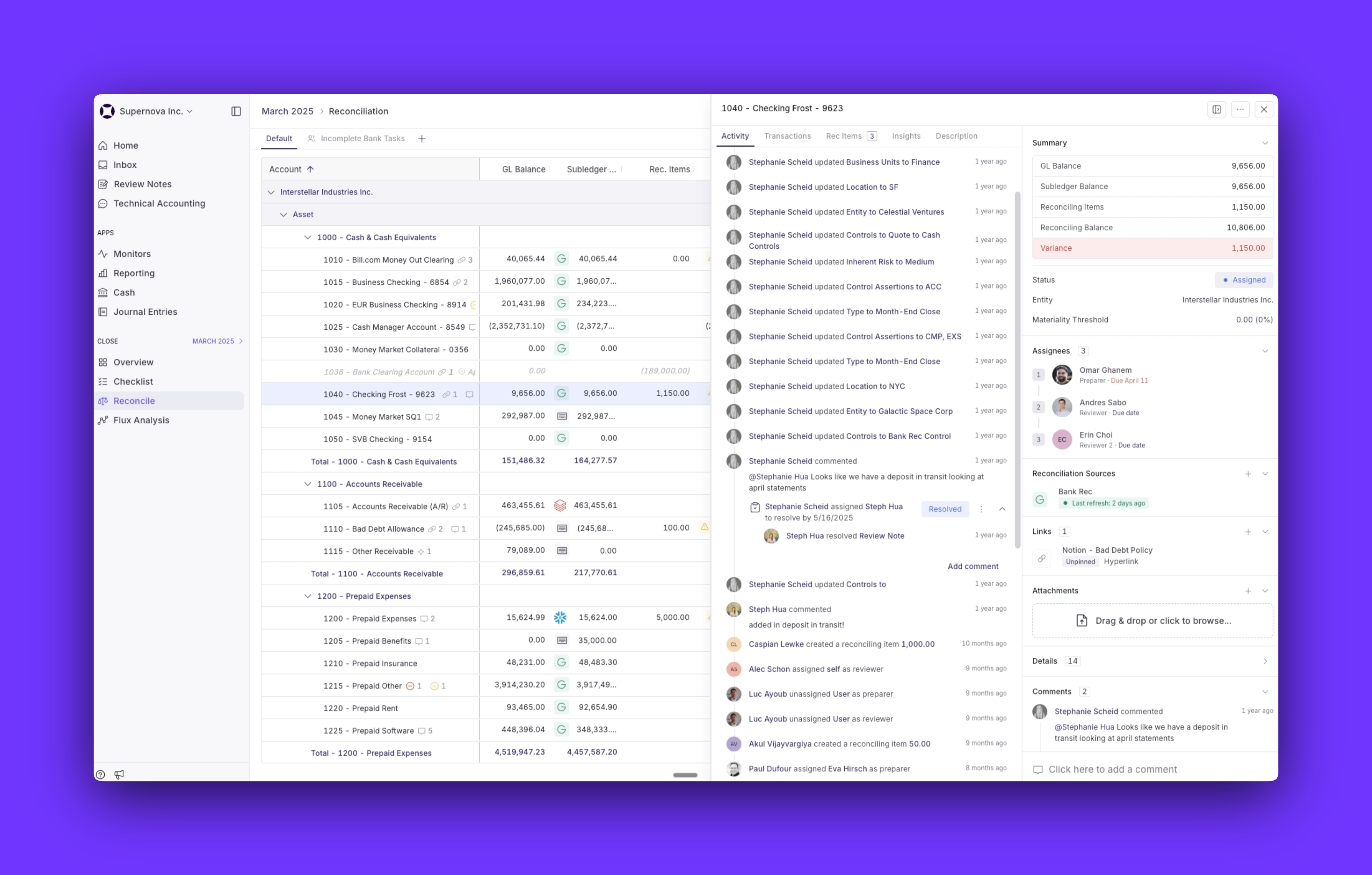
3. Account Reconciliation
Reconciliation is the process of matching general ledger balances with subledgers — AP, AR, inventory — and external sources like bank statements. Its purpose is catching discrepancies before they compound and confirming that the GL reflects reality before the books are closed. For a full breakdown of how to approach this step, see Numeric's guide to account reconciliation.
Key reconciliation types include bank recs, intercompany recs, balance sheet account recs, and subledger-to-GL recs. In traditional R2R workflows, reconciliation is the most time-consuming step in the entire cycle. Teams export trial balances, compare them against workpapers in separate spreadsheets, and investigate variances manually without direct access to the underlying transactions.
Reconciliation done at month-end under close pressure is reconciliation done at its worst. Teams that shift to a continuous model, reconciling accounts on a rolling basis throughout the month, resolve issues while they're still fresh and reduce the volume of work that needs to happen in the final days of the period.
4. Financial Close
The financial close is the period-end process of finalizing account reviews, booking provisions, running depreciation, and locking the books for reporting. It requires coordinating tasks across the accounting team: assignments, dependencies, approvals, and supporting documentation all need to be completed in the right sequence.
Close cycles exist at three levels. The month-end close is the most frequent, focused on core accounts and standard reporting. The quarter-end close is more detailed, often requiring additional review and management commentary. The year-end close is the most comprehensive, with audit-focused documentation requirements that go well beyond the monthly process.
Timelines vary considerably across organizations. According to APQC's General Accounting Open Standards Benchmarking survey of more than 2,300 organizations, top performers complete the monthly close in under five calendar days while the bottom 25% need ten or more. Teams with manual, backloaded workflows routinely land in that lower quartile, and that timeline tends to grow as the business adds entities or complexity.
5. Consolidation of Multi-Entity Data
Consolidation is the step that brings financial data from multiple departments, subsidiaries, legal entities, or business units together into a single, unified view. The core activities are rolling up entity-level financials, eliminating intercompany transactions, and applying currency conversions where applicable.
This step is especially consequential for companies with complex organizational structures: multiple entities, international operations, or shared services. Consolidation errors tend to cascade. An intercompany elimination that doesn't balance, or an entity whose close runs two days late, can hold up the entire consolidated close. At scale, consolidation is often where manual R2R hits its ceiling.
6. Financial Reporting and Variance Analysis
This step covers the generation of the core financial statements (the Income Statement, Balance Sheet, and Cash Flow Statement) along with the variance analysis that compares actuals against prior periods, budget, or forecast.
Producing the statements is the mechanical part. The work that creates real value is variance analysis, specifically the question of why numbers moved, not just by how much. A 14% increase in software spend is a data point. Understanding that it came from two unbudgeted tool renewals and one new contract signed by a department outside finance is what turns a close package into something your CFO can actually act on — and what keeps you from rebuilding the same analysis from scratch every period.
Teams that get to that level of explanation efficiently are the ones with direct access to transaction-level detail. Teams that have to manually pull reports from the ERP and cross-reference them in spreadsheets spend most of their flux time on discovery rather than analysis. The reports never quite feel ready to trust at scale, which is exactly the problem.
7. Strategic Review and Decision Support
R2R culminates in KPI monitoring, management review, and the strategic insights that inform business decisions. Accounting teams present findings to leadership by highlighting key variances, explaining the drivers behind them, and surfacing the operational questions those variances raise. That's the shift from recording to advising, from documenting what happened to explaining what it means and what the business should consider as a result. Getting there consistently requires having the earlier six steps running cleanly enough that real bandwidth exists for it — and it requires that the numbers leadership is looking at are current enough to act on.
Common Challenges in the Record to Report Process
Traditional R2R cycles are slow, error-prone, and compliance-heavy. The challenges below create real bottlenecks for accounting teams and limit the strategic impact the function can have.
Manual Reconciliations and Spreadsheet Sprawl
Reconciliations that live in Excel are difficult to audit, hard to hand off, and don't scale as transaction volume grows. Version control issues, broken formulas, and files stored in multiple locations by multiple team members are routine in spreadsheet-heavy close environments. When an account doesn't reconcile, tracking down the source of the discrepancy often requires digging through weeks of transaction history without any automated way to isolate which entry caused the problem. Teams in this situation often spend the majority of close time on reconciliations alone, and that time compounds each month as the business grows.
Numeric pulls transaction-level detail directly from the ERP so when an account doesn't tie, the discrepancy and the transactions causing it are visible in the same place. No export, no spreadsheet pivot required.
Delayed and Backloaded Close Activities
The most common pattern in traditional R2R is that nearly all close work happens in the final days of the period. Reconciliations start when the month closes. Journal entries get reviewed in bulk. Variance analysis begins after the books are locked. This backloading is why close timelines stretch and why the last week of the month feels disproportionately stressful relative to the actual complexity of the work. Independent research confirms the pattern is widespread: a 2025 benchmark study found that half of finance teams still need six or more business days to close. Backloaded closes leave no buffer for problems, so when an issue surfaces on day nine of a ten-day close, there's no time to investigate it cleanly before reporting is due.
Numeric's transaction monitors run continuously throughout the month, flagging unusual transactions and policy violations as they happen rather than waiting for the close to surface them.
Limited Real-Time Visibility Into Financial Data
Traditional R2R relies on periodic exports from the ERP, which means accounting teams regularly work with data that is days out of date. Mid-month, the business cannot get a reliable financial snapshot. Anomalies in transaction data go undetected until someone runs a report at period-end, and issues that could have been resolved in an hour when they occurred become multi-hour investigations when they're discovered three weeks later.
Late visibility is also what erodes leadership's confidence in the numbers. When the CFO has a question and the answer requires re-pulling a report or checking back in after the close, reassurance replaces control. That's the cost of a process built around periodic exports rather than continuous access. Numeric syncs transaction-level data from the ERP every one to two minutes, so the numbers Controllers and CFOs are looking at reflect what's actually in the books right now.
Audit and Compliance Risk
When close work is distributed across spreadsheets, email threads, and Slack messages, the documentation needed to satisfy auditors has to be assembled after the fact. Auditors need to see who prepared each reconciliation, who reviewed it, when it was signed off, and what support backs it up. Reconstructing that picture at year-end takes significant time and reliably surfaces gaps that require remediation.
The deeper problem is that audit prep gets rebuilt from scratch every single period. Review notes from last quarter don't carry forward. Reconciliation history lives in files that weren't designed to accumulate. So each audit cycle collides with the close that's already in progress, creating two simultaneous demands on the same team. Numeric carries close history forward automatically each period. Review notes, reconciliation documentation, and approval trails are always there, so audit prep is never a separate project.
Disconnected Accounting and FP&A Workflows
Accounting controls the data. FP&A needs it to build models and prepare forecasts. When those two functions are operating on different export timelines with different levels of reconciliation, the downstream planning work is only as reliable as the latest handoff — which is rarely current. FP&A ends up waiting for explanations, reworking inputs when numbers shift, and building forecasts on data that accounting hasn't fully closed. The result is slower planning cycles and eroded trust in reported numbers across both teams. The general ledger reconciliation guide covers how getting the GL right upstream directly improves what FP&A receives.
Difficulty Scaling Without Headcount
As businesses grow, entities multiply, transaction volumes increase, and reporting requirements expand. In a manual R2R environment, all of that additional complexity flows directly into close workload. The instinct is to hire, but that approach has a ceiling. At some point, the volume of manual work outpaces what any team size can reasonably handle within the expected close window. Teams that want to scale their finance function without proportionally scaling headcount have to automate the repeatable work before complexity outpaces capacity.
Numeric – the #1 automation platform for the close
.png)
Benefits of an Efficient Record to Report Process
Optimizing R2R delivers both operational and strategic advantages. The most visible result is a faster close, but the more durable benefit is the shift it enables in how accounting teams spend their time, moving from reactive reporting to proactive business partnership.
Faster and More Predictable Close Cycles
Efficient R2R reduces close timelines from the ten-to-fifteen-day range toward five to seven days, with best-in-class teams landing at three to five. Speed matters, but predictability is equally valuable. A close that runs consistently is easier to plan around than one that varies by several days each month. Predictable closes let the business commit to reporting dates, give FP&A a reliable handoff timeline, and reduce the last-minute pressure that makes close periods harder than they need to be.
Faster closes also mean faster reporting to leadership, boards, and investors — which improves the quality of decisions that depend on current financial data.
Higher Accuracy and Stronger Internal Controls
Optimized R2R reduces errors through automation, standardized workflows, and built-in validation at each step. When reconciliation matching runs against rules rather than human review, the opportunities for manual error shrink significantly. When approval workflows are embedded in the close process, the controls that auditors need to see are being enforced continuously rather than recreated at audit time.
Stronger controls also mean fewer audit adjustments, cleaner financials, and higher confidence in reported numbers across the organization.
Real-Time Insight for Better Business Decisions
Efficient R2R creates the conditions for financial data to be available continuously rather than only at period-end. Controllers can pull an accurate P&L mid-month. Monitors surface anomalies as they happen. FP&A can run scenario analysis on current numbers rather than waiting for the close to finalize.
That shift matters most in the moments that count: when the CFO has a question before a board meeting, when a department head wants to understand a variance before a business review, when leadership needs a number and needs it now. Teams that can answer those questions instantly, rather than promising a follow-up after the close, build a different kind of credibility.
Audit and IPO Readiness
The documentation that auditors need is generated as a byproduct of a well-run R2R process. Reconciliation sign-offs, JE approval trails, supporting schedules, accrual memos: these exist without extra effort when the workflow is built to produce them. More importantly, that history carries forward automatically each period. Teams that operate this way aren't rebuilding audit prep from scratch each cycle — they're accumulating a continuous record that's ready when an auditor asks for it.
For companies moving toward an IPO, this compounds significantly. Audit scrutiny intensifies, documentation requirements multiply, and the bar for financial statement reliability rises sharply. R2R infrastructure that was adequate for a private company reporting to a board typically needs meaningful upgrades before it can hold up to public company audit standards.
Lean Team Scalability
Efficient R2R lets small teams handle growing complexity without proportional headcount increases. When reconciliation matching is automated, when journal entries are drafted rather than manually keyed, when monitors catch errors as they occur, the labor input per transaction decreases. That's what allows a lean accounting team to deliver enterprise-level reporting: not working harder, but spending time on the work that requires judgment rather than the work that could run on rules.
How Automation and AI Are Transforming Record to Report
Automation removes the repetitive execution layer from reconciliation, journal entries, and flux analysis so accountants can focus on review and judgment. AI adds practical daily value on top of that — drafting variance explanations, flagging anomalies, and handling the discovery work that used to eat up close time.
From Manual Processes to Automated R2R
Traditional R2R runs on manual effort at every step. Trial balances get exported and compared in spreadsheets. Journal entries get tracked in shared workbooks. Flux explanations get drafted from scratch by scanning transaction detail line by line. Task status gets communicated through Slack messages and email threads. The finance automation guide covers how teams are systematically removing that manual layer.
Automation removes the repetitive execution layer from each of those steps. Reconciliation matching runs against rules rather than requiring human review on every transaction. Journal entries get drafted based on context from prior periods. Task management happens in a purpose-built close tool with visibility into assignments, due dates, and dependencies across the entire team.
The practical effect on the accounting team's role is real. When the first pass at manual work is handled automatically, accountants shift from executing to reviewing. Senior accountants in particular get out of the weeds of transaction-level reconciliation and into the work that actually requires their judgment: overseeing the close, identifying trends, and advising the business rather than validating output.
Key Automation Areas in Modern R2R
Purpose-built R2R platforms handle several categories of work that used to require significant manual effort:
- Automated reconciliations: Transaction matching without manual effort, with exception flagging and materiality thresholds that auto-submit clean accounts
- Real-time ERP integration: Live data sync so teams are always working from current information rather than a stale export
- AI-generated variance explanations: Flux analysis drafted automatically using transaction context, vendor data, and historical patterns
- Continuous accounting: Ongoing monitoring and reconciliation distributed across the month rather than compressed at period-end
- Centralized close management: Task tracking, dependencies, approvals, and documentation in a single platform
- Proactive anomaly detection: Rules-based monitoring that flags unusual transactions as they happen, not after the books close
AI That Works Today (Not Theoretical)
The AI embedded in modern R2R platforms is not a chatbot bolted onto existing software. It does specific, practical work inside accounting workflows: drafting variance explanations from transaction-level data, detecting anomalies against established patterns, suggesting account mappings, identifying reconciliation matches that fall outside standard rules.
The model is that AI handles the first pass and the accountant handles the judgment. That framing reflects how it actually works in practice. Some teams use AI auto-drafts to get a head start on the majority of their variance explanations, then review and refine rather than writing from scratch. The time savings are real and repeatable.
Numeric's AI is built into core workflows — reconciliation, flux analysis, transaction monitoring — rather than offered as a separate tool. The distinction matters because adoption is what determines whether AI investment translates into actual productivity gains. Numeric also ships an MCP (Model Context Protocol) that lets teams trigger close workflows directly from AI clients like Claude, creating custom automations that run across Numeric, the ERP, and other tools in the stack without requiring engineering support.
Best Practices for Optimizing the R2R Process
The teams with the fastest, most reliable closes share a common foundation: deep ERP integration, a centralized close with distributed work, AI-assisted flux, and audit trails built into daily workflows — not assembled after the fact.
Start With Transaction-Level ERP Integration and Standardized Templates
Summary-level integrations that pull only trial balance data are not sufficient for modern R2R. Transaction-level integration is what makes automated reconciliation, real-time variance analysis, and drilldown reporting possible. When you can see the individual transactions behind an account balance, the discovery work that used to take hours takes minutes. NetSuite, Sage Intacct, Xero, and QuickBooks all support deep integration when paired with a platform built to use it. The 2024 accounting tech stack guide covers how these integrations fit together.
Consistent templates compound the benefit. When every reconciliation follows the same structure, reviewers know exactly where to look for exceptions. When close checklists are standardized, a Controller can assess status at a glance. Standardization also makes it clearer where time is being spent each period and what could be automated or moved earlier in the month.
Centralize the Close and Distribute the Work
A single source of truth for close tasks, assignments, due dates, dependencies, and approvals is not optional at any meaningful level of close complexity. Spreadsheet-based tracking, Slack follow-ups, and email approval threads all create the same problem: nobody has a complete picture of where the close stands without asking someone. Centralized task management gives the Controller real-time visibility into close progress, surfaces bottlenecks before they become blockers, and creates an automatic record of who completed what and when. Numeric's close checklist is purpose-built for exactly this.
Continuous accounting takes that structure further by distributing R2R work across the month rather than compressing it at period-end. Reconciling accounts on a rolling basis, running transaction monitors throughout the month, and completing as many tasks as possible before the final days means the close period becomes a finalization rather than a sprint. Controllers who have made this shift consistently describe the last week of the month as significantly calmer.
Use AI for Flux and Build Audit Trails Into Daily Work
The time accounting teams spend on variance analysis is disproportionately front-loaded with discovery work: finding the transactions behind a variance, identifying the vendors or cost centers driving a change, pulling together the context needed to write an accurate explanation. AI handles that discovery well. The accountant then steps in for the interpretive layer, deciding what the variance means, whether it's expected, and what leadership needs to understand about it.
Audit readiness follows the same logic. Every action logged, every reconciliation with preparer and reviewer stamps, every journal entry linked to its support documentation: these aren't extra steps when they're built into the workflow from the start. Teams that operate this way aren't rebuilding their audit record before each audit. They're accumulating it continuously, which reduces audit fees, shortens audit cycles, and makes IPO prep considerably less disruptive.
Record to Report vs Other Finance Cycles
R2R is one of several core finance processes, and it's worth clarifying how it relates to the adjacent cycles that often get confused with it.
Procure to Pay handles the purchasing cycle — requisitions, purchase orders, goods receipt, vendor payments — and those transactions flow into R2R for GL recording, AP reconciliation, and financial reporting. Order to Cash manages the sales cycle — orders, fulfillment, invoicing, collections — and the cash receipts flow into R2R for revenue recognition and AR reconciliation. The general ledger sits inside R2R as its central ledger, not alongside it as a parallel process. R2R is the more comprehensive term that encompasses the GL plus reconciliation, close, consolidation, reporting, and analysis.
The Future of Record to Report
The direction R2R is heading is clear from what high-performing teams are already doing. Period-end batch processing is giving way to real-time accounting where the close becomes a formality rather than an event. AI built directly into workflows, not bolted on as a separate tool, provides practical daily value in reconciliation, variance analysis, and anomaly detection. As automation handles more of the execution layer, accountants shift toward roles that require judgment: reviewing AI-generated output, advising business units, and building the systems that make the finance function work. Unified platforms are breaking down the silos between accounting, FP&A, and treasury so all teams work from a single source of truth.
Best-in-class teams in 2026 share a recognizable profile: close cycles of five days or fewer, reconciliations completed on a rolling basis, variance explanations that arrive in draft form for review, and real-time dashboards showing close progress without anyone having to ask. Audit-ready documentation is a byproduct of normal workflows, and the accounting team spends most of its time on analysis and strategic work rather than data entry. That's achievable with the right process architecture, and it's increasingly the baseline that well-run finance teams are being measured against.
Modernizing Record to Report With Numeric
Numeric is built to run the R2R cycle — not just track it. This section covers how the platform works, who it's built for, and what teams like Brex, GOAT, and Stash have done with it.
How Numeric Transforms R2R
Most R2R tools help teams manage the close. Numeric is built to run it. The difference is transaction-level ERP integration that keeps every reconciliation, flux explanation, and monitor current in real time data syncs. That's what separates a platform that organizes close tasks from one that eliminates the manual work behind them.
The tools that dominate R2R for mid-market teams, FloQast and BlackLine, are built around task management and reconciliation sign-off. They help teams track what's done. Numeric goes further: it surfaces the transactions causing a discrepancy, drafts the variance explanation, posts the journal entry, and runs the monitors that catch issues before the close. For teams on NetSuite specifically, the depth of integration creates capabilities that generic close tools can't replicate: native multi-entity consolidation, direct JE posting, and drilldown from any balance to the underlying transactions without leaving the platform.
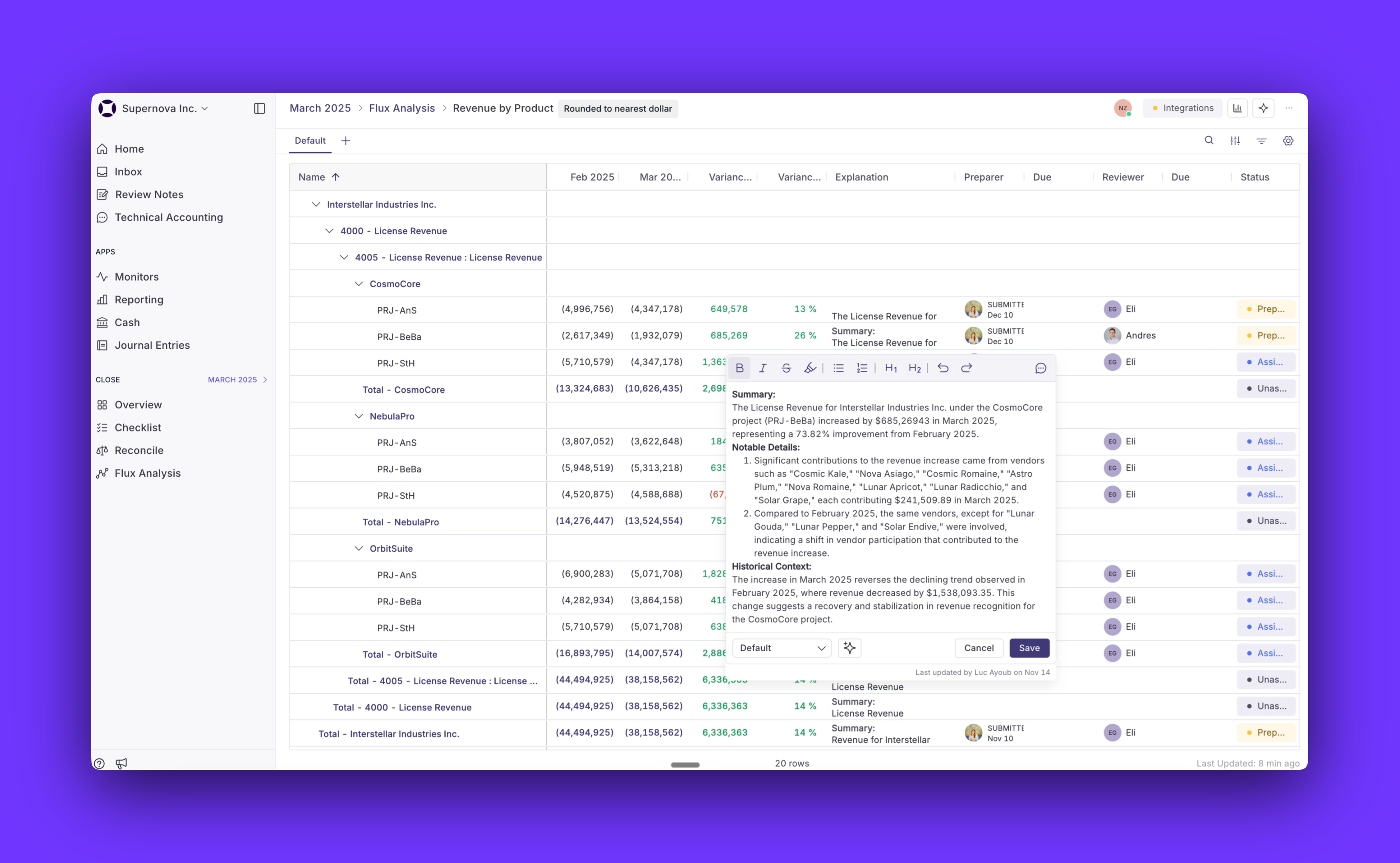
Numeric addresses the root problem in R2R at the source: fragmented, stale data that forces teams into manual, reactive work. When the ERP only syncs on export, when reconciliation happens in spreadsheets disconnected from transaction detail, when the close checklist lives in a shared tab that everyone updates differently, the entire R2R cycle inherits those constraints. Numeric removes each one.
- Deep NetSuite integration: Native multi-entity and multi-currency handling, live GL sync, and direct JE posting from within the platform
- Automated reconciliations: Transaction-level matching with exception flagging and materiality thresholds
- AI-powered flux analysis: Auto-generated variance explanations using context-rich transaction data
- Continuous accounting: Proactive transaction monitoring and intra-month close activities
- Centralized close management: Task tracking, dependencies, approvals, and documentation in one platform
- Audit-ready workflows: Every action logged, documented, and traceable
Why Accounting Teams Choose Numeric
Numeric is built for high-growth tech companies using NetSuite, Xero, QuickBooks, or Sage Intacct — teams that need to scale their accounting function without scaling headcount. The platform replaces the patchwork of spreadsheets, manual exports, and disconnected tools that slow most R2R cycles down, giving lean teams the infrastructure to close faster, answer the CFO's questions instantly, and spend more time on the strategic work that makes accounting a genuine business partner rather than a reporting function.
Brex, for example, uses Numeric to automate over 95% of cash reconciliations across more than 100 bank accounts. GOAT built a PwC audit-ready close on Numeric. Stash runs CFO-ready flux analysis through the platform every period. These are teams that needed to scale R2R without proportionally scaling headcount, and Numeric is how they did it. Schedule a demo to see how Numeric fits into your close process today.
Frequently Asked Questions About Record to Report
Related Content
.png)
Numeric vs. Maxima: Which AI Close Platform Fits Your Team?
Numeric and Maxima both automate close work. Compare how each handles reconciliations and cash matching, who owns the rules, and when each one fits.
.png)
7 NetSuite Reporting Tools, and When to Just Replace NetSuite
Compare 7 NetSuite reporting tools by use case and cost, and learn when replacing NetSuite solves reporting problems at the source.
.png)
What Is Multidimensional Accounting? Benefits, Examples, and 3 Steps to Set It Up
Learn how multidimensional accounting tags transactions by department, product, and customer, with examples and 3 steps to set it up.