Numeric vs. Ledge: What's the Best Close Platform for Your Business?

.png)
If you've been battling the status quo of working with manual spreadsheets or your legacy tools aren't delivering as intended, it's likely time to seek out more modern close management software.
Of the options on the market, Numeric and Ledge are becoming fast favorites. They each offer modern user interfaces, advanced AI capabilities, and pretty comprehensive close management tooling.
Numeric has spent the last several years becoming the close management platform of choice for lean accounting teams at high-growth companies, with a 4.8 rating on G2 and a customer base that includes some of the most advanced finance teams in the market like Paddle, Brex, and Riskified. Ledge is newer, with an interesting pitch around AI-native close preparation and a smaller pool of customers who can speak to how the tool holds up at scale and under audit.
Both platforms are worth evaluating. They are solving different problems and making different architectural bets, and the right answer depends on where your close bottleneck actually lives.
This post walks you through how each platform works, how features compare between the two, and a clear framework for figuring out which one fits your team.
Key Takeaways
- Numeric is the stronger close platform for most mid-market finance teams. It connects to NetSuite at the transaction level, syncing every GL entry continuously. Automated reconciliations, flux analysis, cash matching, and reporting all run from that same live data layer, and every workflow ships with a built-in audit trail that auditors can self-serve without additional prep.
- Ledge is purpose-built for one specific problem: eliminating close preparation work. If rebuilding working papers, drafting journal entries, and reconciling accounts from scratch every period is your team's dominant bottleneck, Ledge's agent model addresses that directly.
- The architectural difference is what compounds over time. Ledge automates at the preparation layer, shifting your team from preparers to reviewers. Numeric automates at the analysis layer, providing a better, more structured data foundation for your team and even their AI tools. As AI in accounting matures, the platform with the deeper data foundation is the one that gets more powerful over time.
Numeric vs. Ledge: At a Glance
Both platforms support the core workflows of the modern close. What matters most in this comparison is the architecture underneath each one, because that determines what your AI tools can actually do with your data and how much structure your team has when something needs to be traced back to source.
The table above covers what each platform does. But how do they actually position your team? Ledge positions accountants as reviewers of agent output. Numeric keeps your team in control of a close that runs on better data and has a deep integration with your existing AI tools via MCP.
Numeric Platform Overview
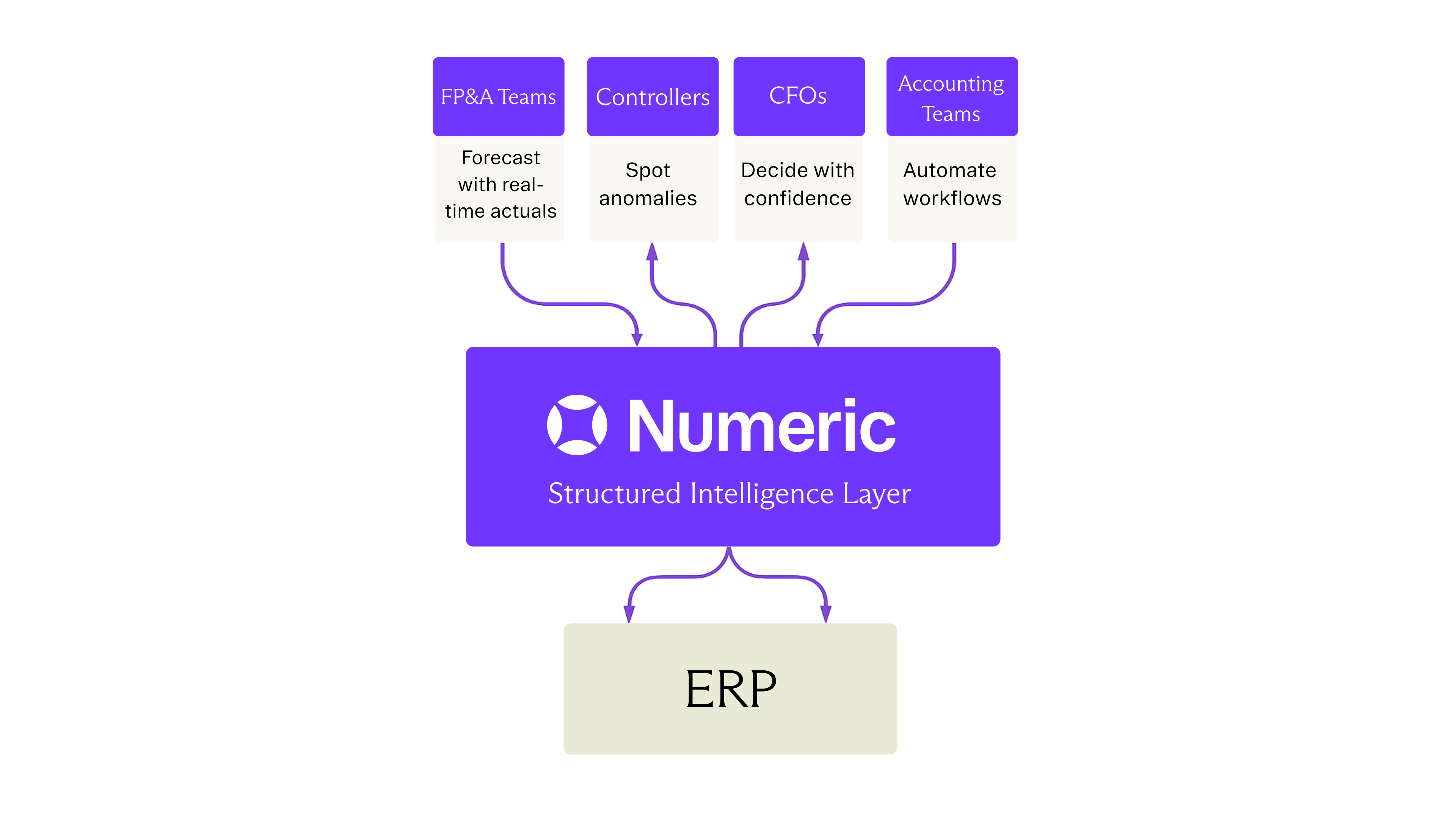
Numeric is an AI-powered close management platform built on your GL, designed for high-growth finance teams on NetSuite, Xero, QuickBooks, and Sage Intacct.
A data-first foundation
Most close tools connect to your ERP and pull what they need when they need it. Numeric warehouses the entire GL at the transaction level, syncing every line item every one to two minutes for NetSuite users. That means every reconciliation, every flux explanation, and every AI-generated insight runs against the same live, structured data your ERP holds.
Built for Controllers who need more than a checklist
Controllers at scaling companies can't afford to spend the close firefighting. They chase status updates across Slack, catch issues only after tasks have already been submitted, and manually rebuild the same reports for leadership every month because nothing in their ERP makes that process easy or fast. Numeric gives that time back by automating the most manual parts of the close and providing reporting and analytics that are faster and easier to build than anything you would put together in NetSuite directly.
- Close Checklist — a purpose-built close management tool with task dependencies, preparer and reviewer assignments, and a full audit trail built in from day one, so status lives in one place instead of scattered across Slack threads
- Account Reconciliation — pulls your trial balance in real time alongside supporting sources, and for NetSuite users, surfaces the exact transactions driving any variance so your team spends time resolving issues rather than finding them
- Flux Analysis — automatically generates a structured variance report each period, with AI-drafted explanations built from transaction-level data, so Controllers can get to the "why" without spending 3 to 4 days combing through Excel
- Cash Management — connects directly to your banks for a live transaction feed, matches at a 90%+ auto-match rate, and lets your team build and modify matching rules in plain language without a third-party consultant
- Reporting — pulls standing reports from your GL directly inside Numeric, auto-runs them each close period, and makes them shareable with FP&A and leadership without requiring a NetSuite login
Numeric Pros
Numeric wins on depth — deeper ERP integration, AI that's embedded rather than bolted on, and an open data layer that works with whatever tools your team is already running.
- Purpose-built for NetSuite teams, with a transaction-level GL sync that updates every one to two minutes — deeper ERP integration than any other close platform on the market
- AI is embedded throughout the platform rather than added as a module — flux explanations, cash matching, and reporting all run from the same live data layer
- Native MCP server means the AI tools your team already uses — Claude, ChatGPT, Copilot — can connect directly to your close data without any vendor intermediation
- Rated 4.8 out of 5 on G2 with consistently high marks for ease of use, quality of support, and implementation speed
- Implements in days to weeks with no dedicated admin required
- Full audit trail built into every workflow by default — auditors can self-serve without additional prep
Numeric Cons
The tradeoffs are real and worth knowing upfront, especially if your team isn't on NetSuite or if working paper automation is the core thing you're evaluating for.
- Transaction-level depth is available today for NetSuite users only — Xero, QuickBooks, and Sage Intacct connect at the trial balance level
- Does not auto-generate working papers the way Ledge does — for NetSuite users this is largely offset by the live GL sync, but teams on other ERPs may still rely on spreadsheet-based prep work
- Pricing includes per-seat fees, which can increase cost as teams grow
Numeric Pricing
Numeric charges a platform fee plus per-seat fees, with pricing that scales based on team size and complexity. Numeric does not publish pricing publicly — prospective customers can request a demo to get a custom quote.
Watch how Numeric's MCP works in practice. Numeric's Co-founder and CPO Anthony Alvernaz walks through how accounting teams are using MCP to run their close without switching between tools.
Ledge Platform Overview
Ledge is an agent-based close platform that describes itself as "AI accountants that prepare your close."
Ledge uses automation in the preparation layer of the close. AI agents act as digital preparers, generating the work. Recurring close tasks like journal entry preparation and preparing reconciliation workbooks are assigned to an agent that delivers a first draft every period, shifting accountants from preparers to reviewers by default. Ledge's automation changes some task ownership from humans to agents, but it does not remove accountability. Reviewers are still fully responsible for the accuracy of every output the agent produces.
In Ledge, agents handle some close preparation tasks directly:
- Working papers — auto-generated each period as multi-tab Excel files with live formulas and source data linked, so teams open a draft rather than a blank spreadsheet
- Journal entries — agent-drafted across accruals, reclasses, intercompany, and FX workflows using your structure and thresholds, posted directly to NetSuite with supporting documentation attached
- Reconciliations — agents draft balance sheet reconciliations across bank, subledger, intercompany, accruals, and deferred revenue accounts; your team is still responsible for reviewing and approving every output
- Flux and variance explanations — auto-prepared by agents each period, generated from reconciled close data rather than a live transaction-level GL sync
Ledge Pros
Ledge's strongest case is execution-layer automation — if close preparation work is your team's dominant bottleneck, these are the points that will resonate.
- Agents handle close preparation tasks before the team logs in each period — working papers, journal entries, reconciliations, and flux explanations are all drafted automatically
- Scope-based pricing with no per-seat fees means teams can invite the full accounting organization without increasing cost
- Implements in hours to days with no implementation fees
- Connects to 150+ systems natively including banks, billing platforms, payment processors, and HRIS
Ledge Cons
Ledge's cons come down to four things: limited independent validation, a credibility gap that shows up under scrutiny, closed AI architecture, and audit traceability that sits in Excel rather than a live data layer.
- Ledge's newer platform status matters most when your environment has specific requirements. Broad agent capabilities are a straightforward pitch — they're harder to validate in practice when a prospect pushes on a non-standard data source or a complex close workflow. The limited published customer base makes that verification difficult before you commit.
- No published MCP support — instead of connecting the AI tools your team already uses directly to your close data, you're limited to whatever agents Ledge has built and maintained on your behalf.
- Audit traceability runs through the Excel working papers the agents generate. A reviewer approving an agent-prepared workpaper is signing off on the agent's output, not the underlying transaction. For teams preparing for audit, that's a meaningful distinction — auditors typically want to trace a balance back to source, not back to the document that summarized it.
- Rated 4.5 out of 5 on G2, though based on only 6 reviews — too small a sample to draw meaningful conclusions about performance at scale.
- Reporting and analytics capabilities are not documented as a standalone product on Ledge's site.
- The close checklist is built around agent task delivery — the agent populates the work, the team reviews it. That model works when agent coverage matches your workflows. Where it doesn't, there's less room to manually structure, assign, or customize tasks compared to a purpose-built close management checklist.
Ledge Pricing
Ledge uses scope-based pricing across three tiers with no per-seat fees. Pricing reflects the workflows you automate and the complexity of your environment rather than headcount. Implementation and onboarding are included. Ledge does not publish pricing publicly — prospective customers can request a demo for a custom quote.
Close faster with Numeric
.png)
Feature by Feature Comparison
Not all close management platforms are built the same. Here's how Numeric and Ledger stack up across the features that matter most to Controllers.
Close Checklist
Both platforms have a close checklist at their center. Numeric's is meaningfully more robust, with structured process, audit trail, and visibility built in from day one. Ledge's checklist is agent-driven, meaning the functionality is largely tied to what agents can prepare rather than what your team can configure and control.
Numeric
- Task dependencies, preparer and reviewer assignments, and entity-level breakouts built in from day one
- Full audit trail created automatically as a byproduct of the workflow — every action, approval, and supporting document logged without extra steps
- Real-time status visibility across the team with Slack integration so status lives in one place rather than scattered across threads
- Auto-rollforward each period so teams do not rebuild the checklist from scratch
Ledge
- Agentic checklist where each task opens pre-populated with draft work from an AI agent
- Tasks are completed by agents before the team logs in, shifting accountants from preparers to reviewers
Account Reconciliation
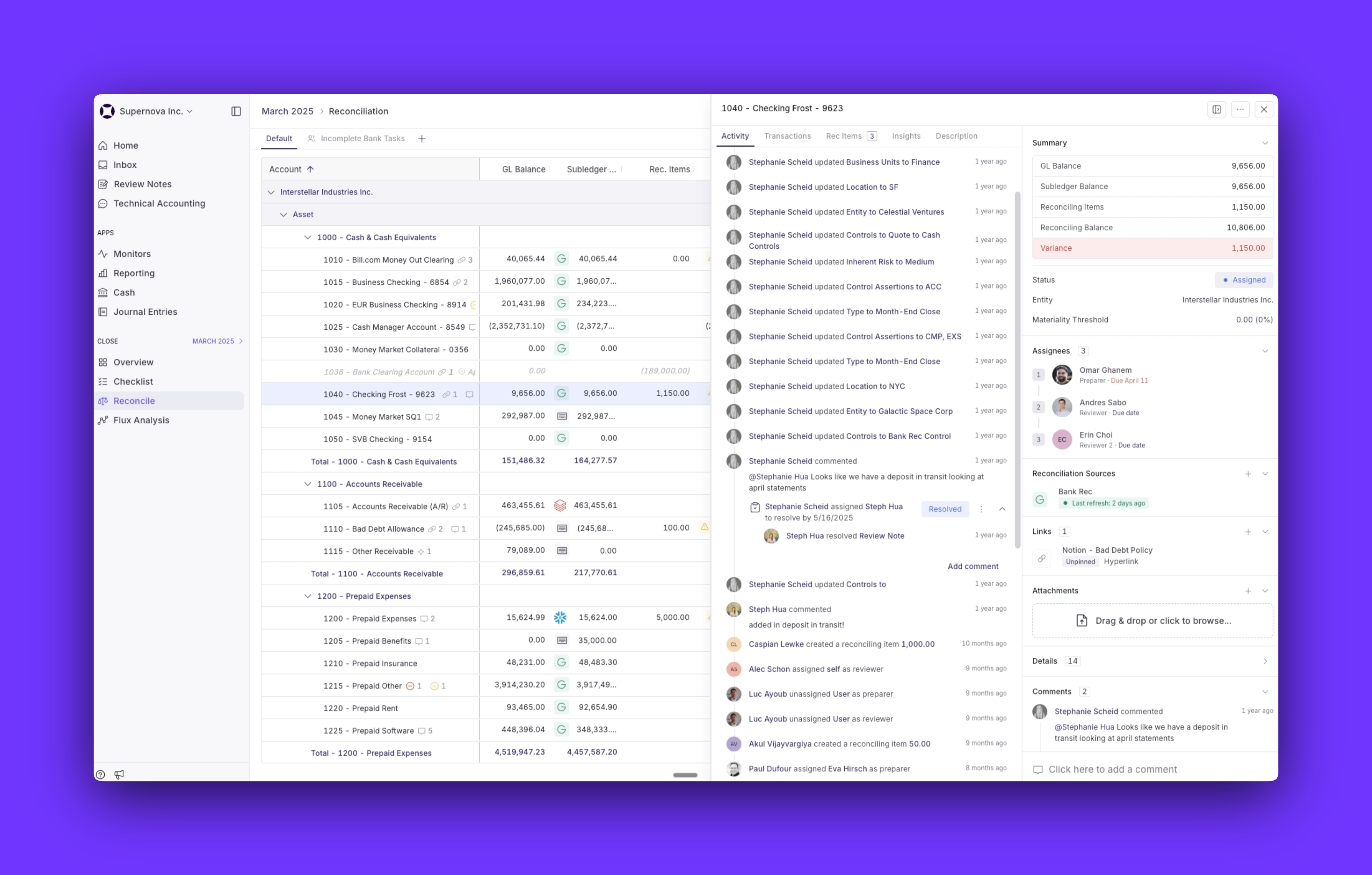
This is one of the clearest areas of divergence between the two platforms. Numeric reconciles at the transaction level with a live GL sync, meaning your team can drill into the exact entry driving any variance without leaving the platform. Ledge automates the preparation work, but traceability runs through agent-generated Excel output rather than a live data layer.
Numeric
- Pulls trial balance directly from NetSuite in real time, syncing every one to two minutes
- For NetSuite users, surfaces the exact transactions driving any variance directly inside the platform with no manual drilling required
- Proactive change alerts notify teams when new transactions hit an already-reconciled account, pointing to the specific transaction causing the discrepancy
- Auto-submission for accounts that tie out under a set materiality threshold so teams do not manually sign off on predictable, low-risk accounts
Ledge
- Agents prepare every balance sheet reconciliation before the team logs in, across bank, subledger, intercompany, accruals, and deferred revenue accounts
- When a number needs to be traced back, the path runs through the agent's generated output — not a live transaction layer. That's the verification step your team and your auditors will be doing by hand.
Flux Analysis
Though both platforms automate flux, Numeric relies on transaction-line data while Ledge uses trial balances from reconciliations. This difference determines how much manual investigation your team still has to do afterward.
Numeric
- AI-drafted variance explanations built from transaction-level GL data — combs every transaction, compares to historical trends, and surfaces the specific drivers of variance analysis
- Flexible grouping by department, vendor, entity, or custom category so teams can run flux on any dimension the business cares about
- Custom explanation templates let teams specify which fields to reference and the desired layout so AI-generated explanations match the team's format
- Materiality thresholds applied at the account or report level to focus attention on significant changes and filter out noise
Ledge
- Variance explanations auto-prepared by agents alongside reconciliations each period
- Generated from reconciled close data rather than a live transaction-level GL sync, meaning more manual investigation is needed
Cash Management
Both platforms handle cash, but they're solving different problems. Numeric is built around close-side cash matching and JE posting; Ledge's cash product is oriented around AR-side cash application and payment reconciliation.
Numeric
- Connects directly to your banks for a live transaction feed with a 90%+ auto-match rate out of the box
- Supports complex many-to-many matching and lets teams build and modify rules in plain language without a consultant — with bank reconciliation automation built in
- Cash JEs post directly to NetSuite with one click
Ledge
- Dedicated cash application product that matches incoming payments to open invoices across banks and payment processors, posting directly to NetSuite
- Handles bank rec and cash application, but close-side matching and JE automation requires agent review at each step rather than posting natively
Reporting
Reporting is a core strength of Numeric's platform and a gap in Ledge's published close management offering.
Numeric
- AI Report Builder turns natural language requests into reports instantly — no NetSuite saved searches, no pivot tables, no admin required
- Reports pull real-time data directly from the GL so leadership always has current actuals, not end-of-month snapshots
- Flexible grouping by vendor, department, entity, or custom category — build reports that mirror how your team actually tracks performance
- Auto-runs each close period and is shareable with FP&A and leadership without requiring a NetSuite login
Ledge
- Offers configurable reporting oriented around reconciliation and payment data, with GL-ready summaries and the ability to export to other systems
- Reporting is not documented as a standalone close analytics or leadership reporting product — it sits closer to a reconciliation output than a CFO-ready report builder
Proactive Monitoring
Numeric includes proactive transaction monitoring. Ledge does not.
Numeric
- Transaction Monitors run on Numeric's live transaction-level GL sync, flagging common errors and policy violations before month-end rather than discovering them during close
- Teams describe the condition they want to monitor in plain language — flag any JE posted to a cash account, catch all expenses missing a vendor tag, surface any transaction above a materiality threshold hitting a fixed asset account — and Numeric builds the rule automatically
- Shifts more close work into the pre-close period so teams are not sprinting at month-end to resolve issues that could have been caught weeks earlier — see 10 monitors worth building
Ledge
- No published transaction monitoring product on Ledge's site
AI and MCP
This is the largest gap between Numeric and Ledge. Numeric is built on an open protocol that lets your team connect whatever AI tools they already use directly to their close data. Ledge runs on a proprietary agent framework, meaning your team works with the agents Ledge has built.
Numeric
- Ships a native MCP server built on Anthropic's open Model Context Protocol standard — see 11 key use cases — with 19+ pre-built skills
- Any AI client your team already uses — Claude, ChatGPT, Copilot — can connect directly to your Numeric workspace without any vendor intermediation
- The accounting team can trigger their own workflows from whichever AI client they work in, querying the GL, running flux, and building custom automations without switching tools or waiting on a vendor to build it for them
Ledge
- Operates on a proprietary agent framework with no published MCP support
- Your team works with the agents Ledge has built — there is no path to connect the AI tools they already use to their close data directly
How Numeric and Ledge Differ on Data
The AI your team uses is only as good as the data it works from. Deloitte's 2025 analysis confirms it: no matter how advanced the algorithm, flawed or incomplete data undermines AI output. In finance specifically, the consequences are more acute than in almost any other function. Bad AI outputs are faster, more expensive, and harder to detect than bad manual outputs.
The depth of Numeric's GL sync helps to produce fundamentally better AI outputs than a trial balance pull or a CSV upload, because the underlying data is structured, live, and traceable rather than aggregated and static.
Hear Sean, Controller at Commure, speak about why data hygiene is the essential prerequisite for successful AI automation.
When AI generates the prep work, the burden shifts from preparation to verification, and verification without structure is still a problem. An accountant signing off on an auto-generated workpaper still needs to trace outputs back to source data with confidence. If your close platform generates working papers automatically but the underlying data is not structured, live, and traceable, you put your financial data at risk during an audit.
In Numeric, every reconciliation, flux explanation, and AI-generated insight is traceable to a specific transaction because the GL is warehoused at the transaction-line level. A reviewer can click into any balance and see exactly which transactions are driving it without leaving the platform. Auditors benefit from the same access: a full record of every task prepared, reviewed, and documented is available directly inside Numeric.
When to Choose Each
The right answer depends on where your close bottleneck actually lives and what you want your team's relationship with AI to look like long-term. If you want a structured close process and an open data layer your existing AI tools can work from directly, Numeric is the stronger bet. If your primary bottleneck is close preparation work, Ledge is worth evaluating.
Choose Numeric if
Your team needs a close platform that runs on a deep data foundation, automates the work natively, and gives your existing AI tools direct access to your close data.
It tends to be the right fit when:
You are on NetSuite and want the deepest possible data layer. Numeric's transaction-level sync means every reconciliation and flux explanation traces back to the exact transaction driving it, updated in real time inside the platform.
Your close bottleneck is reporting, flux, and visibility. Flux Analysis surfaces AI-generated explanations from transaction-level context, and Reports turns that data into leadership-ready output without the manual rebuild.
You are already using Claude, ChatGPT, or Copilot. Numeric's native MCP server means the AI your team already uses can query your GL, run flux, and build custom workflows without needing to rely on vendor-created agents.
You want elite-level close structure. The Close Checklist keeps every task, dependency, and reviewer assignment in one place, with a full audit trail built in from day one.
You are preparing for audit, IPO, or investor scrutiny. Every action logged, every preparer and reviewer approval tracked, every supporting document linked. The audit trail is a byproduct of the workflow, built into how Numeric works by default.
The through-line across all of those scenarios is the data foundation. Because Numeric warehouses your GL at the transaction level, the AI your team uses — whether that's Numeric's native tools or Claude running through MCP — is working from the same live, structured source your ERP holds. Each workflow you add to that foundation gets more reliable over time. That's a different kind of compounding than what you get from a platform that automates the preparation layer but leaves the underlying data aggregated and static.
Choose Ledge if
You need close management functionality and some AI agent features, without the need for heavy audit readiness.
It tends to be the right fit when:
Working paper rebuild time is the dominant source of close effort. You want the system to do the preparation, not just organize it.
You want automation that kicks in immediately. Agents executing work from day one rather than a platform you build into over time.
You are comfortable with a newer platform and willing to take that bet for the execution-layer payoff.
Your primary goal is reducing headcount dependency on close prep, with reporting and analysis as secondary priorities.
One thing worth flagging regardless of which bucket you fall into: push hard in any Ledge eval on the specific workflows you need covered — particularly if your environment involves non-standard data sources, complex subledger structures, or audit-sensitive accounts. The agent model is a compelling pitch, and for the right team it's worth serious consideration, but for a team without the right organized data systems, it could be a mess on implementation. The platform's track record outside of straightforward implementations is thin, and agent-based automation requires real confidence in the quality of your underlying data before you build your close around it.
Evaluating Close Tools — Questions to Ask
Most teams evaluating both platforms fall into one of three places.
Some need a serious close management system with structured process, audit trail, reporting depth, and the infrastructure to scale with the business. Some are genuinely AI-forward, already building in Claude or ChatGPT, and want a data layer those tools can actually work from. Numeric tends to win both of those conversations.
The middle is where it gets interesting. Buyers who want AI but mainly want agents to handle the preparation work, with minimal configuration required, find Ledge a credible fit. That is a real and legitimate use case. But teams who want a platform that automates the close natively and gives them a data layer that works with the AI tools already in their stack will find Numeric compounds better over time.
The fastest way to figure out which type you are: in six months, do you see your team doing their work in an LLM like Claude or ChatGPT, or in whatever UI the AI accounting tool provides? If you're still building your accounting tech stack, that question is worth asking now.
If you recognized your team in one of those descriptions, the next step is pressure-testing that instinct with a few honest questions.
Ask what the platform actually syncs. Before you evaluate any feature, ask what each platform syncs from your ERP. Transaction-level or trial balance? That gap determines what your AI tools can do with the data when they connect. Ask where your close time is actually going: working paper rebuild, or analysis and review? The answer tells you which layer needs solving. And ask whether you can trace any AI-generated output back to the underlying transaction. If you cannot, you are reviewing on faith.
Ask about MCP before you ask about agents. Does the platform have a native MCP server? If not, the AI client your team already uses cannot connect to your close data directly, which means you are dependent on whatever agents the vendor has built for you. Platforms built on open protocols age better than platforms built on proprietary agent frameworks.
Where Do You Want Your Close to Be in 2027?
Both Ledge and Numeric represent a genuine step forward from the close tools that came before them. The more important question is which one is making the right architectural bet for where AI in accounting is actually heading.
As MCP becomes the universal standard for connecting AI to external data, the platforms that will age best are the ones built on clean, structured data that traces back to every source entry that any AI tool can work from. Proprietary agents will likely come and go, but a reliable data layer is sure to compound over time. The best close platform in 2026 gives your team the most reliable data to work with. If that sounds like the right foundation, see how Numeric works in practice.
Related Content
.png)
Numeric vs. Maxima: Which AI Close Platform Fits Your Team?
Numeric and Maxima both automate close work. Compare how each handles reconciliations and cash matching, who owns the rules, and when each one fits.
.png)
7 NetSuite Reporting Tools, and When to Just Replace NetSuite
Compare 7 NetSuite reporting tools by use case and cost, and learn when replacing NetSuite solves reporting problems at the source.
.png)
What Is Multidimensional Accounting? Benefits, Examples, and 3 Steps to Set It Up
Learn how multidimensional accounting tags transactions by department, product, and customer, with examples and 3 steps to set it up.