How to Build an AI Audit Trail for Your Accounting Workflows

.png)
AI is now drafting flux explanations, matching transactions, and proposing journal entries inside the close. That raises a question auditors are already asking: when an AI system touches the numbers, how do you prove what it did, why, and who signed off? The answer is an AI audit trail, and for any finance team heading toward an external audit or an IPO, it is quickly becoming something auditors expect to see.
The definition is the easy part. The harder question, and where this piece spends most of its time, is how to audit AI agents and skills that act across your systems, not just AI features bolted onto your close software.
What an AI Audit Trail Is: Why Basic Logging Isn't Enough
An AI audit trail is a complete, traceable record of every AI-assisted action in your accounting workflows: the inputs the model saw, the prompt or instruction it was given, the model version, the output it produced, and the human decision that accepted, modified, or rejected that output.
It is a higher bar than a traditional audit trail, and a different thing from the two records teams most often confuse it with. Basic logging captures user actions and system events. That is useful for IT and access control, but it says nothing about why a result is what it is. Data lineage captures where data came from and how it transformed, which is essential for governance, but it stops at the data. An AI audit trail has to capture model behavior and the human judgment around it.
Traceability, though, is necessary but not sufficient. A complete log of every action an AI took does not prove the underlying judgment was appropriate. Logging tells you what happened; lineage tells you where the data came from; an AI audit trail has to make the judgment inspectable. That last bar is the one auditors actually care about, and the one most tools miss.
Why AI Audit Trails Matter More in Accounting Than Anywhere Else
Most software teams treat AI logging as an infosec checkbox. In finance, anything that touches the financial statements eventually meets an auditor, and auditors care about the reliability of the process, not just whether the final number happened to be right.
Under Sarbanes-Oxley, internal control requirements extend to any process that touches financial reporting, AI-generated steps included. Section 404(a) requires management to assess the effectiveness of internal control over financial reporting; 404(b) requires the external auditor to attest to it. Neither cares whether a human or a model performed the step, only that the control operated and there is evidence to prove it. An AI-drafted accrual with no record of how it was produced or who reviewed it is a control gap.
The PCAOB is sharpening its focus on how AI gets used and documented in engagements. Its audit-evidence standard (AS 1105) anchors the concept of information produced by the entity: the principle that whenever someone operates a control using information, the auditor must be satisfied the information was complete, accurate, and appropriate for its purpose. That applies squarely to information a model produces. The regulator is not settled here either: the PCAOB has not blessed any AI-assisted accounting workflow to date, and meaningful feedback is unlikely until the next inspection cycles play out. The teams building disciplined trails now are setting the norms auditors will later examine.
GAAS documentation standards require sufficient, appropriate evidence to support conclusions. An AI output with no source tracing, such as a variance explanation with no link to the transactions behind it or a match with no record of the logic, may not clear that bar. The requirement does not soften because a model was fast and confident; because large language models are non-deterministic and won't reproduce the same output twice, it arguably rises.
All of this comes to a head at IPO and first external audit. First audits are brutal precisely because teams that ran on spreadsheets and tribal knowledge suddenly have to produce organized, auditable evidence for everything, under time pressure, for an outside party with no patience for "we know the numbers are right, we just can't show you why." Add AI without a trail and you compound the problem: incomplete records become delays, management-letter comments, and, at worst, a material weakness disclosure that follows a controller for years.
What a Defensible AI Audit Trail Captures
If an AI touches financial reporting, five things belong in the record, and the depth of each should scale to how much the workflow actually matters.
Inputs and source references. Every piece of data fed to the model (trial balances, transaction records, subledger exports), linked back to its ERP source at transaction level, not a rolled-up summary, so a reviewer can verify completeness and accuracy against the system of record.
Prompt, model version, and parameters. The exact instruction given and the model used. With non-deterministic models, this is what makes a result reconstructible after the fact.
Output and confidence signals. What the model actually produced (the explanation, the proposed entry, the matched items), plus any point where it flagged uncertainty or asked for clarification.
Human review, overrides, and approvals. Who reviewed the output, what they checked, whether they accepted or changed it, and when. "A human reviews the output" is not a control; a control specifies what the reviewer looked at, what evidence they recorded, and where the sign-off lives. In a close platform like Numeric, that sign-off is the preparer and reviewer approval on the task itself, and a period can be configured so it cannot close while review notes are still open, so the trail builds itself as the work happens.
Immutable timestamps and change history. Tamper-evident time stamps, with edits versioned rather than overwritten, so a record cannot be silently rewritten.

How to Audit AI Agents and Skills
This is where most guidance stops short. Logging an AI feature inside your close software is one thing. Auditing an AI agent or skill, like a Claude workflow, an MCP-connected automation, or an RPA bot that pulls data, transforms it, and proposes actions across systems, is another. It is the fastest-growing gray area in AI-assisted accounting, and it is where the audit conversation is heading.
The goal is auditability by design: building AI workflows and skills so the work they produce can be defended to an auditor without retrofitting evidence after the fact. Two ideas do most of the work.
As Chris Canoles, a former EY audit partner who worked on the Okta and Dropbox IPOs, puts it:
"Auditors are wary of agentic AI in financial workflows, and the work gets harder, not easier, if you layer agents on top before your data and controls are right."
Audit-relevance attaches to the information, not the system. The instinct to ask "is this tool audit-ready?" is the wrong question. A SOC report covers what happens inside a system. It does not cover what happens to information once it leaves, what happens when sources are combined, or what happens when a tool exercises judgment on a user's behalf. When an AI skill executes in a sandbox outside your close platform, no SOC report covers its transformations, so that evidence has to be captured on purpose.
Scale the Evidence to What the AI Is Doing
Not every AI action carries the same risk, and applying maximum rigor everywhere just slows the close down for no added assurance. The useful way to calibrate is by what the action produces:
Keep Human Review Substantive
Human-in-the-loop review has to be substantive. The defensible pattern for AI-assisted review: the user defines the specific checks (not "find anything weird"), the model documents the logic it applied and what each check found, the user validates that logic, reperforms a sample of what the model marked clean, investigates every flagged exception, and signs off owning the review. Done that way, the AI is an instrument and the human stays the reviewer. Done the other way, where the AI reviews and the human rubber-stamps, the control is fictional.
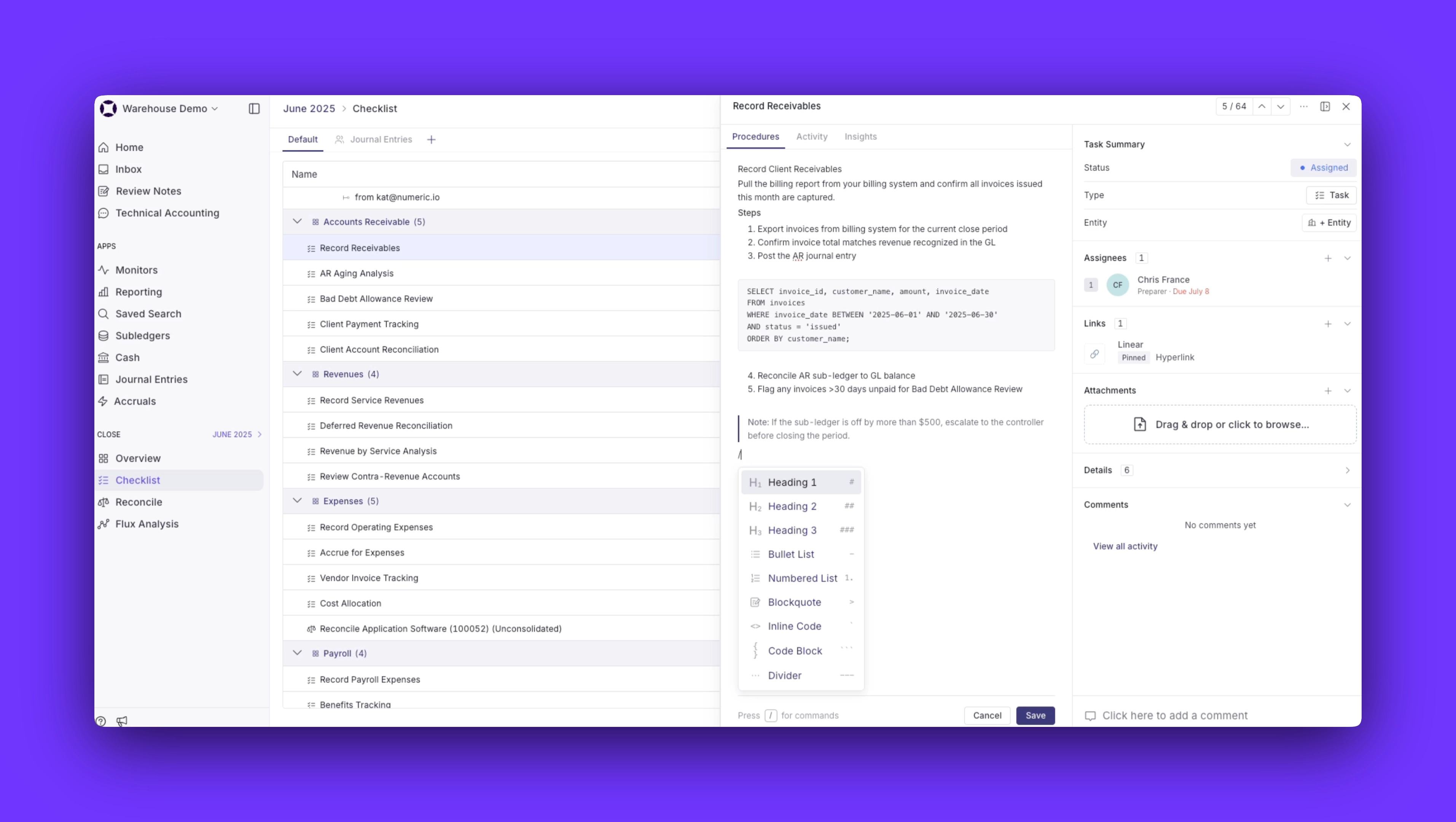
In Numeric, those defined checks live in each task's procedures, where teams document how the work should be done as reusable instructions that a person authors and an AI agent then follows the same way every time. The human still decides what belongs and reviews the result.
Solve the "AI Documenting AI" Problem
The "AI documenting AI" problem is real, and the answer is corroboration. If the model does the work and writes the artifact describing it, that looks circular. It partly is, so separate the pieces. The system-emitted audit log is generated by your platform, not the model, and carries the same weight as any user action. The deterministic parts of a skill (calculations, mappings, rule application) run as reproducible code whose inputs and outputs tie back to source; capturing that code turns out-of-perimeter execution into in-perimeter evidence. Only the narrative ("what the model considered, why it recommended X") is a model-authored description of model behavior, and that is supporting context for the human review, corroborated against the verifiable elements, never standalone evidence. Auditors already handle this category: it is how they treat management-prepared schedules, which they verify against system state, with the reviewer's sign-off as the real control.
So the working pattern is clean: a workflow skill should produce the work, and a companion step should produce the evidence: source identifiers, transformation code, findings, the human's validation, exception resolution, and sign-off, all living inside your system of record, attached to the task it supports. Evidence generated as a byproduct of the workflow is auditability by design. Evidence reconstructed months later from a chat transcript that no longer exists is audit theater.
In practice, this is work a close platform should take off your hands. When an AI agent acts through the Numeric MCP, it operates as the user, inherits that user's permissions, and every action lands in Numeric's own audit log, the same in-scope evidence any user action produces. A companion evidence step can post the underlying logic, source references, and sign-off back to the Numeric task, so the agent's work is captured inside the audited system instead of stranded outside the system of record.
Getting AI into the close responsibly, with the procedures and documentation to back it, is a project in itself. Numeric's AI Mandate Playbook is a controller's toolkit for exactly that, from a step-by-step implementation framework to a build-vs-buy calculator.
Build Your AI Audit Trail: A Five-Step Blueprint
The principles translate into five concrete moves.
1. Inventory every AI touchpoint in the close
You cannot log what you have not named. Walk the close and mark every place a model acts: flux and variance explanations, reconciliation and transaction matching, anomaly and policy alerts, journal-entry suggestions, and any drafting. For each, note what it feeds: an operational dashboard, or a financial-statement assertion. That single distinction drives most of your evidence decisions.
2. Set the evidence bar per touchpoint
Map each touchpoint to the risk spectrum above. A model that relabels close tasks needs nothing beyond the standard audit log. A model that drafts a flux explanation feeding the reviewed financials needs a record of its logic and the reviewer's confirmation. A model that pulls a vendor file, maps it to GL accounts, and posts accruals needs the full treatment: source data, transformation code, completeness checks tied to source totals, and explicit sign-off. Calibrate deliberately; don't put a spreadsheet-grade workflow through a SOX-grade evidence process for no reason.
3. Anchor every AI output to transaction-level source data
An AI-drafted variance explanation should tie to the specific GL account, period, and transactions that moved the number, not a summary. This is where deep ERP integration earns its keep: if the trail only reaches a rolled-up balance, no reviewer (and no auditor) can verify completeness. Numeric, for instance, syncs full GL detail in real time (memo, class, vendor, and more), so an AI output can be traced back to auditor-grade records rather than a summary layer. The same holds for matching, where a match should carry the rule and the source records behind it, and for proposed entries, which should carry the underlying calculation and supporting schedule before anything posts.
4. Build review and sign-off into the workflow, not around it
The evidence that a control operated should build itself as the work happens. Route AI outputs through the same preparer / reviewer / second-reviewer structure that governs the rest of the close, so acceptance or modification is captured in place. For AI-generated journal entries, either architecture is defensible: the model posts via a GL integration with the action attributed to the authenticated user and the calculation attached as a work paper, or the human posts manually after reviewing the recommendation. The control is the substantive review, not the posting mechanism.
5. Make it immutable, then rehearse a mock audit
Records should not be editable or deletable without version history, and periods should be configured so they cannot close with open review notes, which enforces the closed loop that makes the evidence real. Then pressure-test it: pick an AI-assisted entry and try to reconstruct the whole chain (input, prompt, output, review, sign-off) from the trail alone. If you have to go ask the person who ran it, the trail isn't done.
How to Evaluate AI Vendors on Audit Trail Depth
Whether you buy or build, treat the audit trail as a procurement requirement, not a nice-to-have. Useful questions:
- Does it log input data sources and model versions?
- Can the records be exported for external auditors?
- Are records immutable, or can they be edited or deleted?
- Does it capture the agent's activity and the human review, not just the human's clicks?
- How long are records retained?
- Is the AI feature actually inside the vendor's SOC report scope (SOC 1 Type 2 specifically, for anything relevant to financial reporting), or carved out?
Don't wave past that last question. It is common today for AI features to be excluded from audit scope, with a user-entity control that quietly pushes review of all AI output back onto the customer. A tidy in-tool log of the model's activity is not the same as a tested control over it, so read the most recent SOC report before you rely on it. The broader red flags: AI as a wrapper with no native logging of what the model did, and audit trails sold as a separate add-on. The structural tell is teams doing the work in one system and documenting it in another. When the work and the evidence live apart, sign-offs lag, the trail fragments, and audit prep becomes a fire drill instead of a filter. The opposite arrangement is the one to look for: when the close and the controls live in one place, as they do in Numeric, the audit trail is a link rather than a reconstruction, and the evidence exists whether or not anyone remembered to assemble it.
Making Audit Readiness a Byproduct of the Close
The teams that sail through audits don't treat readiness as a separate project. Their reconciliations, flux, and review sign-offs already happen inside the close, so the evidence that a control operated builds itself, because the work and the documentation live in the same place.
As Chris Canoles puts it:
"Don't give yourself a false sense of security with a so-called 'X-day close' if it omits the activities required for GAAP and SEC reporting and performing key controls."
Retention aligned to SOX and tax timelines (often seven years or more), role-based access over who can view or export the trail, and a single clear owner, usually the Controller, keep it defensible over time.
The same logic extends to AI. When AI audit trails are embedded where the work actually happens, across reconciliations, flux, close tasks, and the AI skills that assist them, there is no backtracking and no re-documenting at audit time. The answer to "how was this produced, and who signed off?" is already a link, not a search. That is the difference between controls you have and controls you can prove.
Numeric is built on that principle: controls and the close as one and the same, with evidence captured in real time instead of assembled retroactively, across reconciliations with review-note sign-off, flux with AI-drafted explanations and reviewer approval, control-tagged close tasks, and real-time transaction monitoring. It is how GOAT built a PwC audit-ready close on Numeric, with the controls and sign-off evidence captured as a byproduct of the close rather than assembled after the fact.
To see an always-audit-ready close in action, with the trail building itself as your team works, schedule a demo.
Frequently Asked Questions

Related Content
.png)
Expense Allocation in Accounting: From Shared Costs to True Margins (and Why the Usual Methods Break)
Learn what expense allocation involves, why it's essential for fully loaded P&Ls and true margins, and why spreadsheet models and aggregate JEs keep failing, plus how to fix the root cause.
.png)
Multi-Entity Consolidation: What It Involves, Why It Breaks, and How to Fix It
Learn what multi-entity consolidation involves, why it breaks as companies grow, and why both Excel and add-on tools share a structural flaw. A guide for controllers and VPs of finance.
How to Build an AI Audit Trail for Your Accounting Workflows
A practical guide to AI audit trails for accounting: what to capture, why SOX, PCAOB, and GAAS require traceability, and how to audit AI agents and skills, not just AI features bolted onto your close software.