Multi-Entity Consolidation: What It Involves, Why It Breaks, and How to Fix It

.png)
On paper, consolidation is addition. You combine every entity's books, remove what they did with each other, convert to one currency, and publish. In practice, it eats days of the close, creates reconciliation work of its own, and still leaves you unsure the numbers will hold up.
And unfortunately, adding a new tool to your tech stack historically hasn't solved the problem. Teams implement a consolidation product, go through the mapping exercise, and still spend the back half of every close tying the consolidated output back to the entity ledgers it came from. The close gets a little shorter, but you're left with that all-too-real nagging feeling that the numbers might not hold up.
This is because Excel and most consolidation tools work from data copied out of your entity ledgers. What you consolidate is always slightly behind what's actually in the books, and no amount of process discipline or extra headcount closes that gap.
This post will break down what consolidation involves, why it gets harder with every entity you add, and what changes when consolidation runs on the ledger itself. Numeric's Financial Data Platform (FDP), an ERP replacement, is built to run consolidation that way.
Key Takeaways
- Consolidation rests on three mechanics that each fail in their own way, namely intercompany eliminations, currency translation, and chart of accounts mapping.
- Complexity scales non-linearly. Intercompany relationships grow combinatorially, so 10 entities produce 45 possible pairs and 20 produce 190.
- Consolidation runs three ways: Excel, bolt-on software, and running consolidation inside the ledger itself. Excel and bolt-on software both run outside the ledger. The third approach runs inside it.
- Excel and bolt-on tools share one structural flaw, since both operate on data extracted out of the ledger, so every post-extraction change requires a re-sync and a reconciliation nobody budgets for.
- Numeric supports multi-entity consolidation on the FDP today, so a Controller can build a consolidated report across entities and currencies from the same records the accounting runs on. Intercompany accounting and transfer pricing at the most complex levels aren't supported yet.
The Multi-Entity Consolidation Process: Eliminations, Translation, and Mapping
Consolidation comes down to three jobs. Most teams still do all three by hand, and each one breaks in its own way.
Intercompany Eliminations Under ASC 810
Transactions between entities are real for each entity and fictional for the group, so internal activity has to come out before you publish. KPMG's consolidation handbook covers the requirements in ASC 810, with IFRS 10 governing the same territory internationally.
What gets eliminated:
- Intercompany sales and purchases, with the receivable and payable on each side
- Intercompany loans and the interest on them
- Dividends and management fees between entities
- Unrealized profit in inventory one entity bought from another and hasn't sold externally
Done by hand, this means collecting trial balances and matching counterparties before posting elimination journals. An elimination only works when both sides agree on the amount, the account coding, the period, and the currency. Where entities close on different calendars and use different local GL codes, that agreement is the exception, and netting turns into an investigation across ledgers during close week.
Foreign Currency Translation Under ASC 830
Entities keeping books in different functional currencies must be restated into the group's reporting currency. ASC 830 and IAS 21 govern this, and Deloitte's roadmap on foreign currency transactions and translations is the standard technical reference.
Under the current rate method, three rate types apply:
- Assets and liabilities at the closing rate on the balance sheet date
- Income statement items at the average rate for the period
- Equity at historical rates, except the change in retained earnings, which comes out of the income statement translation
The residual becomes the cumulative translation adjustment, which lands in other comprehensive income and accumulates in equity rather than hitting net income, staying there until the foreign operation is sold or liquidated.
That equity exception breaks most manual models. Translate all of equity at one rate and the plug won't tie back to a real number.
Chart of Accounts Mapping Across Entities
Every entity keeps a local chart of accounts shaped by its own history and statutory requirements. Consolidation requires all of them to roll into one group structure, and that mapping is never finished. It resurfaces with every reorganization, acquisition, new local account, and new reporting requirement.
The risk here is quieter than the other two. Eliminations that don't tie announce themselves, but an account renamed locally, or a new one nobody mapped, throws no error. It lands in a default bucket or drops out entirely, and the consolidated statements stay wrong until an auditor traces the balance.
Consolidation is one piece of the close. Master the whole process.
Why Multi-Entity Consolidation Gets Harder as You Scale
Consolidation work scales with the relationships between entities rather than the entity count, and relationships grow combinatorially.
Two entities have one possible intercompany pair. Ten have 45. Twenty have 190. Your team didn't grow by a factor of 190, and neither did your close calendar, which is why a process that felt tedious at six entities feels broken at twelve.
Acquisitions accelerate it. Each one hits all three mechanics at once, arriving with its own chart of accounts, new intercompany relationships, and often a new functional currency on a different ERP. Add partial-period consolidation, purchase price allocation, and goodwill, and the first close gets crowded fast. For serial acquirers, a process that takes weeks to onboard each entity limits how fast the company can buy.
Somewhere in there is a threshold. Below roughly three to five entities, with a single currency and light intercompany activity, spreadsheet consolidation is defensible. Past that, Excel becomes a control risk rather than a process, and the failure isn't gradual. Teams run the spreadsheet well past the point where it's appropriate, and the problem surfaces during an audit or diligence rather than during a close.
The Three Approaches to Multi-Entity Consolidation
Multi-entity companies consolidate one of three ways. Two run consolidation outside the ledger, and one runs it inside. That distinction matters more than any feature difference between them.
Manual Consolidation in Excel
Consolidating in Excel means collecting each entity's trial balance, mapping the accounts into a group structure, and building the elimination and translation logic yourself in a workbook. It's where most multi-entity companies start.
Excel has real strengths. It can model any structure you can describe, without a license cost or an implementation project, and nobody needs training to use it. For a group with a handful of entities, one currency, and light intercompany activity, a well-built workbook is genuinely enough.
Weaknesses include:
- Trial balance collection is manual every entity, every period, along with the chasing that implies.
- Intercompany matching is manual, and it's the work that expands combinatorially.
- CoA mappings and FX logic sit inside formula networks that break whenever an entity, account, or reporting structure changes, and usually one person knows how to repair them.
- No audit trail and no version control, so testing controls means testing formulas.
Bolt-On Consolidation Software
Bolt-on consolidation software is a separate platform that connects to your entity ledgers, pulls trial balances on a schedule, and performs the consolidation outside the ERP. The consolidated financials live in that platform rather than in your general ledger.
It fixes the operational problems above properly, ingesting trial balances through connectors, centralizing CoA mappings, running eliminations on documented rules, and handling FX translation rather than leaving it modeled. For groups whose entities sit on several different ERPs, it's often the only practical option.
Weaknesses include:
- The platform works on extracted data, so any ledger change after extraction, whether a late journal entry, a reclass, or an intercompany correction, requires a re-sync and often a re-run of eliminations.
- Implementation runs months, and each acquisition triggers a re-onboarding inside the tool.
- Some products sold as consolidation software are really FP&A reporting layers. They produce a consolidated view without producing auditable consolidated accounting, which fragments the close instead of consolidating it.
Running Consolidation as Part of the Ledger
The third approach runs consolidation inside the system of record itself, with no second system and no export step. Numeric's Financial Data Platform is built this way. It's an ERP replacement, so consolidation runs on the same records the accounting does.
This is what changes when consolidation runs as part of the ledger itself. Nothing is exported, so there's nothing to sync and nothing to reconcile back.
Download the whitepaper on Numeric's Financial Data Platform, the ERP replacement built on data-centric accounting.
Why Excel and Bolt-On Tools Leave You Reconciling
Excel and bolt-on consolidation software look like opposite ends of a spectrum. Structurally they are the same thing. Both keep consolidation somewhere other than the entity ledgers, and that one fact generates most of the reconciliation work your team absorbs at close.
Consolidating From Extracted Data Creates a Sync Gap
In both Excel and bolt-on tools, the consolidation logic lives somewhere other than the entity general ledgers, and every consolidation run begins with an export. That export is a snapshot, and it is stale from the moment it's taken. That means anything posted afterward is invisible until someone refreshes.
This is structural rather than procedural. As long as consolidation runs on a copy, there is a window between what the ledger says and what the consolidation layer believes.
Tighter cut-off discipline and faster syncs narrow that window without ever closing it. It matters most during the close, when late entries, reclasses, and intercompany corrections cluster in exactly the days the consolidated view is being finalized.
Extraction also strips context that consolidation depends on. Pull subsidiary balances out of a system like OneWorld and you inherit two traps, since summing raw transactional amounts across subsidiaries mixes currencies, and using pre-elimination balances double-counts every intercompany transaction.
The Hidden Reconciliation Tax of a Separate Consolidation Layer
Tools bought to reduce reconciliation work end up generating a new category of it.
Every close, someone on your team reconciles the consolidation environment back to each entity's general ledger. Discrepancies surface, and each one has to be investigated to establish whether it's a real accounting issue or an artifact of the sync, after which eliminations get re-run. This work scales with entity count, lands on your most experienced people, and appears in no ROI model a vendor has ever presented.
LiveFlow research covered by CFO Dive found close to 80% of finance professionals pointing to delays caused by waiting on data from other systems or departments, with over half flagging reconciliation across multiple platforms as a separate obstacle. What slows the financial close is the movement of data between systems rather than the accounting itself.
The audit dimension compounds this problem. When someone asks why a consolidated number changed between two versions, answering means reasoning about extraction timestamps and refresh logs across different systems, which is time consuming and frustrating.

The Fix: A Financial Data Platform
Excel and bolt-on tools fail for the same reason. Both run consolidation on a copy of the ledger instead of the ledger itself. Native ERP consolidation gets closer by keeping eliminations and translation inside the system of record, but it still tops out at whatever that ERP's reporting tools can express, and it's still built around a system that treats every transaction as a journal entry first.
Run Consolidation on the Financial Graph
The FDP closes the remaining gap by changing what a transaction is, in addition to where consolidation runs. Instead of flattening every transaction into a journal entry, the FDP keeps the financial graph: long-lived objects, like invoices, contracts, and leases, the relationships among them, and the business events that happen to them. The trial balance is one report the system produces from that graph. A consolidated view across your entities is another.
That matters most when the group changes. When you add an entity or restructure the reporting hierarchy, reports re-derive from the same records, so there's no fresh export to pull and reconcile.
What This Looks Like on the Financial Data Platform
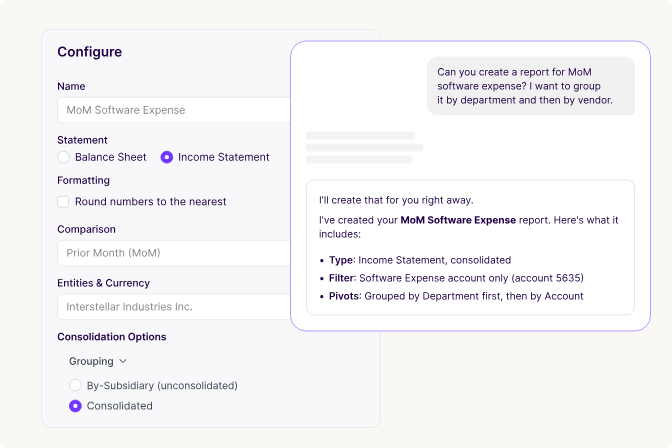
Numeric supports multi-entity consolidation on the Financial Data Platform today. The one carve-out is intercompany accounting and transfer pricing for the most complex group structures, which the FDP doesn't support yet. For a Controller, that means building a consolidated report, or dropping into a single subsidiary's view, without ERP administration rights or saved search expertise. Every number stays tied to its source, because the report and the ledger are reading the same data instead of two separate copies of it.
It's the same principle behind continuous accounting. Work that used to be possible only at period end becomes possible any time, because the data is current rather than batched.
How to Evaluate Your Multi-Entity Consolidation Process
Whatever you conclude about architecture, there is work worth doing now. Doing it first will sharpen any evaluation that follows, and it pays off regardless of what you eventually buy.
Audit Your Current Consolidation Data Flow
You can't evaluate alternatives without having a clear picture of what you have. Here's how to assess your existing consolidation flow:
- Map the end-to-end data flow. Trace it from source GLs through the extraction method to the consolidated output, and count the manual steps in between. The number is usually higher than the team's mental model of it.
- Quantify the reconciliation tax. Measure hours per close spent tying the consolidation environment back to entity ledgers and re-running eliminations. This figure rarely appears in any business case, and it can be the largest single cost of the current setup.
- Test the trust gap. Ask whether your team, and your auditors, can trace a consolidated line item to its source transaction in one drill-down. If the answer involves an export, you've found your constraint.
Standardize Before You Automate
Financial automation applied to an undocumented process produces faster inconsistency, and in our experience, a chunk of consolidation failures trace to rules nobody wrote down instead of tools that weren't purchased. Here are the steps you need to take:
- Standardize the global chart of accounts before evaluating any solution, since every tool will ask you to map to it anyway.
- Enforce intercompany policy explicitly, so that both sides are recorded, matched, and cleared within the same period, with agreed coding.
- Document your FX and elimination rules, including which rate applies to which account category and how the CTA roll-forward is constructed.
Questions to Ask Consolidation Software Vendors
Most consolidation software vendors handle eliminations, translation, and mapping, which makes their feature pages nearly interchangeable.
The differences show up in how data gets into the system and what it takes to keep it current. Ask these four questions during the demo, ideally using your own data:
- Does the system operate on extracted copies of the books, or does it read the ledger natively and continuously?
- Can I drill from a consolidated line item to the originating transaction without a re-sync or data refresh?
- What does onboarding a new entity actually involve, a dimension value and some rules, or an implementation project?
- When a journal entry posts after the last refresh, what has to happen before the consolidated view reflects it?
Pro tip: For acquisitive companies, that third question deserves the most weight, because it determines whether consolidation stays proportional to the deal pipeline.
See why Built replaced NetSuite with Numeric's Financial Data Platform.
Multi-Entity Consolidation Is an Architecture Problem
Multi-entity consolidation is technically demanding work. Eliminations require judgment, translation requires precision, and mapping requires maintenance. None of that goes away with better software, and none of it should.
The work that can go away is everything stacked on top. Your team reconciles the consolidation environment back to the entity ledgers, chases differences that turn out to be sync artifacts, and carries a low-grade doubt about whether the consolidated numbers match the books right now. That layer exists because of where consolidation runs, which is why changing where it runs removes it.
Your setup should let you trace any consolidated number back to its source transaction, in one system, without waiting for a refresh. If it can't, that's the gap worth closing, and closing it is what frees accounting teams to partner with the business instead of assembling reports for it.
See Numeric in Action
If you are weighing whether to keep patching that architecture gap or remove it, that is worth walking through before you renew anything.
Schedule a demo to see the Financial Data Platform run multi-entity consolidation as part of the ledger itself, with every number tied to its source.
Frequently Asked Questions on Multi-Entity Consolidation
Bolt-on consolidation software sits outside your ERP. It pulls trial balances from your entity ledgers on a schedule and runs eliminations and currency translation in its own environment, so the consolidated numbers live in a separate platform. Native ERP consolidation skips that step. The elimination and translation logic runs inside the general ledger itself, against live data, with nothing exported and nothing to reconcile back. The catch is reporting, since you can only cut consolidated numbers the ways the ERP's reporting tools allow. An ERP replacement like Numeric's Financial Data Platform keeps consolidation inside the ledger and lets you report on any dimension from the same records.
Somewhere between three and five entities, assuming a single currency and light intercompany activity. Past that point, complexity grows faster than the team does. Ten entities create 45 possible intercompany pairs, twenty create 190. The relationships compound even when the entity count doesn't, which is why a workbook that felt fine at six entities can fall apart at twelve.
Yes, for standard intercompany activity. Every transaction in OneWorld carries its subsidiary, balances are held in transactional, base, and consolidated currency at once, and elimination entries post automatically during consolidation. Transfer pricing differences and partial equity ownership still need manual treatment.
Because the work scales with the relationships between entities, not the entity count. Two entities have one intercompany pair to manage. Ten have 45. Twenty have 190. Acquisitions make it worse, since each one arrives with its own chart of accounts, its own intercompany relationships, and often a different functional currency or ERP.
Not from NetSuite's native reporting tools on their own. Anything past the standard statements usually means building a saved search, and at public companies with SOX controls, report-building permissions are often restricted to a small group. An ERP replacement like the Financial Data Platform closes that gap by running consolidated reporting off the same live data as the ledger itself, so a Controller can build the report without saved search expertise or ERP administration rights.
Related Content
.png)
Numeric vs. Maxima: Which AI Close Platform Fits Your Team?
Numeric and Maxima both automate close work. Compare how each handles reconciliations and cash matching, who owns the rules, and when each one fits.
.png)
7 NetSuite Reporting Tools, and When to Just Replace NetSuite
Compare 7 NetSuite reporting tools by use case and cost, and learn when replacing NetSuite solves reporting problems at the source.
.png)
What Is Multidimensional Accounting? Benefits, Examples, and 3 Steps to Set It Up
Learn how multidimensional accounting tags transactions by department, product, and customer, with examples and 3 steps to set it up.