The Finance Engineer: Why Accountants Are the Best Builders in the Room

A new role is emerging in accounting. Not a job title handed down from a reorg or invented by a recruiter, but something that is happening organically, in the margins of month-end close and on nights and weekends, across accounting teams in every corner of the country.
At Numeric, we have been watching this shift happen in real time across the Controllers and accounting teams we work with every day. They are writing Python scripts, building internal tools that used to require an engineering ticket, and shipping automations without waiting on anyone else to do it for them. We call them finance engineers: the individuals architecting systems and automations with the finance and business context they already have, turning processes that used to take days into something that takes hours.
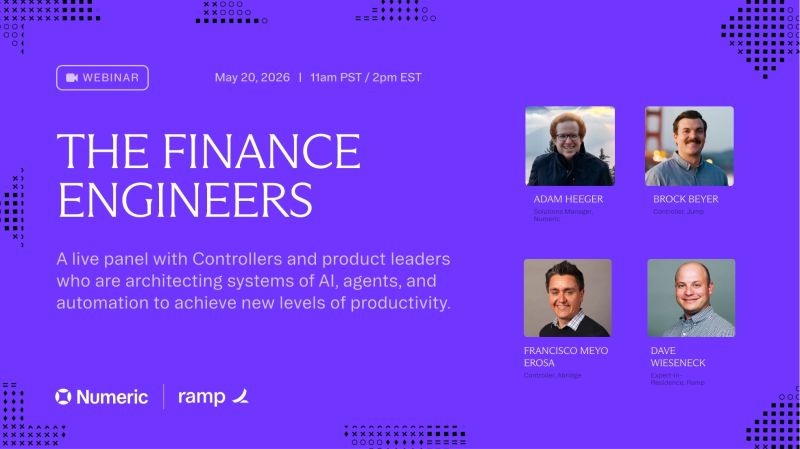
We hosted a live panel with Brock Beyer, Controller at Jump; Francisco Meyo, Controller at Abridge; Dave Wieseneck, Expert-in-Residence at Ramp; and our own Adam Heeger, Solutions Manager at Numeric to talk through their latest builds, the decisions they are making in 2026, and what the future of accounting roles actually looks like. If you are a Controller trying to figure out where to start, what to build, and how to think about AI inside your close process, this is what they had to say.
Your Accounting Experience Is Actually the Edge You Already Have
Over the last two years, you have probably asked some version of this question: how does my accounting experience translate into the world of AI?
Brock Beyer, Controller at Jump, hears it constantly. His answer is direct. He says:
"I actually firmly believe that our foundation in accounting and in finance is actually going to be the thing that sets us apart and makes us great. The people who have actually been in the trenches, the people who have actually been doing the month end close, they know those late hours, they've had to perform manual reconciliations, they've had to do analysis. Those are the people who are going to win in the AI race.”
The fear that your background is somehow incompatible with this moment is understandable, but it gets the situation exactly backwards. The Controller who has lived inside a month end close, who knows where the data breaks down, who understands why a recon won’t match , is precisely the person who can build something that actually fixes broken processes.
Accountants who are new to AI tools often underestimate how much they already have going for them. Learning the nuances of accounting, the rules, the edge cases, the judgment calls, is arguably the harder skill set. At Numeric, we refer to this knowledge as "ACCT'G INTEL" or accounting intelligence, and it's one of the five key traits of being a finance engineer.
.png)
Once you have that foundation, learning to apply AI becomes the more tractable problem. You need to understand the problem before you can direct the technology toward it. Accountants already have that understanding.
The finance engineer is simply an evolution of what accounting has always required: people who understand the business deeply enough to build systems around it. The people best positioned to lead that shift are the ones who already spent years inside the work.
MCPs: How Finance Teams Are Connecting Every Tool in Their Tech Stack
MCPs, or Model Context Protocol, are the connective tissue between your AI tools and the rest of your tech stack. They work similarly to APIs, using existing authentication protocols so that your AI tools can talk to other systems and pull real context in an automated fashion.
In practical terms this means your AI is no longer working in isolation. It can reach into your ERP, your Slack, your recorded meeting notes, your contract management system, and act on real information rather than guessing at it. The panelists on this webinar are already using MCPs connected to tools like NetSuite, Ramp, Ironclad, and Granola as core parts of how they work every day.
As Adam put it:
"MCPs are sort of similar to APIs in a lot of ways. They let you use existing authentication protocols so that your AI tools, be it Claude, Codex, Gemini, whatever, can go and talk to these other systems and get the context information out of these tools in an automated fashion.”

The Quality of Your Data Determines the Quality of Your Agents
Everyone is excited about what agents can do. Far fewer people are asking whether their data is actually ready for agents to act on it.
If the information living inside your financial platforms is messy, incomplete, or siloed across systems that have never talked to each other, the agent can easily reproduce that mess with speed and at scale. The output will look confident but will be wrong. That investment compounds. Every workflow you build on top of clean data performs better, requires less review, and breaks less often.
Context quality is the foundation everything else runs on. The Controllers getting the most out of agentic workflows right now are the ones who have done the unglamorous work of getting their close platform organized, their task structures clean, and their data sources connected. Things like prompt sophistication are secondary to that.
The Future Is Agents Talking to Agents
The way humans interact with software is changing faster than most people realize. For years the model was simple: you went to a user interface, you typed something or clicked something, and the software pulled from a database behind it. You were the bridge between yourself and the system.
What MCPs and APIs are enabling now is a different model entirely where you work via agents who can also query the systems and execute tasks. We are entering a multiplayer era, where humans and their agent counterparts run actions simultaneously. The process may look the same but who runs it is changing. That is where the architecture of finance work is heading.
Dave framed what comes next in a way that is worth acknowledging:
"What's coming next is going to be agent to agent interaction. My agent knows everything about me and the job that I want to get done, and together they're going to work together to get that job done. You can add in multiple agents. NetSuite plus Notion plus Ramp plus Numeric. And together that team of agents will work together to get a job done, each doing what it is best suited for."
This pattern, while not quite a reality today, is already starting to take shape in how the most advanced finance teams are building. One Numeric customer has begun embedding Claude skill references directly into their task descriptions at the start of close. When the workflow kicks off on a schedule, Claude reads the task, identifies the skill it needs to run, pulls data from upstream sources, notifies downstream owners in Slack, and submits the prepared task back to Numeric ready for review; that's all happening without a human functioning in between. That is a production orchestration layer, built and run by a Controller.
Build vs. Buy: How Finance Engineers Decide What to Build and What to Buy
The ability to vibe code a tool in an afternoon has created a real and understandable temptation to build everything yourself. If you can spin up a lightweight version of a workflow in Claude in 20 minutes, why would you pay for a vendor?
Francisco Meyo, Controller at Abridge, has a clear answer.
"It's one thing creating a script that runs very nicely in your computer. It's very very different when you put something into production. We manage very sensitive information. I don't want accounting to be the one that causes a data breach that bankrupts the company.”
The build vs. buy decision comes down to a few honest questions. Is your build a micro automation that fills a gap between two existing integrations? Build it. Is this something that touches sensitive customer or financial data and needs to scale across your team? Buy it, or at minimum, involve IT and security before you ship it.
Dave put it well: having access to a digital camera does not make you a photographer. The cost of building software has dropped dramatically, and there is real value in building niche tools for your own specific workflow. But production software has edge cases, security requirements, user access controls, and maintenance overhead that vibe coding on a given afternoon may not account for.
The finance engineers who are winning right now are the ones making the sharpest decisions about what deserves to be built and what deserves to be purchased from people whose entire job is to build and maintain software well.
The Skills That Will Get You Hired in the Age of AI
Finance interviews have a new paradigm. Where questions once focused on Excel models and software acumen, today's bar is set specifically for the AI era.
At Ramp, candidates are no longer just asked whether they use AI or what tools they are familiar with.
Dave described the new bar plainly:
"We're asking people to showcase not just do they know AI, what tools do you use, etc. but literally show it to us. Because that is the job going forward. Knowing how to do accounting or knowing debits and credits is not going to get you a job going forward. But being able to deploy agents that have that knowledge plus the entire knowledge of the internet is going to be much more valuable.”
Abridge runs a similar exercise. Candidates receive an anonymized real world case study, something like a payroll register, and are asked to build a solution that prepares the journal entry for the ERP. The output has come back in TypeScript, Python, and no code tools. What matters in this exercise is whether the person can look at a real problem and build something that solves it.
The New Cover Letter Is a GitHub Repo
The practical advice for anyone positioning themselves right now is straightforward: send what you built, not just a resume. A GitHub repo with a README file. A screen recording of you vibe coding a solution to a problem you actually had. Any proof that you can close the gap between a business problem and a working workflow.
This shift also reframes what accountants are capable of contributing inside their own organizations. When the transactional layer of close is handled by agents and the mechanical work of routing and reconciling is automated, the Controller's job becomes something different.
As Dave put it:
"The faster you can close the books, the faster you can get to insight and then strategic decision making to drive the company forward. AI works 24/7 and can automate all of that transactional work, which then allows us as a profession to focus more and more on the strategic work and moving our business forward.”
Accounting has historically been a back office function, but that dynamic is changing. The finance engineer who can close faster, surface insights in real time, and walk into a leadership conversation with real-time data is one of the most valuable people in the room.
How to Not Fall Behind
One thing to point out: everyone on this panel mentioned feeling behind.
Every time you open LinkedIn there is something new to contend with: a Claude update, a different agent framework, a workflow that makes the one you built last month feel outdated. This creates a lot of external noise and can make you feel farther behind than you really are.
Dave offered a valuable reframe:
"No one is that far ahead. I learned how to use Claude Code three months ago. Just get started today. You will be an expert in no time. You will be building really cool stuff. Being on this call makes you in the top 1%.”
The best place to start is the most annoying manual process you did last month-end. The thing that had you moving data around in Excel for two hours before you could even start the actual analysis. Start there, and build the thing that removes that one friction point. When it works, and it will work, you will know exactly what to build next.
Why Finance Engineers Build on Numeric
Numeric holds the financial context your agents need to do the work correctly: the close tasks, the account history, the variance data, the team structure. For teams on NetSuite, Numeric offers one of the deepest NetSuite integration on the market so your agents are always working from a clean, complete, and current picture of your books.
A few features that matter specifically for finance engineers:
Close Checklist is project management purpose-built for the month-end close. Every task carries its own documentation, dependencies, and assignments, with a full audit trail of everything prepared and reviewed. The checklist regenerates automatically each period, so your close process stays documented and consistent without rebuilding it. And because all of that context lives in Numeric, AI agents can act on it too, working securely across your checklist through the Numeric MCP and pre-built Skills.
Numeric MCP connects everything living in Numeric to the other systems in your stack. Your agents are always working from a complete picture of your books, your close, and your history.
Monitors run in the background like a second set of eyes, catching miscodings and anomalies in real time before they become close day problems.
Together they give finance teams a foundation built for whatever comes next, whether that's automation, agents, or simply a faster close.
Conclusion
The shift described here is not a prediction. Brock, Dave, Adam, and Francisco are already doing this work, taking years of accounting expertise and applying it to problems only they understood well enough to solve. Their paths look different, but the takeaway is the same: the tools are ready, and the accountants who pick them up get to define what the next version of this profession looks like.
If you want to see how Numeric is built for the way finance engineers work today, request a demo and we will show you what it looks like in practice.
Related Content
.png)
Numeric vs. Maxima: Which AI Close Platform Fits Your Team?
Numeric and Maxima both automate close work. Compare how each handles reconciliations and cash matching, who owns the rules, and when each one fits.
.png)
7 NetSuite Reporting Tools, and When to Just Replace NetSuite
Compare 7 NetSuite reporting tools by use case and cost, and learn when replacing NetSuite solves reporting problems at the source.
.png)
What Is Multidimensional Accounting? Benefits, Examples, and 3 Steps to Set It Up
Learn how multidimensional accounting tags transactions by department, product, and customer, with examples and 3 steps to set it up.