
Deferred Revenue
Deferred revenue is income received in advance of providing good or services to customers — it materializes after the service is fulfilled.
When companies receive advance payments from customers, they cannot yet recognize them as income. That gap between cash received and revenue earned is one of the most consequential items on the balance sheet. And how it's managed determines whether the financials hold up under audit.
Whether your business sells annual SaaS subscriptions, prepaid service contracts, or gift cards, the rule is the same: revenue is recognized when it is earned, not when cash changes hands.
Getting this wrong has real consequences — restatements, audit findings, damaged investor confidence. This article focuses on where high-growth teams most commonly break down: reconciliation at scale, recognition method decisions, and what a defensible process actually requires.
Key Takeaways
- The journal entry is the easy part. Maintaining accuracy across hundreds of contracts with modifications, cancellations, and mid-period upsells is where the process breaks.
- A deferred revenue balance is only meaningful if the subledger behind it is accurate — and most reconciliation errors accumulate across periods before anyone catches them.
- The current vs. long-term classification of deferred revenue affects working capital ratios and how analysts read your balance sheet.
- Under ASC 606, choosing the wrong recognition method can misstate revenue in individual periods even when the total contract value is correct.
- Invoice date and contract start date drift is one of the most common sources of recognition timing errors in subscription businesses — and one of the hardest to catch manually at scale.
- The deferred revenue waterfall — a schedule showing when each dollar of contracted revenue will be recognized — is a standard deliverable in IPO prep and board reporting. Teams that can't produce it cleanly feel it under deadline.
- A clean audit is built on continuous maintenance throughout the month, not a reconciliation sprint at close.
What Is Deferred Revenue and Where Does It Sit on the Balance Sheet?
Deferred revenue, also called unearned revenue or customer deposits, is revenue received before the corresponding product or service is delivered.
Because the company still owes the customer an obligation, those funds are recorded as a liability (not income) until delivery is complete.
The timing of that delivery determines where it appears: obligations due within 12 months are current liabilities; those due beyond that are long-term.
This classification shapes working capital calculations, liquidity ratios, and how analysts read your balance sheet reconciliation — and for a company heading into IPO prep, the current-versus-long-term split is scrutinized.
How to Record Deferred Revenue — With Journal Entry Example
Recording deferred revenue follows a consistent two-step pattern that mirrors standard journal entry structure: recognize the cash receipt as a liability first, then release revenue incrementally as the obligation is fulfilled.
Step 1 — Recording the initial cash receipt:
A customer pays $1,200 upfront for a 12-month service contract. Cash increases by $1,200; a deferred revenue liability of $1,200 is created.
Step 2 — Recognizing revenue each month as service is delivered:
At month-end, $100 of the obligation is fulfilled. The liability decreases; $100 is recorded in the income statement as earned revenue.
Each month, $100 moves from the liability to earned revenue. After 12 months, the balance reaches zero, and the full $1,200 has been recognized.
Multi-deliverable contracts add complexity. A client paying $5,000 upfront for a five-month consulting engagement has that full amount sitting in deferred revenue until milestone work is delivered.
If the project is cancelled mid-engagement, the deferred revenue balance determines exactly what's owed or refundable — an inaccurate balance at that point has financial consequences well beyond the accounting entry.
Multiply that by 500 active contracts with different start dates, mid-year upsells, and cancellations, and the schedule becomes large enough to consume a full day of close time on its own.
.png)
Revenue Recognition Under ASC 606: Where Method Selection Actually Matters
Under ASC 606 and IFRS 15, revenue is recognized when — and only when — a performance obligation is satisfied.
For Controllers managing a live deferred revenue balance, the standard's five-step model is familiar. The decisions that actually create audit exposure are narrower: method selection, SSP allocation, and treatment of contract modifications.
Straight-Line vs. Usage-Based Recognition
Straight-line recognition distributes revenue evenly across the contract term and is the default for most subscription arrangements in which the customer receives consistent benefits throughout the contract.
Output-based or milestone-based recognition applies when delivery is tied to measurable outcomes — units delivered, milestones completed, or consumption volume.
The most common error teams make is applying straight-line recognition to arrangements with distinct deliverables of different values and timing — and then defending that choice when auditors ask why the allocation was made that way.
Standalone Selling Price Allocation in Multi-Element Arrangements
When a contract bundles multiple performance obligations — software access, implementation, and ongoing support, for example — the transaction price must be allocated to each obligation based on its standalone selling price (SSP).
SSP is what the company would charge for that element if sold separately. If SSP hasn't been formally estimated and documented, allocation becomes a judgment call made under deadline, which is exactly the kind of undocumented judgment that creates audit findings.
Teams should establish SSP estimates for each performance obligation they routinely sell, document the methodology, and apply it consistently.
Contract Modifications: Prospective vs. Cumulative Catch-Up
Under ASC 606, a modification that adds distinct goods or services at their standalone selling price is treated as a separate contract — no adjustment to existing recognition required.
A modification that doesn't meet that threshold requires a choice: treat it prospectively (adjust the remaining recognition going forward) or apply a cumulative catch-up (adjust recognized revenue as of the modification date).
That choice has an immediate P&L impact and needs to be documented at the time the modification occurs. Reconstructing the accounting rationale for a mid-year upsell or scope change during audit fieldwork — months after the fact — is one of the more avoidable close-time costs a team can incur.
What the Deferred Revenue Schedule Needs to Show
A defensible schedule includes: contract start and end dates; the selected recognition method and rationale; SSP allocation for multi-element arrangements; and cumulative recognized and remaining deferred amounts by contract.
That documentation is the first thing auditors request. A spreadsheet with a timestamp and no methodology notes is rarely sufficient.
Deferred Revenue vs. Accrued Revenue — Two Sides of the Same Timing Problem
Both arise from the gap between cash and delivery, just from opposite directions — much like prepaid expenses sit on the other side of the same timing problem on the asset side of the balance sheet.
Deferred revenue means the company owes delivery. Accrued revenue means the company is owed payment. You must track both carefully to avoid overstating or understating revenue in any given period.
What These Balances Signal to Analysts
A rising deferred revenue balance is generally a positive signal — strong bookings, future revenue locked in. A rising accrued revenue balance without corresponding cash collection signals collection risk. Investors and auditors read these two accounts in opposite directions, which is why Controllers at pre-IPO companies treat both with equal rigor.
Deferred Revenue Reconciliation at Month-End Close — Where Things Don't Work
Deferred revenue reconciliation is the process of verifying that the deferred revenue balance on the balance sheet accurately reflects all outstanding customer obligations at the end of a reporting period — and it's one of the most scrutinized steps in the month-end reconciliation process.
A clean reconciliation process follows this sequence:
- Pull the opening deferred revenue balance from the prior period close
- Add new cash receipts received during the period that have not yet been earned
- Subtract revenue recognized during the period per the recognition schedule
- Adjust for contract modifications, cancellations, and refunds
- Confirm the ending balance ties to the general ledger and subledger schedules
When the subledger doesn't tie to the GL, it's rarely obvious why. Tracing a $4,300 discrepancy back to a specific contract modification from six weeks ago is the kind of reconciling item that turns a Tuesday close into a Thursday close.
The Errors That Show Up Most Often
Most deferred revenue errors accumulate until the audit.
Premature revenue recognition is the most common. Recognizing revenue before the performance obligation is satisfied inflates revenue in the current period and creates a reconciliation problem that only surfaces later.
Failing to split multi-deliverable contracts into separate performance obligations results in revenue being recognized at the wrong rate and in the wrong period.
Reclassification timing failures are easy to miss. Long-term deferred revenue that isn't moved into the current liability bucket as delivery dates approach skews working capital ratios.
Invoice date vs. contract start date drift. In subscription billing, invoicing dates and service period start dates frequently diverge. Using the cash receipt date instead of the contract start date to trigger recognition is a timing error that compounds quickly across a large portfolio.
The problem with catching these errors at close is that by then, they've already compounded. A modification from six weeks ago has rolled through two or three periods of misrecognition before anyone traces it back to the source.
Reconciling Deferred Revenue to the GL in Real Time
For Controllers managing hundreds of contracts across multiple revenue streams, the tie-out between the subledger and the GL is the step most likely to stall. The problem lies both at the point of reconciliation, when a discrepancy needs to be traced back to a specific contract or modification, and throughout the month, when recognition errors accumulate silently before anyone looks.
A reconciliation process built for this volume needs transaction-level drill-down at tie-out. When the subledger and GL diverge, the work is identifying which specific contract, modification, or timing gap is driving the divergence.
Numeric's reconciliation platform pulls trial balance and subledger data from NetSuite, Sage Intacct, Xero, and QuickBooks Online in real time and surfaces the exact transaction behind any discrepancy. This way, tracing a $4,300 difference takes minutes.
The second requirement is proactive detection before errors compound. A contract modification that causes a recognition timing error in week one should be caught in week one — not when it has rolled through three periods, and the close is already underway.
For teams on NetSuite, Numeric's Monitors let teams configure alerting rules that run continuously throughout the month, flagging deferred revenue issues as they occur. Teams set the rules once; the platform enforces them going forward.
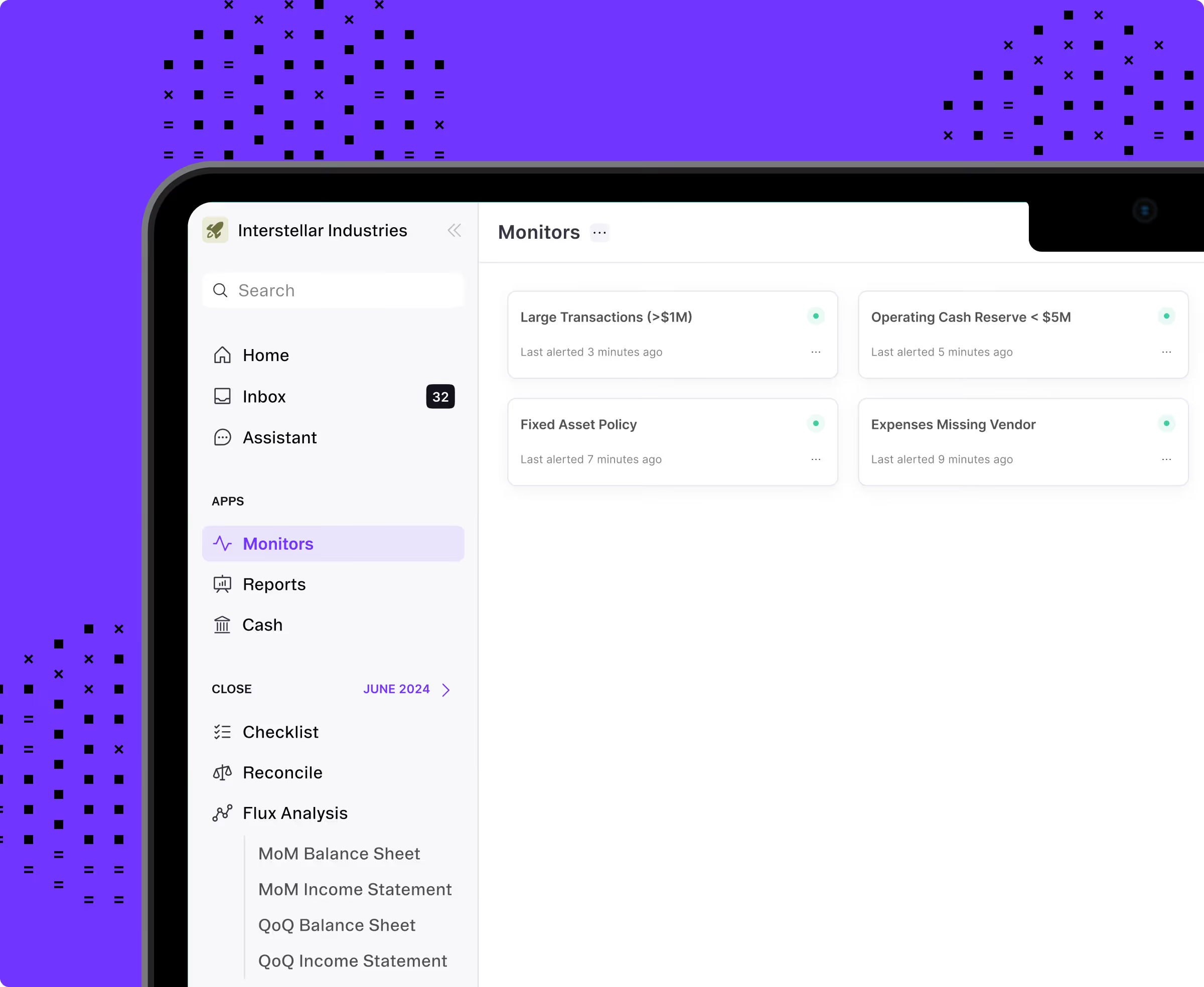
Both capabilities automatically maintain the audit trail. When auditors ask for documentation, the answer is a shared view — not a spreadsheet built under a deadline.
What a Growing Deferred Revenue Balance Tells You
Deferred revenue is a forward-looking indicator of revenue momentum. A growing balance means customers are committing to future purchases and paying upfront: contracted revenue the business hasn't yet earned. For subscription-based companies, it functions as a proxy for retention confidence and ARR visibility.
As companies move into multi-year contracts, usage-based pricing, and multi-element arrangements, the composition of the balance becomes as important as its size. Teams that can break it down by contract cohort, remaining term, and recognition schedule are positioned to forecast more accurately and communicate more credibly with investors and auditors.
The Deferred Revenue Waterfall
The waterfall is a schedule that maps when each dollar of contracted but unrecognized revenue will be recognized — broken down by period, contract cohort, or product line, depending on the audience's needs. It answers the question: of the $8.4M sitting in deferred revenue today, how much is recognized in Q3, how much in Q4, and how much extends into next fiscal year?
For board reporting and investor conversations, the waterfall translates the balance sheet liability into a forward revenue visibility story. For IPO prep, it's a standard deliverable — bankers and auditors use it to validate ARR claims and test the consistency of recognition policies across the contract portfolio.
A waterfall that can't be produced quickly or that doesn't reconcile cleanly with the subledger is a signal that the underlying process has gaps. Teams heading into a fundraise or audit should be able to produce an updated waterfall on demand — not over the course of a close cycle.
Revenue recognition errors are among the most common sources of material weaknesses that surface during the IPO process. Teams that can't produce the waterfall cleanly feel it under SEC deadlines.
Build a Deferred Revenue Process That Holds Up Under Audit
At low contract volumes, a spreadsheet is fine. The problems start when the business grows, and the spreadsheet stays the same. The teams that audit cleanly maintain deferred revenue within a close process built on documented recognition policies, a contract-level subledger that stays current throughout the month, and monitoring rules that catch errors before they compound.
If you're evaluating where your current process stands, this guide to streamlining the month-end close is a useful starting point before you move to tooling decisions.
Numeric is built for that next stage. The platform pulls subledger and GL data from your ERP in real time, flags discrepancies before they compound, and automatically maintains the audit trail. If your current process relies on a spreadsheet that's one contract modification away from breaking, schedule a demo to see how that changes.