Finance Team Goals: How to Set, Measure, and Evolve Goals That Drive Real Business Impact

.png)
Most goal-setting advice for finance teams is either too generic (SMART frameworks recycled from HR platforms) or too narrow (vendor content built around a single metric). Neither helps a Controller figure out what goals to set right now while accounting for their team’s current maturity, staffing constraints, and business outcomes their CFO actually cares about.
This guide covers three dimensions of finance team goal-setting: operational goals, strategic goals, and professional development.
- Operational goals
- Strategic goals
- Professional development
We’ll walk you through a maturity-based goal framework, benchmarks for key metrics, a model for connecting team targets to business outcomes, and guidance on building a review cadence that fits how finance teams actually work.
Why Most Finance Team Goal Frameworks Fall Short
Before building the framework, it’s worth understanding why most fall apart. The pattern is consistent across teams we’ve spoken with, and it usually comes down to four gaps:
- The measurability gap. Finance teams report extensively on business financials but rarely on their own operational performance. Close cycle time, error rates, automation coverage: most teams lack baselines for these metrics, which makes it impossible to set meaningful targets. Building measurement infrastructure is itself a legitimate first-phase goal.
- The business outcome disconnect. Goals get set in accounting-process language (“reduce reconciliation exceptions by 20%”) but presented to executives who think in business-outcome language (“how does this affect our audit costs?”). Every operational goal should connect to a business outcome the CFO and board care about.
- The capacity constraint. The accounting talent shortage is a forcing function for goal design. Most finance teams are understaffed, and lean teams can’t set goals the same way fully-staffed teams do. This makes sequencing critical: operational automation has to create the capacity that headcount can’t.
- The static goal problem. Goals set annually and revisited only at performance reviews become stale as business conditions, systems, and team composition shift. Goals appropriate for a manual team become irrelevant once automation is in place.
The Finance Team Maturity Model: Matching Goals to Where You Are
The maturity model is the organizing backbone of this framework. It helps you diagnose where your team is and set the right goals for that stage, rather than aspiring to goals your team doesn’t yet have the infrastructure to achieve.
.png)
Stage 1: Reactive and Manual
Most teams start here, which is to be expected. The priority at this stage is building the foundation that makes everything else possible.
Characteristics:
- Most time spent on data aggregation, manual reconciliations, and spreadsheet-based close management
- Little documentation and high key-person risk
- Close timeline is unpredictable
Goal priorities:
- Establish controls
- Standardize close processes
- Document procedures
- Reduce key-person dependency
Example goals:
- Implement a standardized close process with documented task ownership and deadlines by Q2
- Reduce reconciliation completion time from five days to three
- Document all critical-path close processes so at least two team members can execute each one
Teams that skip this foundation will find strategic goals unachievable, because you can’t optimize a process you haven’t standardized.
Stage 2: Process-Driven and Efficient
Your team has the basics in place, so now the goal is to do the same work in less time, with fewer manual touchpoints.
Characteristics:
- Standardized processes and basic controls are in place, but execution is still heavily manual
- Close is predictable but long
- Errors are caught during review, not prevented proactively
Goal priorities:
- Accelerate close speed
- Increase automation rate
- Reduce manual touch points
- Build operational measurement infrastructure
Example goals:
- Automate 60% of standard journal entries and low-risk reconciliations by year-end
- Reduce close from ten to six business days
- Establish baselines for all core operational KPIs like close cycle time, rec accuracy rate, or automation rate
Stage 3: Strategic and Proactive
This is where finance earns a seat at the table. Operations run reliably enough that the team’s energy shifts from executing the close to extracting insight from it through continuous accounting.
Characteristics:
- Operations are largely automated and reliable
- Capacity freed from manual work can be deployed toward analysis and business partnership
Goal priorities:
- Forecast accuracy
- Cross-functional partnerships
- Scenario planning
- Board-ready insights
Example goals:
- Deliver monthly business unit profitability analysis by the end of the first week of every month
- Complete two joint ROI analyses with department heads per quarter
- Achieve +/- 3% forecast accuracy on operating expenses
Communicating the Maturity Journey to Your Team
The maturity framework isn’t just one for you to use to quietly assess your team.
Share the progression explicitly so individual contributors understand their goals and roles will evolve from processing toward analysis and advisory as automation grows. This framing supports retention and buy-in: team members see a career arc embedded in the goal framework, not a static job description.
And this is important, because as the team advances, you’ll retire outdated goals. Speaking of which, let’s take a closer look at different types of goals you’ll want to set.
Operational Goals: Building the Foundation
Operational goals are the non-negotiable bedrock. They should be measurable, time-bound, and connected to a business outcome. Here are the three that matter most.
1. Accelerating Financial Close Speed
What to measure: Business days from period end to completion of all close tasks, reconciliations, and management-ready financials. This means the full cycle through reporting, including the time to deliver financials to leadership.
How to baseline:
- Document current close duration over three to six months.
- Identify the longest-running tasks using a close checklist approach.
- Look for sequential dependencies that could be parallelized.
Benchmarks:
- High-performing mid-market teams target five business days.
- Best-in-class at scale achieve three to four.
- Teams currently at ten or more days should target two-to-three-day reductions per improvement cycle rather than trying to halve the close overnight.
Business outcome: Faster close compresses the decision-making cycle, such as financials on Day 5 instead of Day 12, which gives leadership a full extra week to act on the numbers.
2. Maximizing Reconciliation Accuracy
What to measure: First-pass yield rate (which is the percentage of reconciliations completed without material adjustment or rework), and supplement with error rate by account category.
How to baseline:
- Categorize reconciliations by risk tier.
- Track exceptions, adjustments, and rework separately (this is made easier with automated reconciliation tools).
- Establishing the tracking mechanism may itself be a Phase 1 goal.
Benchmarks: Target 98%+ first-pass accuracy on medium and low-risk accounts. For high-risk accounts, track the trend in material adjustments quarter over quarter.
Business outcomes:
- Builds auditor trust (reducing fees and duration).
- Strengthens investor confidence, and ensures operational leaders make decisions on reliable data.
3. Driving the Automation Rate
What to measure: Percentage of finance workflows completed without manual intervention, broken out by categories such as journal entries, reconciliations, variance analysis, reports, and close tasks.
How to baseline: Inventory all recurring processes. Then, tag each as fully manual, partially automated, or fully automated.
Benchmarks:
- Early-journey teams are typically at 10-20%.
- A realistic 12-month target with a platform in place is 50-70%.
- Best-in-class teams target 80%+ on low-risk, high-volume processes.
Business outcomes:
- Automation rate is a leading indicator of capacity creation.
- Every point of automation translates to hours redeployed from processing to variance analysis and business partnership.
- Numeric’s Cash Matching, for example, achieves 90%+ auto-match rates on high-volume workflows, so senior accountants can get out of the weeds and focus on judgment and oversight instead of output validation.
Strategic Goals: Connecting Finance to Business Value
Strategic goals bridge operational excellence to enterprise impact. These are what earn the finance team a seat at the table, and they become achievable once operational goals have created the capacity for higher-value work.
1. Improving Forecast Accuracy
What to measure: Variance between projected and actual results, tracked at operating expense, revenue, and cash flow levels separately.
Target framework: +/- 5% on operating expenses initially, and then tightening to +/- 3% as the process matures with driver-based assumptions.
Implementation: Monthly forecast review with department heads comparing actuals to forecast, documenting root causes, and updating assumptions. This is where the capacity freed by automation gets deployed.
Business outcomes: Forecast accuracy directly impacts capital allocation, cash management, and board confidence. Gartner’s 2026 CFO Agenda found that 51% of CFOs rank improving financial forecast accuracy among their top five priorities.
2. Optimizing Working Capital and Cash Flow
What to measure: DSO (days sales outstanding) and DPO (days payable outstanding) as proxies for cash conversion cycle health.
Target framework: Set specific reduction targets tied to a timeline. For example, reduce DSO from 48 to 40 days by Q3 through automated AR follow-up and weekly collections review.
Implementation:
- Establish a weekly collections review cadence.
- Automate payment reminders and aging reports.
- Track DSO and DPO monthly and report trends to the CFO alongside cash flow forecasts.
Business outcome: An eight-day DSO reduction on $20M revenue is roughly $440K in accelerated cash. That directly funds growth and reduces reliance on external financing.
3. Establishing Cross-Functional Finance Partnerships
What to measure: Number of joint analyses completed per quarter and number of recurring finance deliverables consumed by other departments.
Target framework: “Complete two joint ROI analyses with marketing per quarter” or “deliver monthly CAC reporting to sales leadership starting Q2.” Define these goals in clear, measurable specifics.
Implementation:
- Identify one or two departments where finance data could directly inform decisions (marketing spend effectiveness, product margin analysis, vendor cost trends).
- Align on shared KPIs and establish a regular touchpoint, even monthly, to build the relationship before formalizing deliverables.
Business outcome: Finance moves from a reporting function to a revenue-enabling function. Cross-functional credibility compounds: every useful analysis makes the next partnership easier to establish.
4. Delivering Board-Ready and Investor-Ready Reporting
What to measure: Business days from close to board package delivery, and number of post-delivery corrections per package.
Target framework: Deliver complete board package within seven business days of close with zero post-delivery corrections. Include a qualitative dimension; management commentary should contain forward-looking analysis and at least two actionable insights per package.
Implementation:
- Standardize the board package template so it can be populated as close tasks complete rather than assembled from scratch after the close.
- Assign ownership of each section. Build a review checkpoint at Day 5 so corrections happen before delivery, not after.
Business outcome: Accelerates fundraising, reduces M&A due diligence friction, and builds credibility for strategic influence.
Professional Development Goals: Building the Team That Can Deliver
Professional development directly determines whether the team can achieve its operational and strategic goals. Many Controllers were trained in an era where accuracy and compliance were the job, but there’s now a shift putting them as strategic partners instead.
The shift toward business partnership requires new skills and a different conception of the role. Development goals should reflect this evolution.
Building Technological Fluency
Goal: Set specific certification and proficiency milestones rather than generic training hours. Examples: ERP certification for at least two team members by Q2, two team members proficient in a data visualization tool by Q3, or the full team completing an AI literacy program by year-end.
Implementation: Build a structured training plan with specific milestones by role:
- Preparers should complete platform certification and demonstrate proficiency on their core workflows within 60 days.
- Reviewers should be trained on how to evaluate AI-generated outputs (matching suggestions, variance explanations, monitor alerts) and when to override them.
- Designate one team member as the internal platform lead responsible for rule configuration, threshold updates, and onboarding new users.
- Schedule quarterly skill assessments tied to the maturity model rather than annual training hour targets.
Business outcome: Tech fluency determines whether the team can adopt and maximize the tools that drive operational goals. A platform is only as effective as the team using it.
Developing Financial Storytelling and Business Acumen
Goal: Each senior accountant presents variance commentary to a business unit leader at least once per quarter, with structured feedback collected after each presentation.
Implementation:
- Start with a low-stakes format: a 15-minute walkthrough of monthly variance drivers with a department head the accountant already has a working relationship with.
- Provide a simple template covering what changed, why it changed, and what it means for the business.
- Build toward more complex presentations (board-level commentary, cross-functional recommendations) as confidence grows.
Business outcome: Directly supports the cross-functional partnership goals in the strategic layer. An accountant who can explain why software spend spiked 15% and what it means for the department’s budget is more valuable than one who can only flag that it happened.
Implementing Cross-Training and Succession Planning
Goal: At least two team members fully trained on every critical process by year-end, reducing key-person risk to zero on core workflows.
Implementation:
- Map every critical close process and identify single points of failure.
- Pair primary owners with backup owners and build a rotation schedule so backups get hands-on reps, not just documentation access.
- Test resilience by having backups run their assigned processes for at least one close cycle before year-end.
Business outcome: Protects against disruption during turnover or scaling and builds internal candidates for senior roles.
Connecting Development Goals to Retention
Goal: Every team member has a documented career progression plan reviewed quarterly with at least one skill milestone per quarter. Track retention rate as a lagging indicator.
Implementation: Development goals should evolve with the maturity model.
- At Stage 1, milestones focus on process mastery: learning every critical workflow, earning cross-training certifications.
- At Stage 2, they shift to technology and efficiency: platform proficiency, automation design, KPI ownership.
- At Stage 3, the focus moves to business acumen and strategic analysis: presenting to leadership, owning cross-functional deliverables, mentoring junior team members.
Business outcome: When the team can see this progression, they see a career path. That visibility is one of the most effective retention tools a Controller has, especially in a talent market where experienced accountants have options.
Grow efficiently with AI-driven monthly close software
.png)
Making Goals Measurable: The Baselining and Measurement Playbook
The most common reason finance team goals stay aspirational is that the team has never measured the metrics they’re trying to improve, including close speed, reconciliation accuracy, automation rate. Most teams have a rough sense of where they stand, but no documented baseline. Without one, targets are guesses and progress is invisible.
How to Establish Baselines When You Have No Data
Start by picking five to seven metrics that match your maturity stage.
For a Stage 1 team, for example, that might be close cycle time, number of reconciliation exceptions per period, and percentage of processes documented. For a Stage 2 team, add automation rate, first-pass rec accuracy, and task completion percentage by Day 3.
Then track them manually for one to two close cycles. Good news: this doesn’t require new tooling. Each team member logging their hours by task category, noting exceptions encountered, and timestamping key milestones (like reviews completed) will give you enough data to set a defensible starting point.
Once you have that baseline, set targets against it. A team closing in nine business days doesn’t need to guess that five is the right target. They can see that reconciliations are taking four days and review sign-off is taking two, and target specific improvements against each phase.
The baseline exercise itself is a valid Q1 goal. “Establish documented baselines for close cycle time, rec accuracy, and automation rate by end of Q1” is concrete, achievable, and sets up every goal that follows.
Leading vs. Lagging Indicators in Finance Goal Design
Lagging indicators tell you what happened after the fact: close speed, accuracy rate, audit adjustment count. They’re important, but by the time you see them, the period is over.
Leading indicators predict whether you’ll hit those targets while you still have time to act. For example:
- Task completion percentage at Day 3 tells you whether the close is on track before Day 8.
- Exception count at midpoint tells you whether rec accuracy will hold.
- Automation rate by category tells you whether the team has enough capacity to take on the strategic work you’ve planned.
Pair at least one of each for every operational goal. If the lagging goal is “close in five business days,” the leading indicator might be “80% of reconciliations completed by Day 2.” And if the lagging goal is “98% first-pass rec accuracy,” the leading indicator might be “zero unresolved exceptions older than 48 hours.”
Building a Finance Operations Dashboard
Static spreadsheets reviewed quarterly are how most teams track goals today, and it’s a major reason those goals drift. By the time you pull the data and format the report, the information is weeks old and the review meeting is a backward-looking exercise.
Build or adopt a live dashboard that shows current-period performance against each goal. The metrics that belong on it:
- Days-to-close vs. target
- Reconciliation completion and accuracy rates
- Automation rate by category
- Open exceptions and aging
- Capacity allocation (hours on processing vs. analysis)
The dashboard should be visible to the full team, updated in real time, and reviewed during every close debrief. When performance against a goal is visible daily rather than quarterly, accountability becomes structural rather than managerial.
Numeric’s Close product provides real-time visibility into close progress, task completion, and team performance, giving Controllers the measurement infrastructure that most goal frameworks assume you already have. With an MCP connection, you can take it further — querying your close data directly from your AI platform, asking things like "which departments are driving the most variance this quarter" without ever leaving your workflow. Numeric's MCP makes this possible for accounting teams today.
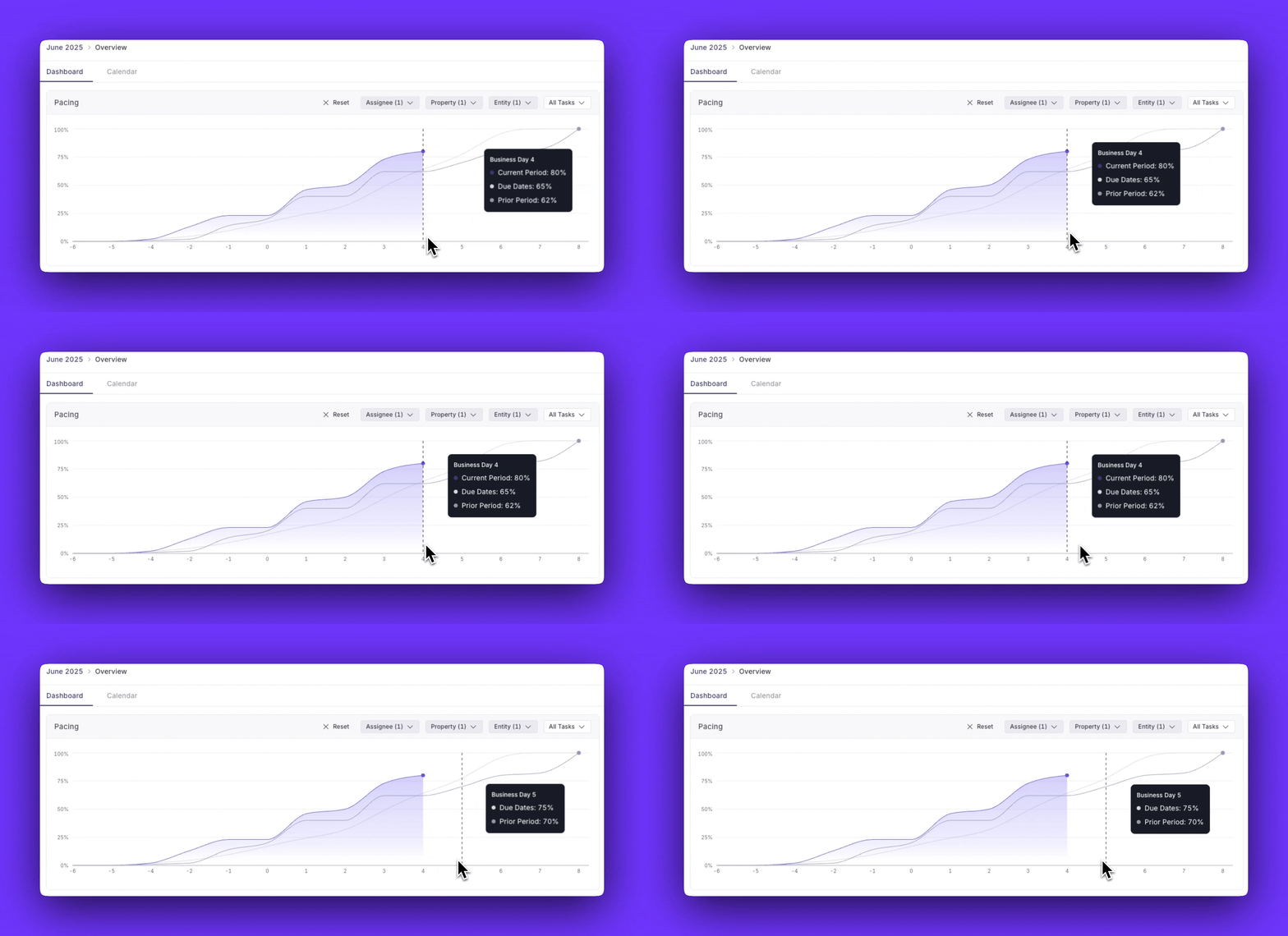
When close progress is visible daily, leadership stops asking for status updates and starts trusting the numbers before the package lands. Answer your CFO instantly instead of scrambling to reassure them at month end.
Goal Cadence, Review, and Recalibration
The biggest reason finance team goals fail is lack of structured review. Most teams set goals once and revisit them only at performance review time. By then, business conditions have shifted, the team has changed, and half the goals are either already achieved or no longer relevant.
Aligning Goal Cadence to Finance Rhythms
Use a three-tier cadence to align your goal cadence correctly:
- Annual: Set the maturity-stage framework. Define which stage the team is in, which goals belong at that stage, and what “graduating” to the next stage looks like.
- Quarterly: Recalibrate if business context has shifted. Reprioritize based on what the last three close cycles revealed.
- Monthly: Use the last 30 minutes of your close debrief to review operational metrics from the period just completed. Identify tactical blockers and quick wins.
Goal Cascading: From Board Priorities to Individual Targets
Finance team goals often exist in a vacuum. A Controller sets a target to “reduce close by three days,” but when the CFO asks why the team needs budget for a new platform, the connection to anything the board cares about is missing.
Goal cascading fixes this by ensuring every target on your team traces back to an endorsed business priority.
Paul Dufour, Solutions Manager at Numeric and former revenue accountant, puts it simply:
The Controller has the ear of the CFO. The CFO knows what the board wants to see. Having that communication trickle downwards effectively and clearly allows the team to build processes that fuel that OKR or that goal. Getting to know the end result can drive everything else that builds up to it.
The structure:
- Board/CEO priority: The strategic directive
- CFO goal: The financial requirement that serves the directive
- Team goal: The operational target that makes the CFO goal achievable
- Individual contributor goal: The specific skills and responsibilities needed to hit the team target
Say the board wants IPO readiness in 18 months:
- Your CFO translates that into “audit-ready financials within five business days of close.”
- You translate that into “automate 70% of reconciliations and achieve 98% first-pass accuracy.”
- Your senior accountant’s goal becomes “complete ERP certification and own three automated reconciliation workflows by Q3.”
- Now when the CFO asks why you need a new platform, the answer writes itself: “The board wants IPO-ready financials in 18 months, and we can’t get there at our current close speed.”
This logic also helps with retention. When individual contributors can see how their daily work connects to the company’s trajectory, the job feels meaningfully different than when goals show up as disconnected line items on a performance review.
When and How to Retire or Elevate Goals
At some point, you’ll achieve your goal. That’s the point!
Retire a goal when it’s been consistently achieved for two or more consecutive periods and is no longer the performance constraint. You should elevate the goal when the team’s maturity makes the current metric less meaningful.
For example, a Stage 1 team might set a goal of “complete all reconciliations within five business days.” Once they’ve hit that target for three consecutive months, the goal is no longer the constraint. At that point, they should retire it and elevate to a Stage 2 goal like “automate 60% of low-risk reconciliations by year-end,” which pushes the team toward the next level of maturity rather than celebrating a milestone they’ve already passed.
When goals are missed, distinguish between poor goal design (which may have an unrealistic target) and execution issues (which is achievable but blocked). Adjust the target or remove the blocker accordingly.
Sample Goal Framework by Maturity Stage
The sections above walk through each goal category in detail. Here’s how they come together at each stage, so you can see the full picture for wherever your team is today.
Stage 1: Reactive and Manual
The close process is unpredictable, documentation is thin, and too much institutional knowledge lives in one or two people’s heads. Every goal at this stage should serve the purpose of building a foundation stable enough to improve upon.
- Operational: Implement a standardized close checklist with documented task ownership and deadlines. Reduce reconciliation completion time from five days to three by identifying and eliminating the specific bottlenecks causing delays. Document all critical-path close processes so at least two team members can execute each one independently.
- Strategic: Establish a baseline reporting cadence for leadership, even if the reports are simple. The goal is consistency, and leadership should know when to expect financials and in what format.
- Development: Focus on process mastery across the team. Cross-train on every critical workflow so that a single vacation or resignation doesn’t derail the close.
Stage 2: Process-Driven and Efficient
The basics are in place and the close is predictable, but it still takes longer than it should and most of the work is manual. Goals shift toward speed, automation, and building the measurement infrastructure you’ll need to set smarter targets going forward.
- Operational: Reduce close from ten to six business days by parallelizing tasks and automating low-judgment workflows. Target 60% automation on standard journal entries and low-risk reconciliations. Establish KPI baselines for close cycle time, rec accuracy, and automation rate so you can track improvement quarter over quarter.
- Strategic: Begin monthly forecast reviews with department heads, comparing actuals to projections and documenting root causes of variance. Deliver a complete board package within seven business days of close with zero post-delivery corrections.
- Development: Set specific certification milestones: ERP certification for at least two team members, platform proficiency for the full team, and an AI literacy program so the team can critically evaluate AI-generated outputs rather than accepting or rejecting them blindly.
Stage 3: Strategic and Proactive
Operations run reliably and the team has capacity for higher-value work. Goals at this stage look fundamentally different because the team is no longer trying to survive the close; they’re trying to extract insight from it.
- Operational: Maintain a three-to-four-day close as the company scales. Sustain 80%+ automation on high-volume processes and 98%+ first-pass reconciliation accuracy. At this stage, operational goals are about maintaining performance while the team’s energy shifts to strategic work.
- Strategic: Target +/- 3% forecast accuracy on operating expenses. Complete two cross-functional analyses per quarter (e.g., joint ROI analysis with marketing, margin impact assessment with product). Produce investor-ready reporting that includes forward-looking analysis, not just backward-looking summaries.
- Development: Build financial storytelling skills by having each senior accountant present variance commentary to a business unit leader at least once per quarter. Complete succession planning across all critical roles so the team has internal candidates for every senior position.
The Bottom Line
Effective finance team goals are a living framework that evolves with the team’s maturity. Because of this, you want to start with an honest diagnosis of where your team is today, establish baselines for the metrics that matter at your stage, and only then build a structured review cadence that fits the rhythms of the close.
Every operational hour saved through financial automation is an hour reinvested in analysis and partnership. That means operational efficiency creates strategic capacity, which your account teams need as they shift into the role of strategic partners.
For teams looking to accelerate close speed, reconciliation accuracy, and automation rate, Numeric makes those goals achievable and measurable. Schedule a demo to see how.
Related Content
.png)
Automated ASC 842 Lease Accounting: From Lease PDF to Audit-Ready Schedule
How to automate ASC 842 lease accounting, from extracting lease terms to the ROU asset, lease liability, and journal entries your auditors can trace.
.png)
ERP for SaaS: How to Choose an Accounting System Built for Subscription and Usage Revenue
A guide to choosing an ERP for SaaS, covering ASC 606 revenue recognition, usage-based billing, multi-entity, reporting, and a checklist for vendor demos.
.png)
Numeric vs. Maxima: Which AI Close Platform Fits Your Team?
Numeric and Maxima both automate close work. Compare how each handles reconciliations and cash matching, who owns the rules, and when each one fits.