5 Best Alternatives to FloQast

.png)
The month-end close forms the foundation of your company's financial data. Selecting the right close management software is one of the more consequential decisions a Controller or accounting manager will make, because the tool shapes how your team works every single month.
FloQast covers the basics well: a month-end checklist, reconciliations, and a familiar interface that accounting teams tend to pick up quickly. But for teams looking for more horsepower, a more modern tech stack, or just a clearer picture of what else is on the market, there are strong alternatives worth considering.
This article covers the five best FloQast competitors, what each one does well, and the situations where it makes sense to choose one over another.
The five best FloQast alternatives are:
How We Selected the Top FloQast Competitors
You'll spend a meaningful amount of time in your close management tool every single month. So the bar matters: easy to use, modern enough to keep up with how accounting is changing, and powerful enough to actually reduce the work involved in closing.
When putting together this list, we focused on the following:
- Platform coverage and comprehensiveness: We looked for cloud-based software that goes beyond a basic checklist and covers the full scope of close work, including account reconciliation, variance analysis, task management, reporting, and ongoing transaction monitoring throughout the month.
- Integrations and compatibility: We prioritized products that connect with multiple ERPs and third-party platforms without requiring API knowledge or an in-house developer to maintain the connection.
- Cutting-edge technology: We weighted products that are investing in modern tooling, including AI, and that have a UI that reflects how software is built today, not ten years ago.
- User-friendliness: Ease of use matters more than a feature list. We prioritized platforms that teams can adopt without extended training or specialized knowledge.
- Onboarding and customer support: We looked at how much lift implementation actually requires and whether support extends beyond go-live into the ongoing close process.
- Pricing: We considered the full cost picture: subscription fees, implementation costs, ongoing admin overhead, and what is actually included versus gated behind a higher tier.
- Customer reviews: We used G2 as the primary review source, focusing on recent reviews and recurring themes rather than aggregate scores alone.

1. Numeric: Best Overall FloQast Competitor
Numeric ranks as the top FloQast alternative. As an established name in the close management space with continued momentum, Numeric has focused on bringing modern technology, including AI and deep ERP integrations, to the work accounting teams actually do every month.
Where other close management tools give you a checklist to track tasks, Numeric gives you a workspace for the entire close. Teams draft accounting policies faster using Numeric's Technical Accounting AI, automate reconciliations, draft flux explanations, build CFO-ready reports, and get full visibility into close status across the team. FloQast helps you complete your tasks. Numeric helps you tell your company story.
Powerful without being complicated, Numeric's transaction-level ERP syncs save teams time spotting changes since an account was last reconciled. Task dependencies map the full order of operations so nothing gets missed. Rated the close management software with the highest user adoption, the easiest admin, and the one teams are most likely to recommend out of mid-market options, Numeric is the choice for tech-forward accounting teams.
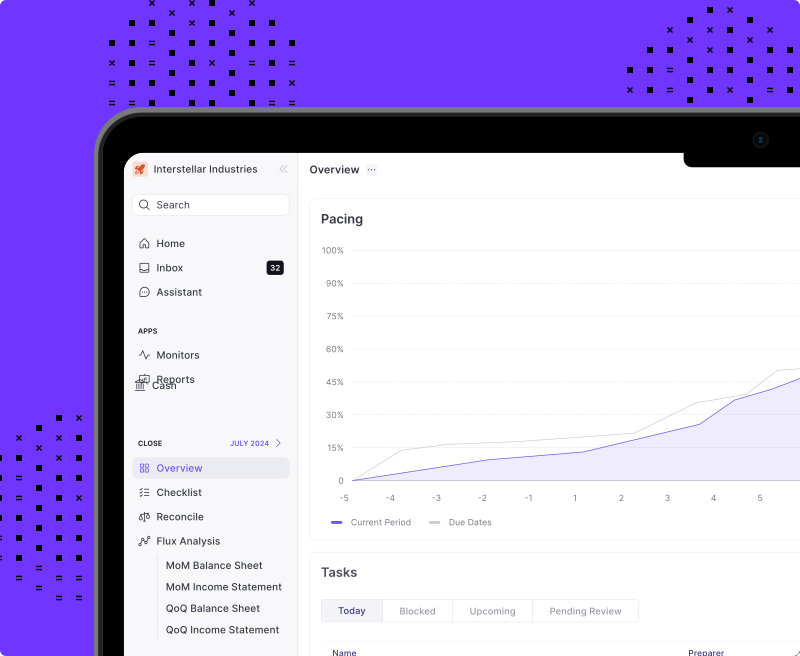
Numeric Features
- A purpose-built close checklist with task dependencies, automated email digests, and a full audit trail
- AI-driven flux analysis with transaction-level drill-downs to pinpoint drivers of change, not just flag that something moved
- Account reconciliations with real-time trial balance pulls and automated alerts when a reconciled account changes, identifying the specific transaction that caused it
- Transaction Monitors: a real-time alerting framework that catches errors and policy violations throughout the month, before they compound into close-week problems. Build monitoring rules in plain language using the AI Monitor Builder
- Cash Management: live bank feeds, AI-assisted match rule building, 90%+ auto-match rate, and batch journal entry posting directly to NetSuite. Validated with Brex across 100+ bank accounts
- AI Insights: ask natural language questions across your Checklist, Reconciliation, and Flux modules and get answers surfaced in context
- Technical Accounting AI trained on accounting standards, Big 4 publications, and SEC filings, with a policy generation bot for drafting GAAP-compliant policies fast
- Numeric MCP: 17 pre-built skills including flux drafting, accruals, journal entry generation and posting, department miscode scanning, and audit evidence packaging. Trigger close workflows and surface GL data directly from the AI tools your team already uses
Watch Numeric's Co-founder and CPO Anthony Alvernaz walk through how accounting teams are using MCP to orchestrate their close. Read more about Numeric's MCP use cases.
Numeric Costs
Numeric offers three plans designed around where your team is in the close process.
- Starter: Focused on close management. Best for teams that want to organize the close, improve visibility, and establish a consistent process.
- Growth: Adds account reconciliation, flux analysis, and reporting. Built for teams looking to consolidate close work and reduce manual effort through integrations and automation.
- Enterprise: Includes Transaction Monitors and advanced features for teams running a proactive, continuous close.
Numeric Setup Process
Implementation is one of the things Numeric gets consistent credit for. The process is straightforward:
- Sign up for the appropriate plan
- Import your existing close checklist
- The Numeric team integrates your GL and configures settings for reconciliations and flux analysis
- Get started
Teams are able to close with Numeric in the first month they sign up.
Numeric Reviews
- G2: 4.8/5 stars
Customers consistently highlight the reduction in close time, real-time visibility across the team, and the AI features as genuinely useful rather than bolted on. Users also point to the depth of ERP integration and how little time it takes to get the team up and running.
Numeric Pros and Cons
Pros
- Frees your team to lead the close instead of just executing it
- Deep ERP integrations with transaction-level detail
- Fast implementation: teams are closing with Numeric in month one
Cons
- Transaction-level features are deepest on NetSuite. Teams on other ERPs get strong close management and reconciliation, but should ask about ERP-specific capabilities on a demo
- Newer to the market than legacy alternatives
How to Get Started with Numeric
To get started, schedule a demo with the Numeric team.
Onboard easily and close faster with Numeric
.png)

2. BlackLine: Best FloQast Competitor for Mature Companies with Dedicated Admins
BlackLine tends to be a good fit for large organizations that need powerful automations and have the resources to support them. As the most mature player in the category, BlackLine works primarily with large, public companies and has been in business the longest. Teams that adopt BlackLine typically need a full-time administrator to implement and maintain the platform.
For a detailed breakdown of how the two compare, see our FloQast vs. BlackLine guide.
BlackLine Features
- Transaction matching and account reconciliations built for high-volume processing
- Compliance through control workflows and audit trail management
- Intercompany accounting and financial statement generation
- Smart close in SAP and Consolidation Integrity Manager
- Verity AI, including the Vera agent for agentic automation across matching, reconciliation, and anomaly detection
- Studio360, BlackLine's unified platform built on a single data layer
BlackLine Costs
BlackLine does not publish pricing on their website, and there are no reliable figures on third-party sources either. Based on customer reviews, BlackLine is more expensive than FloQast and most alternatives. Costs typically include a combination of implementation fees, configuration fees, integration fees, and the annual subscription, among others. BlackLine does not offer a free trial.
BlackLine Setup Process
BlackLine has one of the longer onboarding processes among FloQast competitors. Teams now average around six months to get fully up and running, which reflects the depth of customization involved. The customer success team provides support throughout, though implementation, integration, and data migration may carry separate fees.
The setup process involves:
- Set up task management for the monthly financial close
- Integration with your ERP
- Connect BlackLine with supporting workpapers
- Configure workflows using available or custom templates
BlackLine Reviews
- G2: 4.5/5 stars
Satisfied BlackLine customers highlight the tracking capabilities, the matching system, the elimination of manual tasks, centralized reporting, and the availability of the support team. Some customers report difficulties with implementation, the ongoing need for a dedicated administrator, and ERP syncs that can take up to a full day to reflect changes in the platform.
BlackLine Pros and Cons
Pros
- Powerful automations, particularly for BlackLine account reconciliation
- Integrations with a wide range of ERPs
- Comprehensive feature set for large enterprises
Cons
- Involved implementation, ongoing use, and maintenance
- Requires a dedicated full-time administrator
- Costly pricing model with multiple one-time and recurring fees
- ERP syncs can lag by up to a full day, meaning data in the platform may not reflect real-time changes
- New hires require structured onboarding to get up to speed, which adds ongoing overhead that's easy to underestimate at the point of purchase
How to Get Started with BlackLine
To get started with BlackLine, prospective customers can schedule a demo via the company website.

3. Adra by Trintech: Best FloQast Competitor for Native Workday Integration
Adra by Trintech is a solid mid-market option for teams that want close management automation without the complexity of an enterprise deployment. It's particularly well-suited for organizations running Workday, given the depth of the native integration. Adra is one of two products in Trintech's portfolio: Adra serves mid-sized companies looking for faster implementation, while Cadency targets large global enterprises needing full-scale consolidation.
Adra by Trintech Features
- Account reconciliations and transaction matching
- Close task management and journal entry workflows
- Intercompany accounting, audit trail, and compliance reporting
- Workday, Microsoft 365, and major ERP integrations, including native embedding in Microsoft 365
- Beacon Gen AI Assistant for close workflows, including AI agents for variance analysis, exception handling, and accrual creation
- Planful integration for end-to-end close, consolidation, reporting, and planning workflows
Adra by Trintech Costs
Adra does not publish pricing on their website. Pricing is quote-based and varies by company size and feature set. Prospective customers will need to contact Trintech directly for a quote.
Adra by Trintech Setup Process
Adra does not publish a step-by-step onboarding process. The customer success team leads implementation, and the timeline varies depending on which modules are in scope. Adra is generally positioned as faster to implement than Cadency or enterprise-tier alternatives like BlackLine.
Adra by Trintech Reviews
- G2: 4.5/5 stars
Customers highlight ease of use, time savings during close, task management capabilities, reconciliation accuracy, and responsive support. Common complaints include slow performance with large datasets, limited reporting customization, and configuration changes that require Trintech support involvement rather than being self-serve, which can create delays during close.
Adra by Trintech Pros and Cons
Pros
- Strong integrations across major ERPs and GL systems
- Partnerships with accounting firms for implementation support
- Native Workday integration and Microsoft 365 embedding
Cons
- Performance can slow under large data loads
- Reporting customization is limited out of the box
- Configuration changes typically require vendor involvement, adding lead time during close
How to Get Started with Adra by Trintech
To get started with Adra, prospective customers can request a demo via the Trintech website.

4.OneStream: Best FloQast Competitor for Integration with FP&A Budgeting Tools
OneStream is an Enterprise Performance Management platform that bundles financial close, consolidation, reporting, and FP&A planning into a single system. For organizations where the close is just one piece of a larger financial planning and reporting operation, OneStream removes the need to move data between separate tools. It's a significant investment in both cost and implementation time, and it's built for enterprise teams with the resources to match.
In April 2026, OneStream was acquired by Hg Capital in a $6.4 billion transaction and delisted from NASDAQ. For teams evaluating a multi-year platform commitment, it's worth asking questions about pricing trajectory and roadmap direction as part of the due diligence process.
OneStream Features
- Financial close and consolidation across multiple entities
- Account reconciliations and transaction matching
- Compliance, ESG, and tax reporting
- Workforce, fixed term, and duration-based contract planning
- Budgeting, profitability analysis, and management reporting
- Narrative Reporting for automated financial narrative creation, assembly, and approval
- SensibleAI suite, including SensibleAI Forecast, SensibleAI Agents for autonomous multi-step planning tasks, and Operational Data Chat
- FedRAMP High certification, the only enterprise finance platform with this designation
OneStream Costs
OneStream does not publish pricing on their website. Based on customer reviews and third-party sources, it is one of the more expensive options in this category. OneStream uses user-based pricing, meaning teams get access to the full platform for a single per-user price rather than paying per module. Enterprise deployments typically require a $300K+ implementation investment and a 9 to 12 month timeline to go live. No free trial is available.
OneStream Setup Process
OneStream does not publish a step-by-step onboarding process. Multiple paid training options are available through the OneStream University program. Given the breadth of the platform, implementation is typically led by a certified OneStream partner and scoped based on which modules are being deployed.
OneStream Reviews
- G2: 4.7/5 stars
Customers highlight the unified data model, strong automation capabilities, Microsoft integration, and the ability to handle complex multi-entity consolidations in one place. Common complaints include a steep learning curve for new users, heavy reliance on VB coding for configuration work, reporting capabilities that feel underdeveloped relative to the platform's depth, and performance issues with large data loads.
OneStream Pros and Cons
Pros
- Unified platform for close, consolidation, planning, and reporting
- Strong FP&A breadth eliminates the need for separate budgeting and forecasting tools
- User-based pricing gives teams access to the full platform without per-module fees
Cons
- One of the most expensive and complex implementations on this list, typically 9 to 12 months and $300K+
- Configuration requires VB coding knowledge, limiting self-service for non-technical teams
- Reporting customization is less flexible than the rest of the platform suggests
- Went private in April 2026, introducing uncertainty for teams making long-term platform decisions
How to Get Started with OneStream
To get started with OneStream, prospective customers can sign up for a demo via the OneStream website.

5. Workiva: Best FloQast Competitor for Companies Looking to Consolidate Their Work in Workiva
Workiva is a FloQast alternative that brings together a range of finance and accounting tools under one roof, primarily used by public companies. It's a good fit for businesses already reporting within Workiva that are now looking for close management software that integrates within the same platform. Where the other alternatives on this list are primarily close management tools, Workiva's core strength is in the reporting and compliance workflows that follow the close, particularly SEC filings and SOX controls.
Workiva Features
- Multi-source data centralization with live data linking across all connected documents
- Month-end close task management
- Financial statement automation
- Risk management and SOX compliance tools
- ESG, annual, and interim reporting
- 70+ connectors including Oracle, Salesforce, Workday, BlackLine, NetSuite, and Snowflake
- Workiva AI Intelligent Companion, bundled into the platform with a pre-built prompt library
- Peer disclosure benchmarking with AI comparison against current disclosures
- Dynamic tables, resolving the long-standing issue of line item order getting disrupted during roll-forwards
Workiva Costs
Workiva does not publish pricing on their website. Based on third-party procurement data, Workiva represents a significant annual investment with well-documented pricing pressure at renewal. No free trial is available.
Workiva Setup Process
Workiva does not outline the implementation process on their website. Setup varies based on which subset of features a team is deploying and the size of the organization. Reviewers consistently flag a steep learning curve after go-live, meaning teams should plan for meaningful ramp time before the platform is fully productive.
Workiva Reviews
- G2: 4.5/5 stars across 2,149 reviews
Customers highlight real-time collaboration, live data linking across documents, a strong audit trail, and responsive customer support. Common complaints include slow performance with large datasets, limited functionality compared to Excel for complex modeling, manual effort still required for some roll-forward workflows, and finicky formatting for PDF and EDGAR outputs.
Workiva Pros and Cons
Pros
- Live data linking across all connected reporting documents reduces manual copy-paste across filings
- Strong SEC and SOX reporting depth
- Real-time collaboration and audit trail
Cons
- Performance lags with large datasets
- Not a substitute for Excel for complex modeling or analysis
- Some roll-forward workflows still require manual effort
- Renewal pricing pressure is well-documented, with standard annual uplifts unless a multi-year agreement is in place
How to Get Started with Workiva
To get started with Workiva, prospective customers can schedule a demo through the company website.
Choosing the Best FloQast Alternative for Your Team
Most FloQast alternatives fall into one of two camps: enterprise platforms built for large, complex organizations with dedicated admins and long implementation timelines (BlackLine, OneStream, Workiva), or mid-market tools with a narrower use case (Adra). Each has a clear profile it fits well.
For teams that don't fit neatly into any of those boxes — mid-market accounting teams that want transaction-level depth, built-in AI, and a platform they can actually be live on in month one — Numeric is the strongest fit. It's the only tool on this list purpose-built for the modern mid-market team that wants the depth of an enterprise platform without the implementation overhead to match.
The best way to sift through the options after reading this breakdown is to select a few to demo, come prepared with your specific questions, and evaluate the impact each tool will actually have on how your team closes.
To see Numeric in action, schedule a demo with the team.
Frequently Asked Questions
Related Content
.png)
Numeric vs. Maxima: Which AI Close Platform Fits Your Team?
Numeric and Maxima both automate close work. Compare how each handles reconciliations and cash matching, who owns the rules, and when each one fits.
.png)
7 NetSuite Reporting Tools, and When to Just Replace NetSuite
Compare 7 NetSuite reporting tools by use case and cost, and learn when replacing NetSuite solves reporting problems at the source.
.png)
What Is Multidimensional Accounting? Benefits, Examples, and 3 Steps to Set It Up
Learn how multidimensional accounting tags transactions by department, product, and customer, with examples and 3 steps to set it up.