FloQast vs. BlackLine vs. Numeric

.png)
Numeric, FloQast, and BlackLine are the three main players in the financial close software market. If you're reading this, there's a decent chance you're actively weighing them against each other and trying to determine which is best.
Here's the thing: there's no universal "best" option for all companies.
The platform that works well for a 500-person public company with a robust accounting operation might be completely wrong for a small Series A startup with just a few accountants trying to close the books in a timely fashion.
This post cuts through the noise. We'll walk you through a side-by-side feature comparison, break down implementation timelines, and give you a clear "when to choose each" framework so you can figure out which tool is actually best for what you need.
Key Takeaways
- Numeric is the strongest fit for high-growth teams that want transaction-level depth, built-in AI, and a seamless implementation. The platform connects directly to your ERP and replaces spreadsheet-based workflows rather than organizing them.
- FloQast is a good fit for teams that want a structured close checklist and are comfortable keeping their reconciliations in Excel or Google Sheets. It's well-established and particularly popular in the mid-market.
- BlackLine is best suited for large enterprises with dedicated admin staff, complex compliance needs, and the resources for a lengthy implementation.
At-a-Glance Comparison Table
Before diving into the details, here's a high-level snapshot of how the three platforms stack up across the categories that matter most to Controllers and accounting leaders.
| Category | Numeric | BlackLine | FloQast |
|---|---|---|---|
| Best Fit | High-growth tech companies (Series B–pre-IPO), teams of 3–15 | Large enterprises and public companies with dedicated admin | Mid-market teams comfortable in Excel/Sheets |
| G2 Rating | 4.8 / 5 | 4.5 / 5 | 4.6 / 5 |
| Avg. Implementation | Days to weeks | ~4.5–5 months | ~1.3–1.7 months |
| ERP Integrations | NetSuite, Xero, QuickBooks, Sage Intacct, Workday | NetSuite, SAP, Oracle, Workday, and dozens more | NetSuite, QuickBooks, Sage Intacct, SAP, Microsoft Dynamics, Workday, Infor |
| Close Checklist | Purpose-built with dependencies, tagging, auto-rollforward, Slack integration, JE linking | Hierarchical task lists, cross-product dependencies, certification workflows | Core strength — templates, dependencies, calendar view, automated reminders |
| Reconciliation | Real-time ERP drill-down to exact transactions causing discrepancies | Configurable workflows, auto-certification, Account Analysis for high-volume accounts | Organizes and tracks recs; work stays in Excel/Sheets |
| Flux Analysis | AI drafts explanations from GL data; flexible grouping by department, vendor, entity | Automated flux analysis tied to compliance framework | Flexible comparisons with customizable thresholds |
| AI | Embedded throughout: AI Flux Writer, AI Monitor Builder, AI Report Builder, Technical Accounting AI, AI Insights | Verity AI | Transform AI |
| Cash Management | 90%+ auto-match; batch JE posting to ERP; bank integrations | Rules-driven matching engine | Basic matching |
| Reporting | AI Report Builder; transaction-level drill-down; real-time ERP data | Built-in report writer; pre-consolidation group-level statements | New Report Builder with pivot interface and drill-through |
| Proactive Monitoring | Real-time transaction monitors via AI Monitor Builder | Compliance module with cross-product control linkage | Compliance Management and light monitoring tools |
How Each Platform Works
Each of these platforms takes a fundamentally different approach to the financial close. Understanding that philosophy — not just the feature list — is the fastest way to figure out which one fits how your team actually operates.
FloQast
FloQast's approach centers around the close checklist. Teams connect their ERP, map accounts, and manage the close through a task-based view. Reconciliations stay largely in Excel or Google Sheets, as FloQast organizes and tracks them rather than replacing them. This works well for teams that already have established spreadsheet workflows and want more structure without overhauling their process.
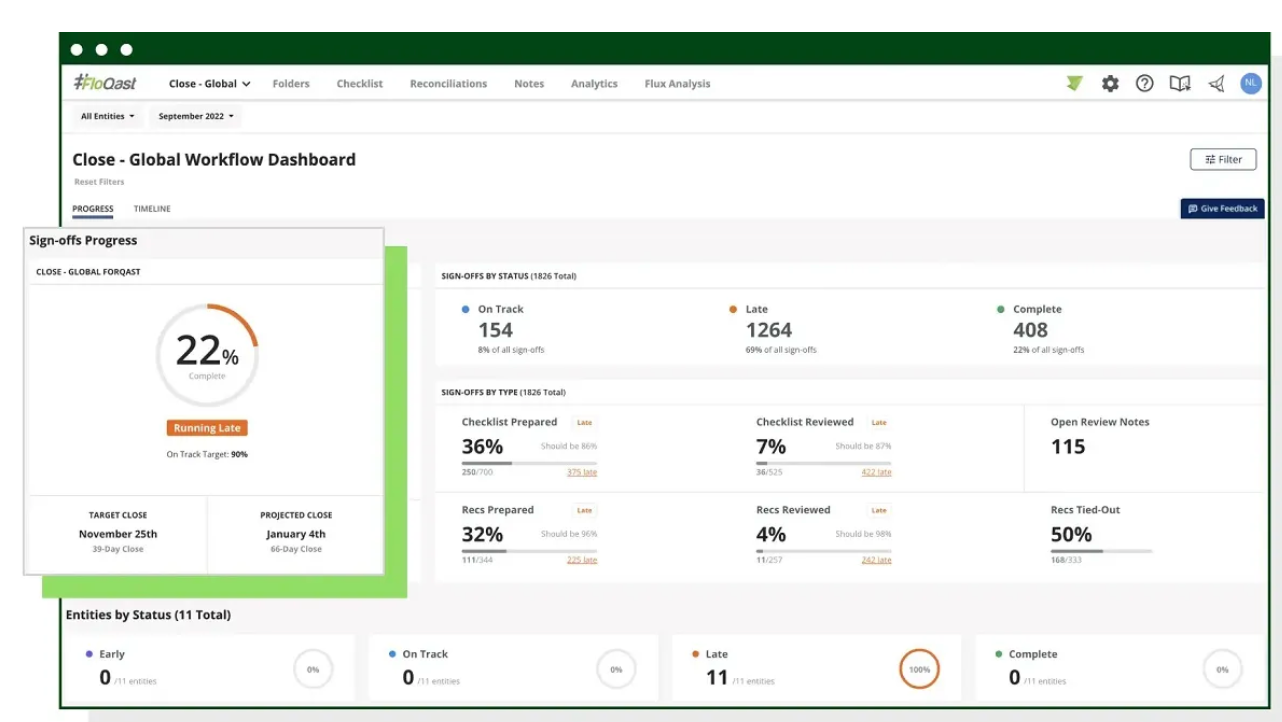
FloQast has built a strong reputation in the mid-market, with over 3,000 global accounting teams using the platform. The company was founded by accountants, and that heritage shows in the product's focus on close task management and collaboration.
BlackLine
BlackLine is a comprehensive platform built for large, complex organizations. Implementation is resource-intensive and typically requires a dedicated admin. Once live, it provides automation, intercompany accounting management, and enterprise-grade compliance controls.
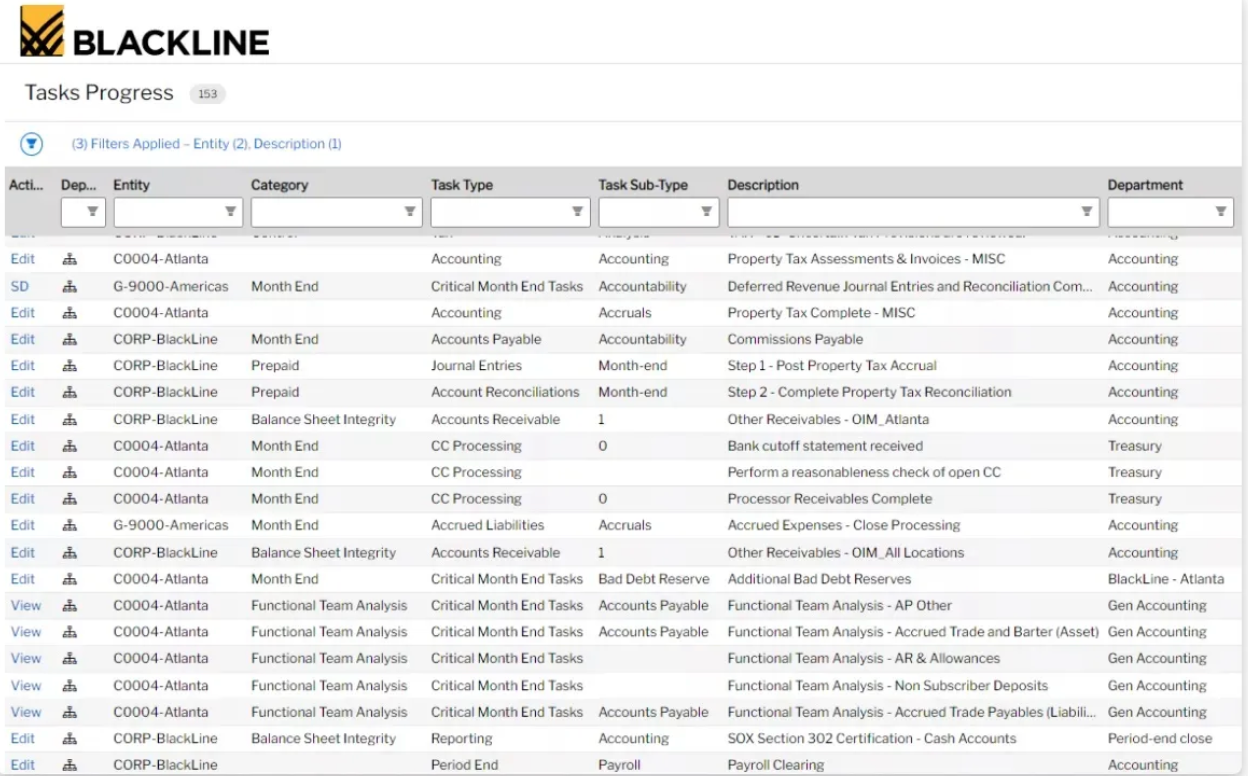
The platform is feature-rich, covering account reconciliation, transaction matching, variance analysis, and more. However, that breadth comes with a steeper learning curve.
BlackLine serves over 4,300 customers and is particularly well-established among public companies and Fortune 500 organizations that need robust, multi-entity compliance frameworks.
Numeric
Numeric connects directly to your ERP at the transaction level, pulling live data into reconciliations, flux analysis, and close management.
The platform is structured around three core pillars:
- Close Management (including the close checklist and account reconciliation),
- Cash Management (including cash matching and JE automation)
- An Analytics Suite (including flux analysis, reporting, and transaction monitors).
And unlike many other accounting software platforms, AI is actually embedded throughout Numeric’s platform, and not added after the fact as an extra module.
This means the AI has full context on your accounting data, your close timeline, and your team's workflows. Numeric's MCP makes that context portable — it lets you bring your Numeric data and close workflows into the AI tools your team already uses, so your AI agents are informed by your actual financial data.That context is what allows it to draft variance explanations that actually reference the right transactions, flag anomalies based on your specific policies, and surface process improvements based on how your team has historically closed.
Watch Numeric's Co-founder and CPO Anthony Alvernaz walk through how accounting teams are using MCP to orchestrate their close.
Teams at companies like OpenAI, Notion, Asana, and Brex use Numeric to close faster and surface insights their ERP alone can't deliver.
FloQast vs. BlackLine vs. Numeric: Feature-by-Feature Comparison
Now let's get specific. Below, we break down how Numeric, FloQast, and BlackLine compare across the capabilities that Controllers and accounting managers care about most.
Close Checklist and Task Management
All three platforms offer close task management, so the question is really about depth and design philosophy.
Numeric
Numeric's Close Checklist is purpose-built for accounting — with built-in review workflows, entity-level breakouts, and real-time status visibility across the team. Key features include:
- Built-in review workflows with preparer and reviewer roles
- Entity-level breakouts that tie tasks to specific business entities
- Real-time status visibility across the team, with the ability to comment, assign, and connect context to other business units
One G2 reviewer noted that using Numeric shortened their close from nine to six days and improved collaboration by making task dependencies visible.
BlackLine
BlackLine's task management module is built for complex, multi-entity organizations and includes:
- Real-time dashboards and advanced reporting for complete visibility into task progress
- Dependent task tracking, so teams can mark tasks as reliant on others — useful for sequential close processes
- Certification workflows that allow reviewers to formally sign off on completed items
- Collaboration tools for monitoring, tracking, and certifying financial and accounting tasks
For teams managing complex close processes with many sequential steps and formal sign-off requirements, BlackLine's task management offers the structure and governance to match.
FloQast
FloQast focuses most heavily here — it's the core of the product and has dedicated features including:
- FloQast Close lets teams build close checklists using predefined or customized templates that can be shared across the team.
- FloQast Analyze gives all stakeholders visibility into the financial close process, including progress against deadlines for checklist items and reconciliations.
- FloQast ReMind allows teams to use available templates or create their own to automate reminders across the close workflow.
The platform also generates CFO summaries of task status, giving leadership a quick read on where the close stands without digging into the details.
Compare BlackLine with Numeric's reconciliation product
.png)
Account Reconciliation
Account reconciliation capabilities is one area where the three platforms diverge sharply.
Numeric
Numeric pulls trial balance data directly from the ERP and sub-ledgers, showing in real time which specific transactions are causing any discrepancy. Teams upload their external evidence and sub-ledgers into Numeric, and the platform shows where accounts don't tie out and identifies the exact transactions behind the gap.
Key features include:
- Real-time ERP integration that pulls trial balance data and transaction-level detail directly from the GL — no manual uploads or batch exports required
- Transaction-level drill-down that shows the exact GL transactions causing an account to fall out of balance
- Proactive change alerts that notify teams when new transactions hit an already-reconciled account, pointing directly to the specific transaction in question
- Cloud storage integration (Google Drive, SharePoint, Box) that pulls in subledger workpapers and lets teams edit them directly within the platform
- Auto-submission for accounts that tie out and remain under a set materiality threshold, so teams don't have to manually sign off on predictable, low-risk accounts
This is a fundamentally different approach compared to the other two platforms. Rather than organizing spreadsheet-based recs, Numeric surfaces the precise source of issues so teams can resolve them faster.
That said, it's worth noting that Numeric does not auto-reconcile end-to-end; the value is in pinpointing exactly where and why things don't tie out, which is what typically takes up the most time.
BlackLine
BlackLine offers more automation in this area, with capabilities including:
- Standardized, customizable templates for reconciliation workflows
- Risk-based routing that directs accounts based on complexity
- Auto-certifications for accounts that fall below pre-set thresholds
- Account Analysis feature for automating the examination of high-volume, high-risk accounts at the transaction level
For large organizations reconciling thousands of accounts, this depth is meaningful, though it comes with more complex configuration and ongoing admin.
FloQast
FloQast Reconciliation Management helps teams organize and track their reconciliation process, with features including:
- A centralized view of each account's reconciliation status
- Automatic notifications to flag items for review
- Detection of unexpected out-of-balance conditions
- Ability to select the reconciliation method most appropriate for each account type
That said, the actual reconciliation work still happens largely in Excel or Google Sheets. This means FloQast organizes and tracks recs rather than replacing the underlying spreadsheet workflow.
Variance and Flux Analysis
Flux analysis is one of the most time-consuming parts of the close, and is another area where the gap between these three platforms is most visible.
Numeric
Numeric's Flux Analysis stands apart for its AI-powered automation:
- AI flux writer that drafts variance explanations automatically — it combs through every transaction in the GL, analyzes historical trends and transaction-level data, and surfaces the core drivers of variance for teams to simply edit and approve
- Custom explanation templates that let teams specify which fields to reference and the desired layout for each account, so AI-generated explanations match your team's format and style
- Flexible grouping and dimensionality, including group accounts by account code, department, specific vendors, locations, or custom categories, then run flux analysis on any of those groupings to isolate where explanations are needed
- Materiality thresholds applied at the account or report level to focus attention on significant changes and filter out noise
- Account trendlines and prior-period explanations displayed inline, so teams can quickly understand shifts in financials and inform current-period explanations without extra clicks
- Built-in report builder that lets teams tee up reports mirroring their business metrics (like grouping OpEx or all revenue accounts) and then run flux analysis directly on those reports
One G2 reviewer specifically called out Numeric's variance analysis as a reason their team switched from FloQast, citing the ability to create reports at any level — including vendors and customers — saving time previously spent building manual reports in NetSuite.
BlackLine
BlackLine's variance analysis module automates the calculation and identification of fluctuations in balances and activities. Key aspects include:
- Automated balance fluctuation analysis across both balance sheet and income statement accounts over configurable periods
- Continuous monitoring for risk, ensuring timely execution of management review controls
- Integration with the broader compliance framework — variance results tie into BlackLine's reconciliation, task management, and compliance modules, so flagged variances can be linked directly to related control activities
- Pre-consolidation, group-level analysis with end-to-end traceability for organizations managing multiple entities
- Automated content generation that can draft narratives from financial data
This works well for organizations that need variance monitoring as part of a larger controls environment, particularly those managing the close across many entities and jurisdictions.
FloQast
FloQast Variance Analysis automates the data collection and sign-off process for flux and budget variance analysis. Key capabilities include:
- Flexible comparison periods, including month-over-month, quarter-over-quarter, and year-over-year comparisons
- Customizable thresholds set as a percentage or fixed amount to focus attention on material changes
- Customizable account groupings with the ability to write explanations at both the individual account and group level
- Assignment workflows that let Controllers assign variance explanations to specific team members and track sign-off status
That said, some reviewers have noted that the flux analysis has historically lacked dimensionality. For example, multiple customer reviews have noted there’s a limited ability to break out more granular views
AI Capabilities
This is one of the clearest differentiators across the three platforms, as FloQast and BlackLine have more limited native AI capabilities.
Numeric
Numeric has AI built throughout the platform, with features including:
- AI flux writer drafts variance explanations by analyzing every transaction in the GL, comparing to historical trends, and surfacing core drivers of variance. Teams set custom templates specifying fields and layout, then review and approve with a single click
- AI Monitor Builder creates proactive transaction alerts using natural language. Teams describe the condition they want to monitor (e.g., "flag any JE posted to cash over $50K") and Numeric builds the rule
- AI Report Builder generates custom reports from natural language requests, turning prompts into pivot-ready reports pulling real-time data from the ERP, with no NetSuite admin or saved searches required
- AI Insights (Numeric Intelligence) analyzes close performance data to identify bottlenecks, redistribute workload, and continuously optimize the close process
AI-native companies like Anthropic even trust Numeric, and used AI Insights to optimize their close timeline and workload distribution. This is because AI isn’t a bolt-on feature, but is deeply embedded within the platform.
BlackLine
BlackLine has automation built into its reconciliation and transaction matching modules — including rule-based auto-certifications and automated matching using both rules-based processes and some AI functionality. Key features include:
- Intelligent insights and proactive analysis that transforms financial data into forward-looking guidance
- AI-powered matching and data capture enhances BlackLine's core automation with an additional layer of intelligence
- Automated content generation and summarization drafts narratives and distills financial data into actionable outputs
The platform does not have AI embedded broadly across its feature set.
FloQast
FloQast has begun introducing AI-assisted features, including AI Agents for automating specific close tasks. These are relatively recent additions and represent early steps toward embedding AI into the close workflow.
Key features include:
- AI Detections provides continuous GL monitoring that flags errors ahead of the close using custom or AI-suggested rules
- AI Testing offers annotation of supporting documentation and first-pass conclusions for internal audits
The core product, however, remains centered on task management and checklist-driven collaboration.
Cash Management
For teams with high transaction volumes, cash reconciliation can be one of the most labor-intensive parts of the close. The three platforms handle it very differently.
Numeric
Numeric's Cash Management is designed as an end-to-end workflow and includes these features:
- AI-powered rules engine with 90%+ auto-match rates, which is roughly 3x the industry standard. The engine handles all match types (1-to-1, 1-to-many, many-to-many) without complex Excel formulas
- Flexible rule building on any field to adjust rules in a matter of minutes, not hours
- Real-time GL sync that pulls live transaction data from NetSuite for continuous reconciliation, not just month-end batch processing
- One-click batch posting of cash-related journal entries directly to NetSuite, so you can draft and batch-post hundreds of JEs in a single click while keeping the entire workflow in one place
- Bank integrations with thousands of banks worldwide via automated daily bank feeds, eliminating manual CSV downloads
- Real-time cash position visibility across all accounts, so teams can see their cash picture at any point — not just after month-end reconciliation
For example, Brex uses Numeric to automate 95%+ of cash recs across 100+ accounts, which completely eliminated an offshore team of five accountants who were previously matching transactions daily.
BlackLine
BlackLine's transaction matching feature is more robust than FloQast’s, and includes:
- Rules-driven matching engine that consolidates and automatically matches millions of transactions from different systems without manual effort
- Flexible matching rules that allow teams define how transactions should be matched
- Exception-based workflows that surface unmatched transactions so teams focus only on items requiring attention
- Continuous data loading, with GL and supporting system data automatically loading throughout the month, enabling ongoing reconciliation rather than month-end-only processing
However, the matching-to-posting workflow involves coordinating across multiple modules rather than operating as a single end-to-end flow, which can add configuration complexity for teams that want a unified cash workflow.
FloQast
FloQast offers basic matching capabilities for bank reconciliation, with features including:
- Automated transaction matching for bank reconciliation scenarios
- Integration with ERP data for comparing GL entries against bank records
This works for straightforward bank reconciliation scenarios. For teams with high transaction volumes, complex matching needs (such as many-to-many or multi-currency), or a need to post journal entries from within the platform, cash management is not a primary strength of FloQast.
Reporting
The ability to build and customize reports — especially without relying on your ERP's native reporting — is increasingly a dealbreaker for Controllers evaluating close software.
Numeric
Numeric's Reporting module is built for teams that need flexible, detailed reports without ERP expertise:
- Custom report builder that builds reports mirroring how your team tracks performance, with filters, pivots, custom groupings, and calculated metric rows, all pulling real-time data from the ERP
- AI Report Builder that turns natural language prompts into reports instantly; just describe what you need and Numeric generates the report with no pivots, custom groupings, or NetSuite admin required
- Transaction-level drill-down on almost anything in the platform; simply click into any number and trace it down to the individual GL transactions behind it
- Reports at any level, ranging from from financial statement line items down to spend by specific vendors, revenue by customer, or expenses by location
- Real-time data, which keeps reports accurate because they pull live from the ERP, so they're always CFO-ready without manual refreshes
- FP&A collaboration, with included comment and edit access for FP&A teams, so the finance team can easily access the data they need for their reporting package
Numeric’s Reporting is a major differentiator for teams running NetSuite, where surfacing this kind of information natively often requires hours of work or a dedicated system administrator.
BlackLine
BlackLine provides a financial reporting analytics module with capabilities including:
- Pre-consolidation, group-level analysis with end-to-end traceability, which is useful for organizations that need to analyze results across many entities before consolidation
- Automatically generated financial statements at both entity and group levels, with the ability to drill down from financial statements to transactional details and commentary
- Built-in report writer that makes nearly every data point in BlackLine reportable, with both grid and visualization views and real-time data updates as reports are edited
- Pre-built report templates answering common questions like: What impact will potential adjustments have on financials? How many reconciliations are incomplete? Which fluctuations exceed materiality thresholds?
For large organizations that need enterprise-grade reporting across multiple entities and compliance frameworks, this is a meaningful capability. That said, some reviewers have noted limitations in customization for organizations with very specific reporting or search needs.
FloQast
FloQast's reporting capabilities have been a noted area for improvement historically, with G2 reviewers flagging restricted customization options. In September 2025, FloQast introduced a Report Builder that has key features including:
- A pivot-like interface for building dynamic, audit-ready reports
- Drill-through visibility to source transaction data
- The ability to export close data into analysis-ready formats for identifying opportunities to drive continuous improvement
FloQast Analyze also contributes to reporting by providing a single-page dashboard of close completion metrics, with filters by process, custom tags, checklist, and prepared items.
Proactive Monitoring
Most close management tools help you manage the close once it's underway. The question is whether your platform can also help you catch problems before the close even starts.
Numeric
Numeric's Transaction Monitors take a different approach entirely compared to FloQast and BlackLine:
- Real-time transaction alerting that flags errors and policy violations throughout the month, and not just when close is already underway. Transactions directly from the ERP populate in real time so teams can verify their monitors are working as expected
- AI Monitor Builder that lets teams create custom alerts using natural language
- Flexible conditions built on any field, including amount, account type, department, vendor, memo, and more.
- Support for monitors like large transaction flags, missing department coding, capitalization threshold checks, and duplicate transaction detection
- Pre-built monitor templates for common use cases like flagging untagged expenses, large round-number transactions, or entries posted to restricted accounts
- Integration with the close workflow, which monitors surface anomalies directly within the context of the close process, so teams can investigate and resolve them without switching tools
This shifts teams from reactive cleanup to proactive control, catching potential issues before they compound during the stressful close period. If your team has struggled with building saved searches in NetSuite, Numeric's monitor builder will feel far more intuitive.
BlackLine
BlackLine includes several modules oriented toward compliance and risk management:
- Compliance module that centralizes risk management and compliance tasks for efficient tracking, control testing, and real-time reporting, with role-based permissions and segregation of duties built in
- Linkage across products, including reconciliations, journal entries, and variance analysis can be linked to applicable controls, so when accounting work is certified it automatically becomes visible as compliance evidence
- Smart Close for scheduling and executing automated tasks, monitoring variances, and verifying outcomes within SAP environments specifically
- Intelligent insights and proactive analysis via Verity AI
- Issue management through an integrated reporting tool that gives all stakeholders visibility into findings, so there are no surprises at the end of the audit period
These are solid compliance and monitoring tools, particularly for structured control environments where compliance evidence needs to flow automatically between accounting work and audit documentation.
FloQast
FloQast offers monitoring capabilities focused on compliance and pre-close error detection:
- FloQast Compliance Management allows teams to capture financial controls during daily tasks, automate synchronization of the risk control matrix (RCM) to process narratives and flowcharts, and define and execute testing plans
- AI Detections (introduced 2025) continuously monitor GL transactions and flag errors ahead of the close, using either custom rules or AI-suggested rules
- AI Testing annotates supporting documentation with first-pass conclusions for internal audit workflows
This expands FloQast's monitoring capabilities beyond close-period compliance into more proactive error detection.
Implementation and Support
Features matter, but so does how quickly you can actually start using them — and what happens when you need help. Here's how the three platforms compare on getting started and staying supported.
Numeric
Numeric’s implementation takes days to weeks, with no dedicated admin or specialist required. G2 reviewers consistently highlight the ease of setup, with one noting the initial setup was "incredibly easy and efficient." Numeric even received G2's awards for Fastest Implementation (Mid-Market).
BlackLine
Implementation with BlackLine takes approximately 4.5–5 months on average, and typically requires dedicated admin staff both during and after setup. The longer timeline reflects the platform's depth and customization options. However, it does require a significant commitment, particularly for teams that need to show results quickly.
FloQast
FloQast’s implementation takes roughly 1.3–1.7 months on average. Implementation is supported by their customer service team and is generally considered smooth by reviewers. The relatively quick setup is one of the product's strengths, but taking up to two months to get things moving may be too long for some customers.
Customer Support
While all three tools are reliable, customer support still matters. You want to know you’ll get the help you need if you’re struggling to adopt a new feature or are running into technical glitches.
Numeric
Numeric’s customers have praised our team for having a highly responsive, hands-on support, with customer reviews frequently citing the following as strong points:
- Fast response times and personalized support
- Proactive about sharing important information like updates
- Knowledgeable support team that understands accounting workflows
- Team that takes feedback seriously and implements suggestions rapidly
BlackLine
BlackLine offers tiered support options based on your plan, along with professional services and training programs. Customer reviews frequently note the following:
- Knowledgeable support staff familiar with complex enterprise environments
- Comprehensive documentation and training resources
- Quick responses to customer questions
That said, some services come with additional fees, and reviewers occasionally note that the complexity of the product can make onboarding more involved.
FloQast
FloQast has built a reputation for great customer support, with customer reviews frequently citing the following as strong points:
- Quick responses to customer questions and inquiries
- Regular check-ins from dedicated success managers
- The self-service FloQademy learning portal
- Receptive to feature requests
Pricing
Let's get the uncomfortable part out of the way: all of these companies require a phone call to get pricing information. None publish full pricing on their websites, so you’ll need a sales conversation.
That said, Numeric’s Essentials plan starts at $30 per user per month. Other plans require custom quotes.
The most practical advice is to review which tools best meet your needs, and then demo your top contenders if you’re still unsure. Get specific pricing for your situation before committing.
When To Choose Each
So which one is right for you? Rather than making you piece it together from the sections above, here's a straightforward framework to help you self-select.
Choose Numeric if:
- You're a high-growth company (Series B through pre-IPO) with an accounting team of 3-15+.
- You want your senior accountants focused on leading the close rather than doing it.
- You're on NetSuite and want transaction-level visibility without becoming an ERP expert.
- You want AI built into your close process and capable of handling variance explanations, proactive monitoring, and reporting.
- You want to be live in days, not months, and don't want to hire a platform administrator.
- You're preparing for an audit or IPO and need a clean, centralized audit trail with everything in one place.
- You need cash management that actually works at volume.
Choose BlackLine if:
- You're a large public company (or are heading in that direction) with dedicated accounting operations and admin support.
- You need to manage intercompany accounting, complex multi-ERP environments, or enterprise compliance frameworks.
- You have the budget, timeline, and resources for a thorough implementation and ongoing admin.
Choose FloQast if:
- Your team lives in Excel and wants more structure without rebuilding workflows from scratch.
- You want a clean close checklist and basic reconciliation tracking without a big behavioral change.
- You want a faster, lighter implementation and are comfortable with more limited reporting depth and AI capabilities.
The Right Tool Depends on Where You Are
Numeric, FloQast, and BlackLine each earned their place in the accounting automation tool market for a reason. BlackLine has the depth and compliance infrastructure that large public companies need. FloQast gave mid-market teams a way to bring order to spreadsheet-driven closes without ripping everything out. Both are legitimate options for the right team.
But the financial close is changing. The teams that are closing fastest today aren't the ones with the biggest headcount or the most complex tooling — they're the ones with real-time visibility into their data, AI that works within the context of their accounting workflows, and platforms that don't require a six-month implementation just to get started.
That's the gap Numeric was built to fill. If you're a high-growth accounting team that wants transaction-level depth, embedded AI, and the ability to go live in days rather than months, Numeric is likely the best choice for you.
Ready to see it for yourself? Schedule a demo to get started.
Related Content
.png)
Numeric vs. Maxima: Which AI Close Platform Fits Your Team?
Numeric and Maxima both automate close work. Compare how each handles reconciliations and cash matching, who owns the rules, and when each one fits.
.png)
7 NetSuite Reporting Tools, and When to Just Replace NetSuite
Compare 7 NetSuite reporting tools by use case and cost, and learn when replacing NetSuite solves reporting problems at the source.
.png)
What Is Multidimensional Accounting? Benefits, Examples, and 3 Steps to Set It Up
Learn how multidimensional accounting tags transactions by department, product, and customer, with examples and 3 steps to set it up.