How Finance Teams Use the Numeric MCP for Close Analysis and Automation

.png)
Finance leaders keep getting asked whether they use AI. KPMG's 2026 global report, which polled 1,013 finance leaders across 20 countries, found active AI use in finance more than doubled since 2024, from 30% to 75%. CFO Connect's 2026 State of AI in Finance puts the number at 56%, while a General Atlantic poll cited in the same report found only 17% use it in core workflows and 45% are stuck in pilot mode.
Those surveys measure what people report doing. We wanted something different: objective usage data on what finance teams actually do when AI has direct access to their close — so we pulled usage data from the Numeric MCP, the connection that lets AI tools like Claude complete tasks directly inside a team's close checklist, reports, and general ledger.
Here's what we found: adoption is real, it happened fast, and it goes well beyond looking things up — teams are pulling transaction data, building custom reports, writing their own close automations, and running their whole close through Numeric's MCP.
Want the skills Anthony references? Explore the Numeric Claude Skills Library.
Most MCP usage reflects real analytical work
It's one thing to use LLMs, and MCPs at a basic level, to help you answer questions or sift through your source systems. It's another to use them for bespoke analytical asks. Teams using the Numeric MCP have AI assemble reports, pull key financials, and drill down to transaction-line detail.
Two thirds (66.7%) of adopters have AI build report data from scratch. 63.4% use the MCP to pull report data on demand, while 42.3% use it to drill into transaction-line detail.
Teams lean on the MCP for the routine close tasks too: four out of five adopters (79.7%) have AI check close task status, 77.2% use it to pull up the right report, while 49.6% use it to find the right account. Read alongside the analytical tools, a picture emerges: teams are orchestrating the close through the Numeric MCP and their AI interface (Claude, ChatGPT, Gemini, Cursor, etc.). The checklist, the reports, and the underlying transactions all live in Numeric, so the place where a team manages its close is also the same place where the analysis is done.
These percentages can feel abstract on their own, but when translated in natural language they start to make a lot more sense.
Take the 79.7% who check task status: that's someone typing "Count pending tasks for close status dashboard" into Claude. The build-report and find-account numbers refer to commands like "Find balance sheet balance for account 10006 as of June 2026" and "Inventory chart of accounts available from the general ledger." And drilling into transaction detail is someone asking to "Fetch transaction lines for flux analysis."
These are real queries finance teams asked the Numeric MCP through their AI interface; we pulled directly from usage logs and lightly redacted only to strip out anything that could identify a specific company — the command itself is untouched.
.png)
Beyond the averages
Not every request fits neatly into a percentage. Some of the most telling uses of the Numeric MCP show up less frequently, but they say more about where MCP adoption and finance is headed than any stat can.
One team had the MCP "drill the Benefits expense accounts to list and count carrier bill postings in May for a double-book check," catching a potential accounting error before it reached the close. Another asked it to "pull the consolidated 12-month monthly income statement to find the payment processing fee account and net sales, so I can compute the processing fee ratio each month and see what changed in June," building a custom financial metric on the fly. A third used it to "inventory the current close checklist and reconciliation tasks, grouped by segment/FSLI, to build a phased ownership-handoff plan for a new hire," compressing what's usually a multi-week knowledge transfer into a single request.
.png)
The frontier: early movers are already going further
The teams furthest along don't stop at analysis. They're using it to draft and submit the work itself. Here's what that looks like for three of them.
The checklist that builds itself
A venture backed productivity software company built a setup routine that runs at the start of each close: in a handful of sessions rather than spread through the month, they use the MCP to create roughly 50 tasks, assign well over 100 of them to the right preparers, and set due dates across dozens more. This scheduled agent via MCP also configures how often tasks recur going forward, effectively authoring its own checklist template.
The division of labor is the same as before: the mechanical, repetitive parts, creating tasks, assigning them, setting due dates, get handed to AI in bulk. A person still decides what belongs on the checklist and reviews it before the period starts.
Skills attached to the checklist
Benchling runs a 30-person accounting team, and before Numeric, their close lived in Google Sheets and Slack follow-ups. By their second month on the platform, the team was running the close in one place at 100% task completion. Then, their finance & accounting went a step further and started writing task-completion instructions as Claude Skills directly into the procedure tab of tasks in Numeric.
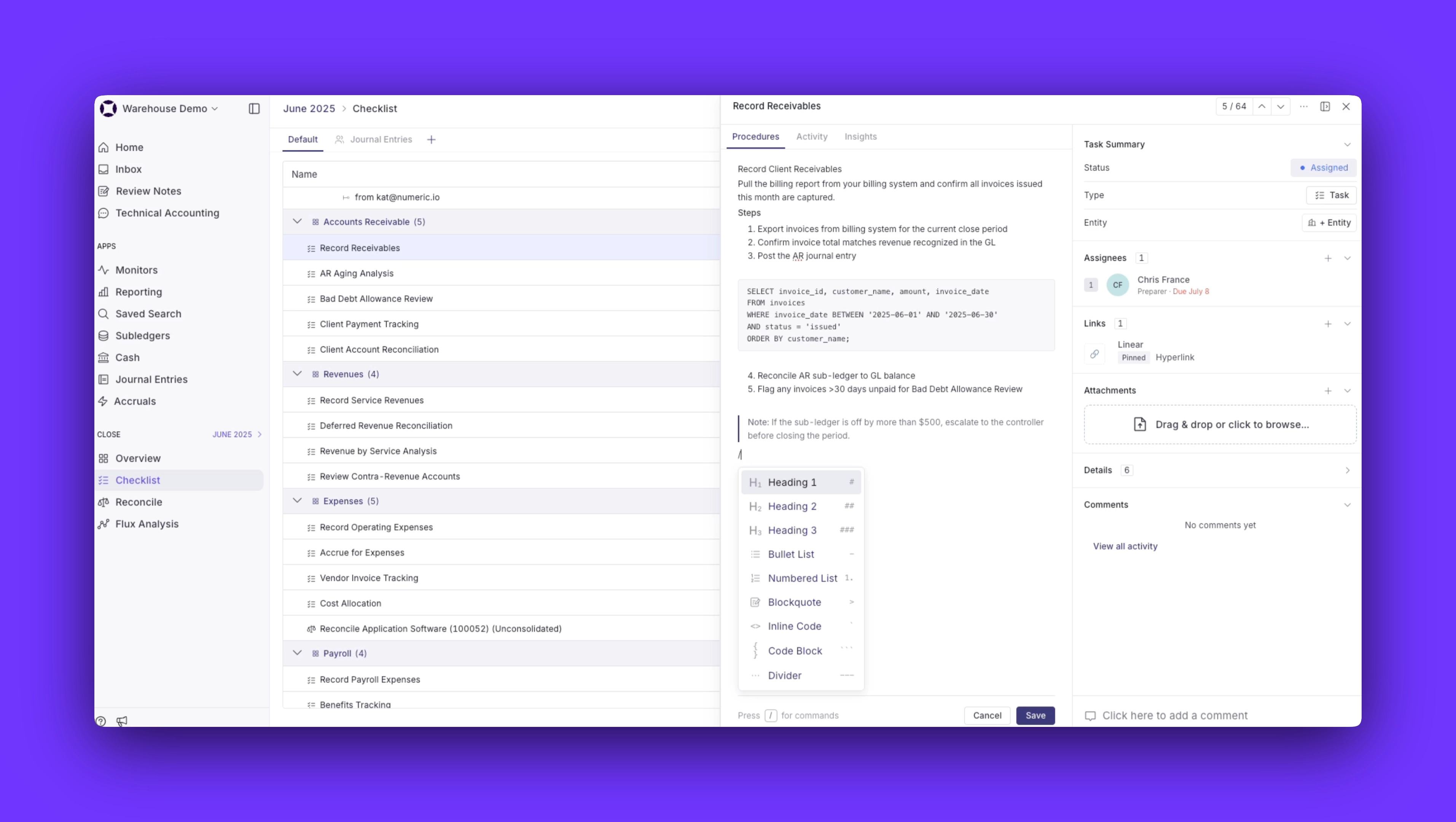
Now, when the MCP picks up a task, it reads the procedure, runs the Claude Skill itself, and works the task the way Benchling's team expects it done. Their procedures have gone from being documentation someone might read into instructions that agents can follow every time. Same close checklist, except every task now carries its own operating manual, and it works for humans and AI alike.
A cash workflow with the MCP at the core
Leslie Cunnane, Sr. Accountant at Jasper AI and runner-up in Numeric's first Finance Engineer Cup, built a Cash Intelligence Dashboard with the Numeric MCP at its center. The system connects Numeric, NetSuite, and Ramp, and generates AI flux commentary that explains why the cash position moved, down to the vendor and the spend category. Every figure is drillable to the transaction, with built-in variance thresholds and a sign-off and audit trail.
What makes the build notable is who built it. Cunnane is a practicing accountant, not an engineer, and there was no custom integration project or dev team behind the dashboard. The MCP handled the build, and her accounting knowledge shaped what the system checks and how it explains itself.
So, has the Numeric MCP already earned a place in the close?
Yes. And most of that usage is analytical work: building reports, pulling data, tracing transactions.
Part of the reason is the way close context is organized in the Numeric platform. By organizing the close into a structured, unified environment, Numeric provides AI agents with a clean, contextual dataset rather than forcing them to parse raw, disjointed ledger entries.
This structured context is optimized specifically for large language models. Consequently, when an AI agent is connected to both Numeric and an ERP MCP (such as NetSuite), it can automatically route close-related queries to Numeric's structured data instead of struggling with unstructured ERP records.
The best AI tools make your staff faster on the parts of the job that don't require judgment, like creating tasks, navigating workspaces, and formatting reports, and frees them to spend more time on the parts that do.
MCPs are taking real work off accountants' plates, and the teams in this piece are proof: they're already adopting these tools and learning what they can do. If you're interested in learning more about the Numeric MCP, schedule a demo here.
How we measured this
The figures in this piece cover the period since the Numeric MCP became available to customers, and every percentage describes the share of companies actively using it. To determine how finance teams actually engage with AI, we analyzed anonymized MCP usage logs. We measured this activity at the company level ensuring that multi-entity organizations didn't duplicate or skew our adoption metrics. Finally, we calculated the active adoption rate against our total customer base and used pattern-matching heuristics to classify user queries into analytical work versus basic usage.

Related Content
.png)
Expense Allocation in Accounting: From Shared Costs to True Margins (and Why the Usual Methods Break)
Learn what expense allocation involves, why it's essential for fully loaded P&Ls and true margins, and why spreadsheet models and aggregate JEs keep failing, plus how to fix the root cause.
.png)
Multi-Entity Consolidation: What It Involves, Why It Breaks, and How to Fix It
Learn what multi-entity consolidation involves, why it breaks as companies grow, and why both Excel and add-on tools share a structural flaw. A guide for controllers and VPs of finance.
.png)
How to Build an AI Audit Trail for Your Accounting Workflows
A practical guide to AI audit trails for accounting: what to capture, why SOX, PCAOB, and GAAS require traceability, and how to audit AI agents and skills, not just AI features bolted onto your close software.