Accounting Efficiency: 7 Strategies for a Faster Close

.png)
The books closed in nine business days last month. On paper, that's acceptable.
In reality, five of those days were spent chasing the same upstream data you chased the month before, rebuilding reconciliation workpapers from scratch, and fielding Slack messages asking, "Are the numbers ready yet?"
None of that is an accounting problem. The math works; the logic holds. It's a process problem. And it's costing your team days every single month.
This guide is about closing that gap — turning accounting from a reactive, spreadsheet-bound operation into one that closes faster, catches errors earlier, and frees up capacity for strategic work.
"You could build out any number of AI-native workflows in accounting, but if you haven't solved the fundamental — where are the data pipelines? What data is available? Is it accurate? Is there a single source of truth? — you won't be able to actually automate anything in earnest."
Anthony Alvernaz, Co-Founder & CPO, Numeric
Why Efficiency in Accounting Is Important
Efficiency in accounting is the optimization of how teams use time, technology, and workflows to close the books accurately and on schedule. But the definition doesn't stop at speed.
For Controllers and CFOs, efficiency is a risk management requirement and a lever. Fewer manual touchpoints mean fewer errors, and cleaner processes determine how quickly leadership can act on financial data.
The common framing is 'do more with less.' But the bigger shift is freeing your team from repetitive close work so they can spend time on variance analysis, system improvements, and the business decisions that leadership actually needs from accounting.
The Strategic Upside of an Efficient Close
Every hour your team spends re-keying data between systems or rebuilding a flux report is an hour lost. That is time not spent on variance analysis that informs a pricing decision, or on a reconciliation review that catches a revenue recognition issue before it reaches the auditors.
The downstream effects are concrete: faster time-to-insight for FP&A (who can't start their work until you close), increased confidence in the numbers the CFO presents to the board, and stronger partnerships with business units.
As Adam Heeger, Solutions Manager at Numeric, puts it: "You want to be in a position where you can get ahead of it — know what business is going to be selling, what costs are going to be incurred — so you have the headspace to write the technical accounting memo or put the right data systems in place."
The Real Impact of Inefficiency
The tangible costs are well-documented: overtime, burnout-driven turnover, and post-close adjustments that erode audit confidence. But the opportunity costs are often larger.
When a team is perpetually in "close mode," there is no capacity for system implementation or the business understanding that prevents surprises.
Heeger describes this as "a recursive flywheel effect — if you're only ever closing the books, you're not ever improving your systems, and you're not going out talking to business partners. So you're always just playing catch-up."
Why Now? Data Volume and Complexity
Growth amplifies every inefficiency. A 12-entity, three-currency SaaS company faces fundamentally different challenges than a single-entity business. It’s more work and more interdependencies and more places for errors to hide.
Expectations from boards and investors are tightening. The tolerance for a ten-day close or manually prepared board decks is shrinking, especially for companies on an IPO trajectory. In this environment, AI and automation are necessary infrastructure for teams expected to deliver both speed and accuracy.
After implementing Numeric Sruthi Lanka, CFO of Public.com, has seen the payoff firsthand from having continuous accounting operations:
"The beauty of having finance operations that are up to date to the day is that any forecasting based on that is extraordinarily flexible. We can factor in pretty much any single scenario without too much incremental work."
1. Diagnose Inefficiencies in Your Accounting Function
Before redesigning anything, you need an honest picture of where time and errors concentrate. Intuition is often misleading.
Spot the Symptoms of an Inefficient Close
The symptoms are usually visible before you measure anything: close dates that shift by two or three days each month, heavy reliance on one person who "knows where everything is," and chronic last-minute reconciliations.
Visibility issues compound the problem. If leadership cannot see close status by entity without pinging someone, or if cash position requires manual assembly, you are operating with structural blind spots. Ask your team: Where do you spend the most time? Where do you feel least confident? The answers are rarely the same.
Note: Numeric helps teams to keep real-time visibility of their close status, with pacing charts and dashboarding for key metrics. To analyze the close for areas of improvement, teams can use Numeric’s AI Insights to ask for feedback on what’s lagging in their close.
Map Workflows End-to-End
Run a process mapping exercise for your core cycles: order-to-cash, procure-to-pay, and record-to-report. This doesn't require expensive consulting — a whiteboard and two hours with your team will surface 80% of what you need.
Focus on upstream dependencies. When does RevOps deliver booking data? When does HR confirm final headcount? These handoff points are where delays originate, often remaining invisible to the accounting team until explicitly mapped.
Establish Baseline Metrics
Start collecting baselines:
- Average business days to close.
- Number of balance sheet accounts reconciled monthly.
- Count of manual journal entries.
- Audit adjustments per quarter.
Roughly 50% of finance teams take six or more business days to close — and only 18% have achieved the three-day close that the industry talks about as the gold standard. If you are closing in nine days, targeting five within six months is aggressive but achievable.
2. Design Efficient Accounting Workflows
Process redesign is the foundation. Automating a broken workflow just produces broken outputs faster.
Standardize and Document Core Processes
Build clear SOPs for every recurring workflow: AP processing, revenue recognition, fixed assets, and accruals.
Heeger is candid about the limits of generic templates: "I hate when I have to give clients templates because I don't know your business. I can give you a super generic template and it'll say 'book AR and make accruals' — those are things all accountants have to do. But every business is a little different."
Granular documentation, specific to your chart of accounts and data sources is the only way to make SOPs useful for training and delegation.
Define Ownership, RACI, and SLAs
Define a RACI (Responsible, Accountable, Consulted, Informed) for every major close process. Set realistic SLAs for upstream dependencies.
If expense reports are due by Business Day Three, document that date in your close calendar and communicate it. If Sales doesn't know their data submission deadline affects the close, they have no incentive to prioritize it.
Centralize Task Management
Relying on Excel checklists creates fragmentation. When a task is "done" in a spreadsheet, there is no timestamp, attachment, or approval record.
Purpose-built close management tools centralize tasks and dependencies. This is both an efficiency play (one place to check status) and a control play (every action is logged). For companies approaching SOX compliance, having this centralization is essential.
Use Numeric to Support Workflow Efficiency
Numeric's close checklist centralizes operations with accounting-specific workflows — tagging by entity or control, assigning prepares and reviewers, and logging every status change.
For a multi-entity SaaS company, that means as a Controller you can filter to a single entity's close status, see which tasks are overdue and who owns them, and review posted journal entries pulled directly from NetSuite. All without switching tabs or pinging someone on Slack.
Saved Views let each team member customize their view by entity, department, or control area, so a staff accountant working the revenue close sees only what's relevant to them.
Every comment, submission, and attachment is timestamped in an audit trail, which means when auditors arrive, they get read-only access to a complete record instead of a folder of screenshots."
3. Make Reconciliations Faster and More Reliable
Reconciliations are one of the highest-ROI areas for improvement. They are repetitive, data-intensive, and prone to error when done manually.
Use Risk-Based Reconciliation Policies
Not every account deserves the same attention. Segment your balance sheet by risk and materiality. High-volume, judgment-heavy accounts (cash, AP, intercompany) warrant daily or weekly reconciliation. Low-risk accounts can be reconciled quarterly.
Move Toward Continuous Accounting
The shift to continuous accounting de-risks the close. Weekly cash reconciliations and rolling intercompany true-ups spread the work, surfacing errors early rather than compressing "discovery work" into the final 48 hours of the month.
Automate Reconciliation Workflows
Automated tools should ingest GL data, compare balances, and flag unexplained differences. For high-volume accounts like cash, rules-based matching can handle the bulk of transactions, allowing accountants to focus on exceptions.
Use Numeric to Streamline Reconciliations
Numeric’s reconciliation product pulls trial balance and transaction data directly from the ERP, automatically comparing schedules against GL balances.
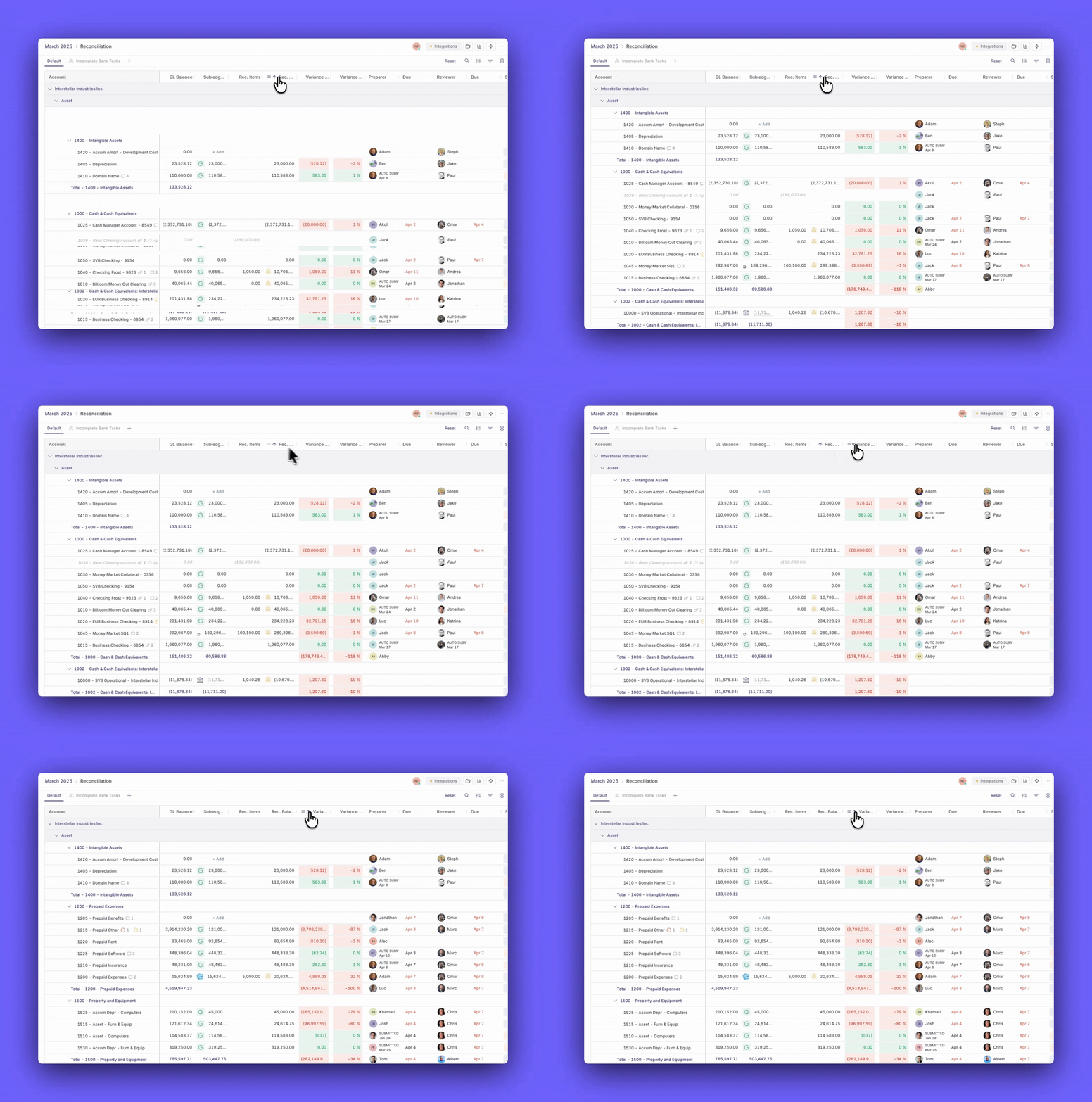
For cash, Numeric connects to thousands of banks worldwide to pull in transaction data automatically, eliminating manual exports before matching even begins. Our software’s cash management automates over 90% of matching. Transaction Monitors flag anomalous entries in real time, ensuring data is clean before it ever hits the reconciliation workpaper.
Master the month-end close with best practices
.png)
4. Accelerate the Month-End Close
The month-end close is where every upstream inefficiency becomes visible; 50% of finance teams take a week to close their books, largely due to manual, spreadsheet-bound processes. While teams using automation or tools report as few as three days. Still, when data quality issues and cross-team dependencies haven't been addressed, no amount of automation will compress the timeline.
The teams that have shortened their close did so by redesigning the process itself — front-loading work, eliminating discovery time, and creating real-time visibility into progress.
The Anatomy of a Modern Month-end Close
A mature close breaks into three stages:
- Pre-close: Recurring JEs, preliminary recs, upstream data collection.
- Close: Final recs, flux analysis, adjustments.
- Post-close: Retros, audit prep, reporting.
The key is front-loading. Recurring entries and standard accruals should be largely complete before the period ends.
The Process Changes That Cut Days Off the Close
The best teams take advantage of the pre-close period to accomplish as much work as possible before the books officially close. Recurring journal entries, standard accruals, and preliminary reconciliations can all be completed in advance, compressing the actual close window significantly.
Better templates and ERP integrations remove the need to start from scratch each month. Equally important is eliminating "discovery work" — the hours spent hunting for data that should already be clean.
Awardco, for example, used Numeric's Transaction Monitors to flag anomalies and catch data issues continuously throughout the month, rather than discovering them during the close. That shift moved work earlier, improved data hygiene, and helped the team shave four days off their close.
Close the Gap Between Process and Visibility
Most accounting teams already treat the close as a managed process — the challenge is that the tooling often doesn't match the intent.
When status lives in spreadsheets and updates travel over Slack, even well-organized teams lose time to manual coordination.
The goal is to close the gap between how the close is managed and how easily stakeholders — FP&A, Operations, the CFO — can see progress without asking for it.
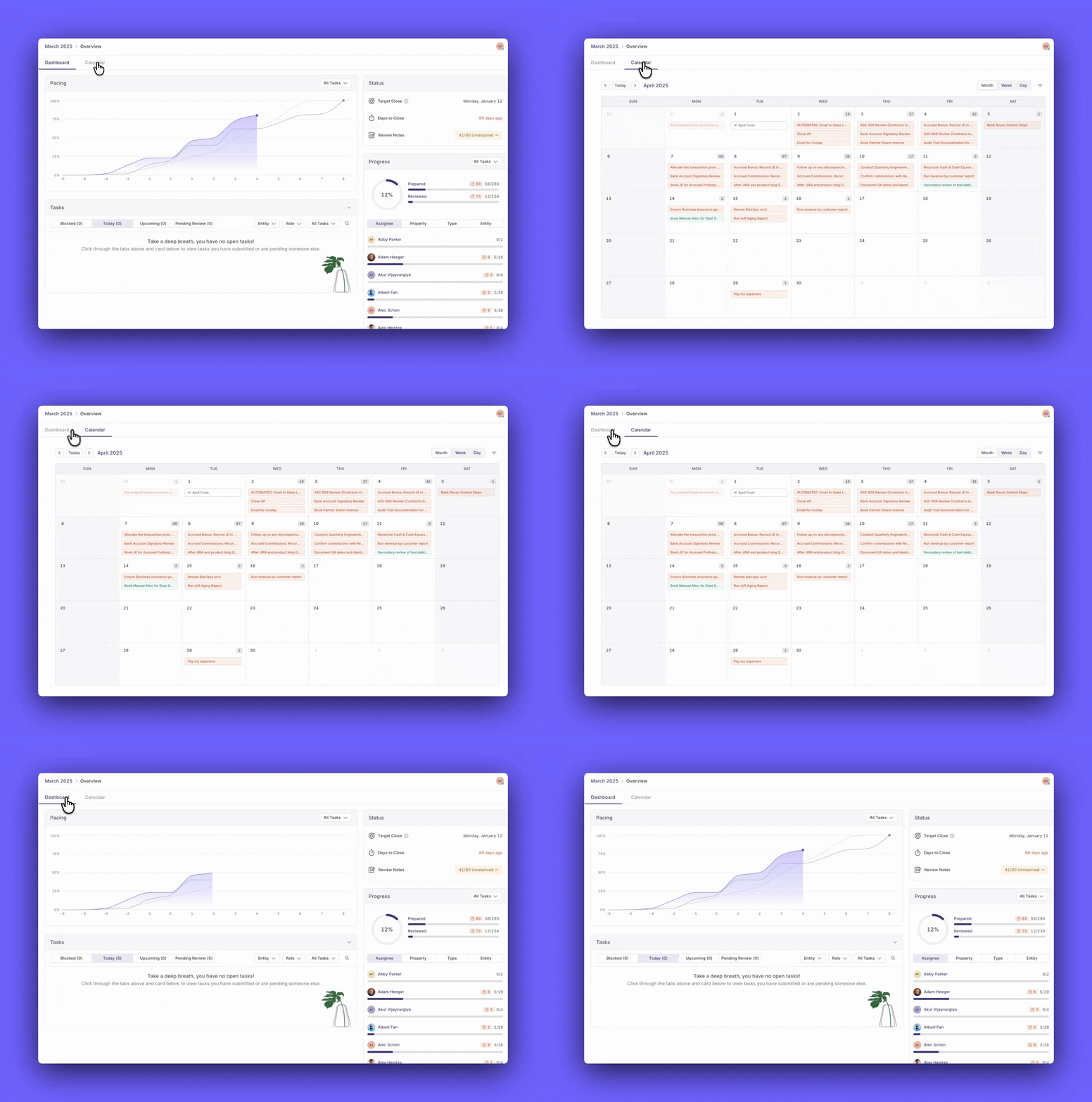
Use Numeric as the Command Center for the Close
Numeric functions as the workspace where the close happens. It unifies task coordination, reconciliations, and variance analysis in a single platform, replacing the sprawl of spreadsheets and emails. Audit trails ensure that speed doesn't come at the expense of rigor. Teams looking to build custom automations can also connect Numeric via MCP to create multi-step workflows directly inside their existing tools.
5. Improve Financial Reporting and Stakeholder Visibility
The goal is to shift from reporting the past slowly to explaining the present quickly. Here’s how.
Standardizing Data for Reliable Reporting
A clean chart of accounts is a prerequisite for automation. If your chart has accumulated redundant codes over years of growth, cleanup is necessary. Review your reporting structure annually as part of a continuous improvement agenda.
Automating Variance Analysis
Automated variance reporting is high-value. Instead of spending hours identifying what changed, teams can focus on the narrative. Automation handles the aggregation; accountants handle the judgment.
Changing Static Reports to Real-Time Insight
When continuous accounting is paired with real-time reporting, the lag between an operational event and a financial insight shrinks. This positions accounting as a source of intelligence rather than just historical record-keeping.
Use Numeric to Improve Reporting and Analysis
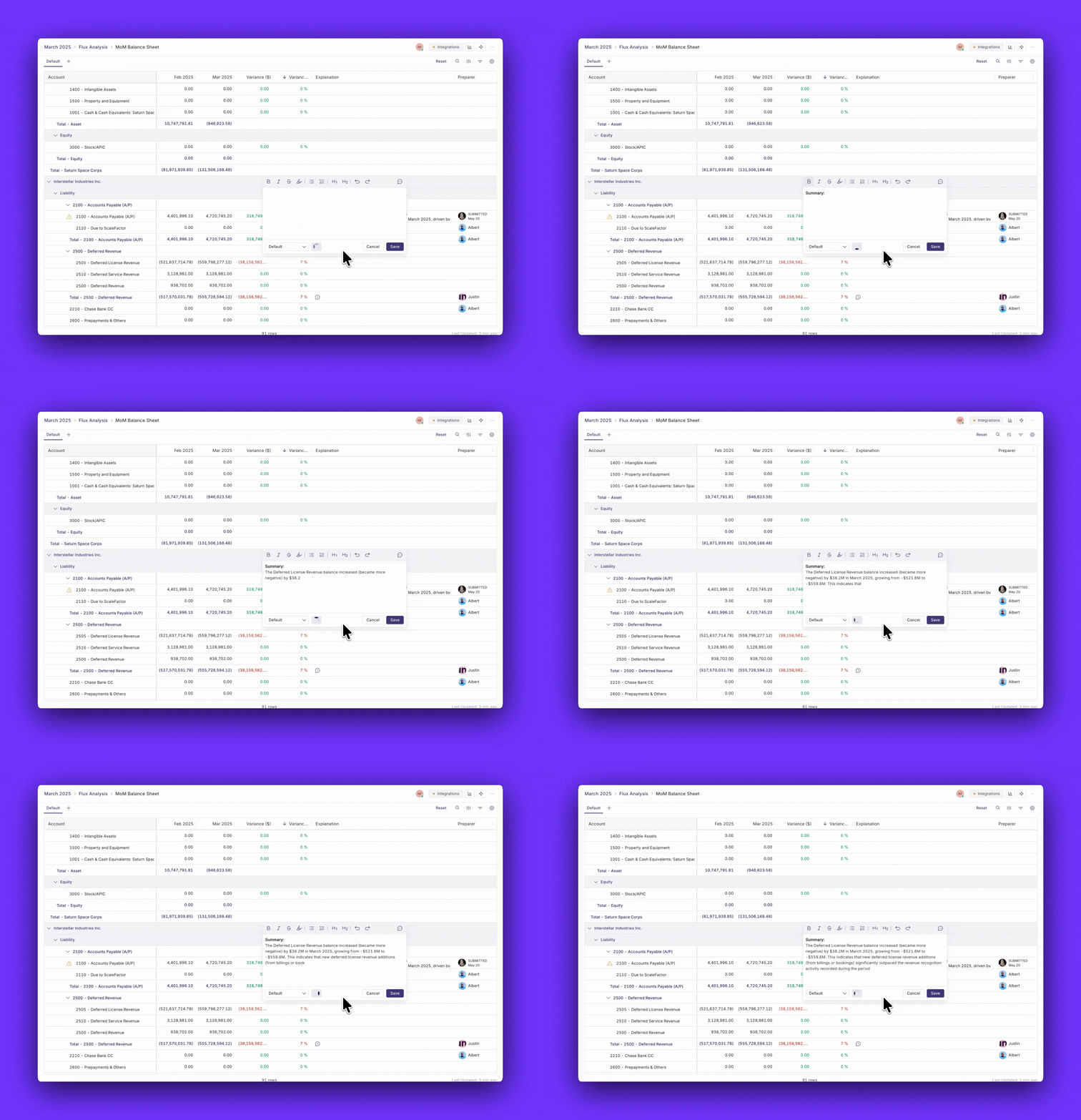
Numeric’s analytics suite covers variance analysis and reporting on top of GL data. AI-powered flux capabilities draft initial variance explanations and surface drivers of change, saving hours during the close.
For example, if SaaS hosting costs jump 30% month-over-month, Numeric's flux agent pivots by NetSuite dimensions like vendor and cost center, identifies that the increase traces to a specific AWS contract renewal, and drafts an explanation a Controller can review and approve rather than write from scratch.
6. Drive Change Management and Continuous Improvement
Tools matter, but adoption determines success.
Tackling Resistance and Building Buy-In
Resistance is rational. Accountants worry about losing control or being measured on new KPIs. Leaders should frame automation as augmentation — removing drudgery so accountants can do high-value work.
Adoption is a leadership problem, not a software problem. When executives set the expectation that the new platform is how the close gets done, teams follow.
Heeger sees this pattern repeatedly: "We had a customer that came over from another close tool. In the first month, they said, 'We never really adopted the last platform, but we closed Numeric in a handful of business days.'" The difference was leadership mandating team-wide adoption from day one instead of treating it as optional.
Build Training and Capability
Invest in upskilling around data literacy and systems thinking. Build internal "champions" who can advocate for improvements from within the team.
Embedding Continuous Improvement
Run a retro after every close. Keep it simple: What worked? What didn't? The long-term goal is to steadily shift from a monthly sprint model to continuous accounting.
7. Build the Business Case for Efficiency
If you need to justify investment to leadership, start with the numbers.
Quantifying Cost and Pain
Calculate hours spent on key workflows and translate that into fully loaded costs. Include indirect costs like delayed insights for FP&A. Narratives about recurring "fire drills" often resonate strongly with executives.
Real Efficiency Gains in Practice
Shaving two to three days off the close reclaims 15 to 25 hours per month. Brex achieved a 50% reduction in matching time, while Awardco shaved four days off their close. For most mid-market teams, the payback period on a close platform is measured in months, even weeks for some
A Practical 30–90 Day Action Plan
- Days 0-30: Map your current close workflow. Set baseline metrics (days to close, manual JEs). Identify one or two high-friction areas.
- Days 30-60: Standardize checklists and define RACI. Set upstream SLAs. Pilot improvements in one entity.
- Days 60-90: Introduce automation for reconciliations and flux in the pilot area. Measure impact against baselines. Run a retro after the first few closes.
Achieving Accounting Efficiency in 2026
The path is consistent: diagnose, standardize, and automate. Efficiency is not about doing the same work faster — it's about higher-quality outputs and the strategic capacity that comes from not being buried in the close.
The teams closing in four to five days aren't working harder. They mapped their workflows, set ownership, and invested in infrastructure that removes the repetitive work. The ones still at six or more days are usually one or two process changes away from a meaningful improvement — the gap is smaller than it feels.
Start with the 30-day plan above. If you're ready to see how Numeric fits into your close, schedule a demo.
FAQs
Related Content
.png)
Numeric vs. Maxima: Which AI Close Platform Fits Your Team?
Numeric and Maxima both automate close work. Compare how each handles reconciliations and cash matching, who owns the rules, and when each one fits.
.png)
7 NetSuite Reporting Tools, and When to Just Replace NetSuite
Compare 7 NetSuite reporting tools by use case and cost, and learn when replacing NetSuite solves reporting problems at the source.
.png)
What Is Multidimensional Accounting? Benefits, Examples, and 3 Steps to Set It Up
Learn how multidimensional accounting tags transactions by department, product, and customer, with examples and 3 steps to set it up.