Automated ASC 842 Lease Accounting: From Lease PDF to Audit-Ready Schedule

It is the week before audit fieldwork, and the Controller has a 36-month office lease open on one screen and a lease schedule on the other. Rent steps up 3% each year, the first two months are free, and each of those terms has to be keyed into the workbook by hand before the right-of-use asset and the lease liability tie to the general ledger. Multiply that by every office and equipment agreement the company has signed, and lease accounting turns into a spreadsheet project that peaks right when the auditors arrive.
Automated ASC 842 accounting starts from the lease document itself. Numeric's Financial Data Platform (FDP) reads the uploaded lease with AI, pulls out the key terms for the accountant to verify against the PDF, and derives the ASC 842 schedule and its journal entries from that lease, so the source and the numbers stay connected all the way through audit. The accountant keeps the judgment calls, starting with the discount rate and classification, and that division of labor shapes every step of the workflow that follows.
Key Takeaways
- ASC 842 puts nearly every lease longer than 12 months on the balance sheet as a right-of-use asset and a lease liability, each backed by a schedule that runs the full term.
- Manual lease accounting breaks down at four predictable points, which are hand-keyed terms, escalations and free rent, modifications, and audit support.
- Automation handles extraction, schedule math, straight-line expense, and journal entries, while the accountant still sets the incremental borrowing rate, makes classification calls on edge cases, and reviews extracted terms.
- Numeric's Financial Data Platform derives the ASC 842 schedule from the lease document and keeps every figure traceable to the source, inside the same system as the rest of the accounting.
What ASC 842 Requires (A Quick Refresher)
Who Follows ASC 842 and When
ASC 842 is the FASB lease standard that moved operating leases onto the balance sheet. Public companies adopted it for fiscal years beginning after December 15, 2018, and private companies followed for fiscal years beginning after December 15, 2021.
A lessee records a right-of-use (ROU) asset and a lease liability at commencement for every lease, with one practical exception. Companies can elect to keep short-term leases, meaning a term of 12 months or less with no purchase option the lessee is reasonably certain to exercise, off the balance sheet and recognize the payments straight-line over the term.
Finance and Operating Lease Classification
Every lease then gets classified as either a finance lease or an operating lease. A lease is a finance lease when it meets any one of five criteria.
- Ownership transfers to the lessee by the end of the term.
- The lessee is reasonably certain to exercise a purchase option.
- The lease term covers a major part of the asset's remaining economic life.
- The present value of the payments amounts to substantially all of the asset's fair value.
- The asset is so specialized that it has no alternative use to the lessor.
A lease that meets none of them is an operating lease, which describes most office and retail space.
Measuring the Lease Liability and ROU Asset
The lease liability equals the present value of the remaining lease payments. Teams discount those payments at the rate implicit in the lease when it is readily determinable, and since lessees rarely have the information to calculate it, most use their incremental borrowing rate (IBR).
The IBR is the rate the company would pay to borrow, on a collateralized basis over a similar term, an amount equal to the lease payments. Private companies can also elect a risk-free rate by asset class.
The ROU asset starts at the lease liability, plus any lease payments made at or before commencement and any initial direct costs, minus any lease incentives received.
Recognizing Lease Expense
Expense follows the classification. An operating lease produces a single straight-line lease cost over the term, so the ROU asset amortization becomes the difference between that straight-line figure and the interest accreting on the liability.
A finance lease splits into interest expense on the liability and straight-line amortization of the ROU asset, which front-loads total expense in the early years. That ROU amortization works much like fixed asset depreciation, spread over the shorter of the lease term or the asset's useful life unless ownership transfers or a purchase option is reasonably certain.
Balance Sheet Presentation and Disclosures
On the balance sheet, the lease liability splits between the portion due in the next 12 months and the long-term remainder, and that split moves every month as rent gets paid.
In the footnotes, ASC 842 calls for a maturity analysis of undiscounted lease payments reconciled to the liability, the weighted-average remaining lease term and discount rate, and lease cost broken out by operating, finance, short-term, and variable components. The full text lives in the FASB Accounting Standards Codification.
Teams that still keep schedules by hand can start from Numeric's free Lease Amortization Workpaper (Finance) or Lease Amortization Workpaper (Operating), both built for ASC 842 in Excel and Google Sheets.
Download our operating lease amortization workpaper. Built for ASC 842 in Excel and Google Sheets.

Where Manual ASC 842 Accounting Breaks Down
Keying Lease Terms by Hand
Spreadsheet lease accounting begins with someone reading the PDF and typing the commencement date, the term, each year's rent, and the options into a workbook. A common setup keeps three tabs per lease, one each for the ROU asset, the current liability, and the long-term liability. With four offices, that comes to 12 tabs before a single equipment lease enters the picture.
Each of those tabs depends on terms someone transcribed correctly. A transposed digit in the base rent, a commencement date pulled from the signature page in place of the possession date, or a renewal option nobody flagged will carry through every period of the schedule. Refundable security deposits, for example, sit outside the lease payments and get recorded as their own asset, and a staff accountant moving quickly can fold one into the rent schedule by mistake.
Escalations, Free Rent, and Incentives
Straight-line expense is where hand-built schedules get fragile. Take the 36-month lease from the opening, with $10,000 monthly rent in year one, 3% annual escalations, and the first two months free. Total payments come to $350,908, so the straight-line lease cost is $9,747 a month for all 36 months. The team records $9,747 of expense in each free-rent month while no cash goes out, and by year three the company pays $10,609 a month against the same $9,747 of expense.
The liability side needs its own math. Discounted at a 7% IBR with rent due at the start of each month, that lease opens with a liability of roughly $315,221. Every month afterward, the schedule has to accrete interest, apply the payment, recalculate the current and long-term split, and plug the ROU asset amortization so total cost stays at $9,747. Tenant improvement allowances, CPI-linked rent, and percentage rent each add another column and another formula to keep pointed at the right cells.
Modifications and Remeasurement
Leases change over their life. When a company extends the New York lease by two years, gives back a floor, or negotiates three months of rent relief, each amendment needs an accounting answer. A modification that grants an additional right of use priced at its standalone price becomes a separate contract. Most other modifications require the team to remeasure the lease liability at the effective date using an updated discount rate and adjust the ROU asset to match. Partial terminations reduce both balances and can produce a gain or loss.
In a spreadsheet, each change means splitting the schedule at the modification date and recalculating the rest of the term at a new rate. Teams end up with "NY lease v3 final" and "NY lease v3 final revised" in the same folder, and the auditor wants to know which one supports the balance sheet.
Audit Support and Disclosure Prep
Auditors test lease balances by tracing them back to the lease agreement. They want the commencement date, the rent schedule, the support for the discount rate, and the math connecting it all to the balances. When schedules live in workbooks disconnected from the PDFs, each request sends someone back to the shared drive to find the right lease version and walk through the formulas.
Disclosures pull from the same schedules, so the maturity table and weighted-average figures get assembled from every lease workbook each reporting period. When leadership also asks for lease cost by location or department, the team builds another lookup on top of the schedules, because the lease data sits outside the ERP with none of those tags attached.
What Automated ASC 842 Actually Handles
Lease accounting automation takes over the repeatable work and leaves the accountant with the decisions the standard reserves for judgment. The split looks like this.
| What Automation Handles | What Still Needs Accountant Judgment |
|---|---|
| Reading the lease PDF and extracting term, start date, rent schedule, escalations, and free-rent periods | Reviewing extracted terms against the source document |
| Discounting lease payments to the initial lease liability | Setting the discount rate, including the incremental borrowing rate |
| Building the ROU asset, lease liability, and straight-line expense schedule | Classification calls on edge cases, like long equipment leases or specialized assets |
| Spreading free rent and escalations evenly across the lease term | Deciding whether renewal or termination options are reasonably certain |
| Deriving journal entries from the schedule each period | Reviewing and approving the entries |
| Tagging leases by location, department, or entity for reporting | Choosing the tags and the reporting structure the business needs |
| Keeping each figure traceable to the source lease | Judging modifications, effective dates, and embedded leases in service contracts |
The discount rate gets its own row because its value depends on the company's credit profile, the lease term, collateral, and market conditions at commencement, and it is an accounting estimate the auditors will ask the Controller to support. Good ASC 842 software keeps that rate as an input the Controller sets.
The most common objection to AI lease accounting software is trust, and it is a fair one. A reviewed spreadsheet has a known owner and a known set of formulas. What changes is what the reviewer looks at. When each extracted field sits next to the lease it came from, review becomes a check of each field against the source document, and the schedule math runs the same way for every lease in the portfolio.
How to Automate ASC 842 Lease Accounting, Step by Step
Step 1. Centralize Your Lease Documents
Pull every executed lease, amendment, and side letter into one place, using the final signed version of each. Include equipment leases and service contracts that might contain an embedded lease, such as a dedicated server or a vehicle fleet agreement. A complete inventory up front guards against a lease that never made it onto the balance sheet.
Step 2. Extract and Verify Key Lease Terms
AI document extraction reads each lease and pulls out the term, commencement date, rent schedule, escalation clauses, free-rent periods, and options. The accountant's job shifts from typing to verifying. Check each extracted field against the source PDF, and spend the most time on the clauses that drive judgment, especially renewal options, termination rights, and anything tied to an index or to sales. When a field comes back wrong, correct it at the extraction step so the fix carries into the schedule.
Step 3. Set the Discount Rate and Classification
Document the IBR methodology once and apply it consistently, keeping the support, like a lender quote adjusted for term and collateral, in the lease file for the auditors. Classify each lease against the five finance lease criteria. Office space usually lands as an operating lease, while long equipment leases and agreements with purchase options the company expects to exercise deserve a closer look.
Step 4. Generate the ROU Asset, Lease Liability, and Expense Schedules
With verified terms and a rate in place, the system discounts the payments to the opening liability, builds the ROU asset from it, and lays out the full schedule for the term. For an operating lease, the schedule should show the straight-line cost, the interest accretion, the ROU amortization plug, and the current and long-term liability split for every period. Spot-check one lease with free rent and one with escalations against a manual calculation before trusting the rest.
Step 5. Derive Journal Entries from the Schedule
Each period's accounting journal entries for the lease should come straight from the schedule. That covers the initial recognition entry, the monthly lease cost, the liability reduction, and the reclass between current and long-term. When the entries are derived for you from the same schedule the auditors will test, the ledger and the support agree by construction, and review focuses on whether the schedule itself is right.
Step 6. Tag Leases for Reporting and Disclosure
Tag each lease with the dimensions the business reports on, including location, department, entity, and asset type. Consistent tags turn the disclosure package and the lease cost by department into a query against the same tagged leases.
Step 7. Keep Schedules Current as Leases Change
Set a routine for amendments, renewals, and early terminations. Each signed document goes into the same lease repository, and the accountant decides whether it creates a separate contract or requires remeasurement at an updated discount rate. Keep the amendment attached to the lease record so the audit trail runs from the original agreement through every change.
What to Look for in ASC 842 and Lease Accounting Software
The ASC 842 software market includes three broad categories. Standalone lease accounting software focuses on lease administration and ASC 842 math and connects to the general ledger for posting. ERP add-ons extend the existing accounting system with lease functionality configured inside it. A third path, the ERP replacement, handles leases as part of the core accounting system, alongside the rest of the books. Which one fits depends on the size of the portfolio and how closely the team wants lease data tied to the rest of its reporting.
Whichever category is on the shortlist, these criteria help sort the ASC 842 lease accounting software solutions that hold up at audit.
- AI document extraction with source references. Each extracted term should sit next to the source PDF for review, and the accountant should be able to correct a field and rerun the extraction.
- Schedule accuracy for escalations and free rent. Run your own messiest lease through the demo, ideally one with free rent and annual increases, and tie the straight-line figure to your own calculation.
- Audit traceability. Every figure in the schedule should trace back to the lease document, so the auditor can follow the support without a separate walkthrough.
- Reporting by location or department. Lease cost and liability should break out by the same dimensions the business uses for the rest of its financial reporting.
- Connection to the rest of the books. Ask how journal entries reach the general ledger, whether someone exports and posts them, and how the lease balances reconcile to the ledger each month.
- Total cost. Price the subscription, implementation, and the time spent reconciling one more system, especially if lease accounting would become another point solution to maintain.
For a wider view of how lease tools fit next to the rest of the stack, our roundup of accounting automation software options covers the categories teams evaluate most often.
How Numeric's Financial Data Platform Automates ASC 842
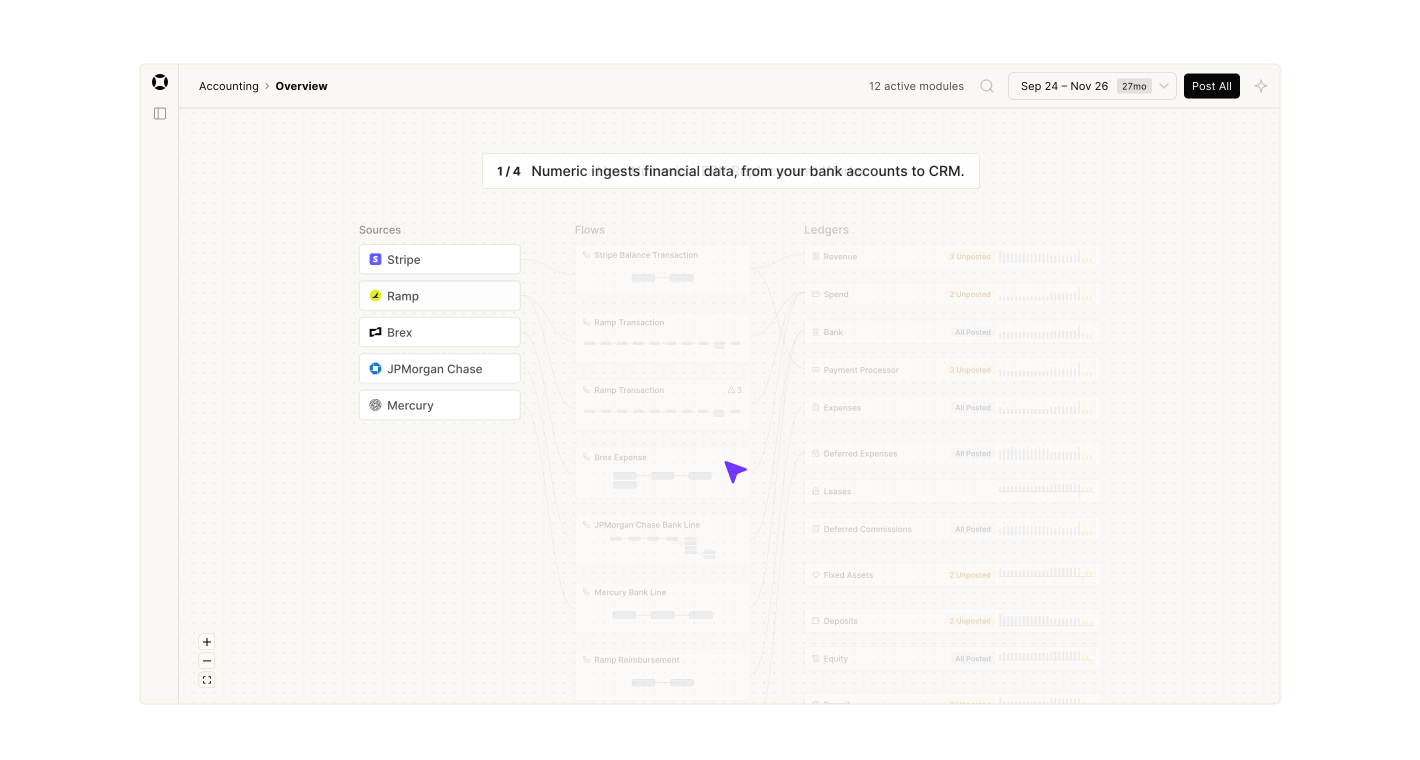
Numeric's Financial Data Platform (FDP) is a data lakehouse with accounting intelligence built on top. It follows a data-centric accounting model, where the system keeps the full business record and produces the accounting from it. For leases, the business record is the lease agreement itself.
From Lease PDF to ASC 842 Schedule
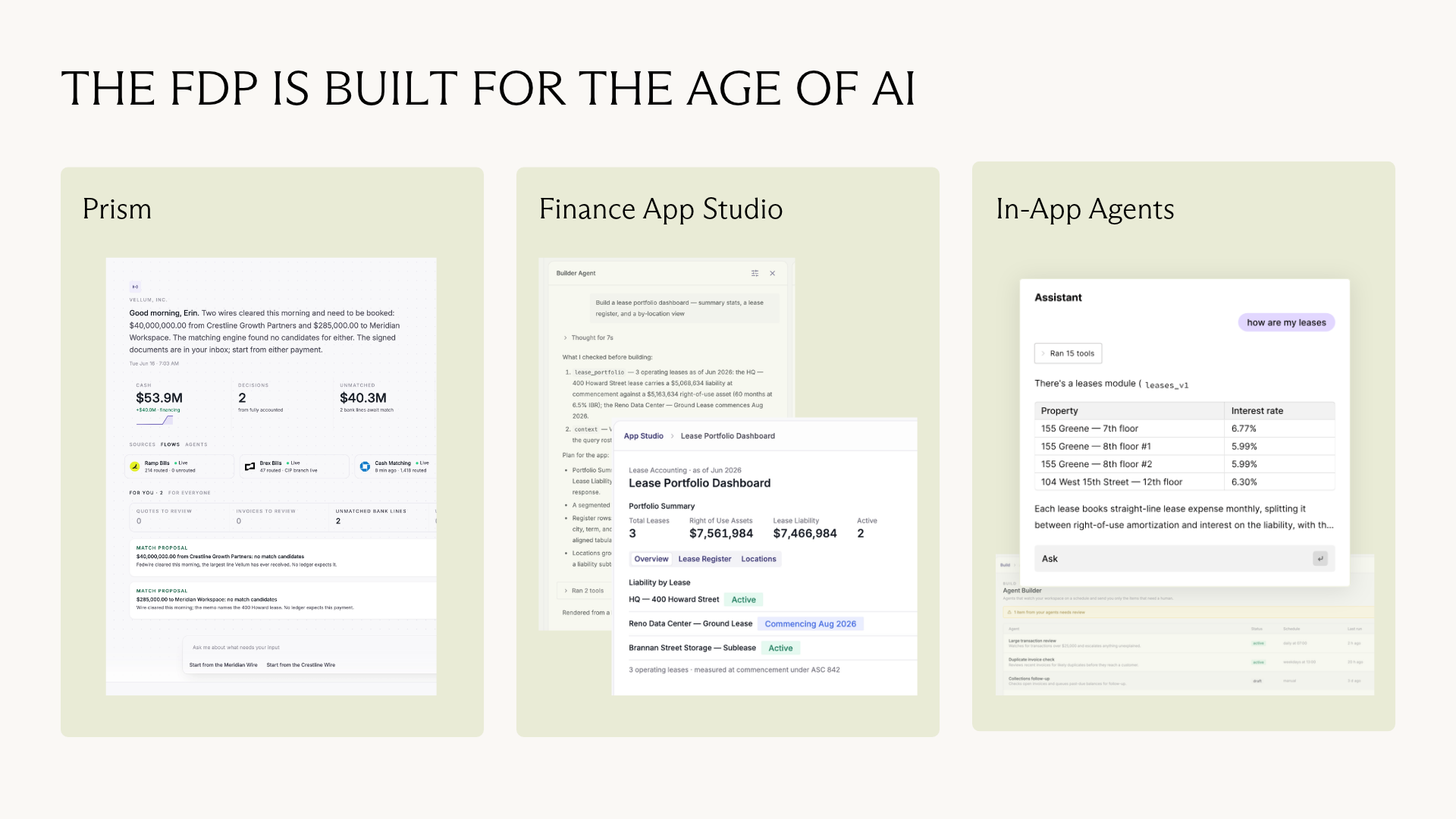
The workflow starts with an upload. Numeric reads the lease PDF with AI and pulls out the key terms, including the term, start date, rent schedule, escalations, and free-rent periods. Your team verifies those fields against the PDF and skips the manual keying. The Controller still sets the discount rate, because the incremental borrowing rate is an accounting judgment, and the platform leaves that call with the person who will defend it to the auditors.
From there, each lease lives in the system as an object. The ASC 842 schedule for the ROU asset, lease liability, and straight-line expense is derived from that object, and Numeric derives the journal entries from the schedule. One routing flow tags every lease, for example by location and department, and applies the same accounting treatment to future leases as they are uploaded. In App Studio, a finance team can describe a lease activity dashboard in plain language and Numeric builds it on the team's own data.
How the Financial Data Platform Resolves the Four Breakdowns
The four breakdowns from earlier share one root cause. In a spreadsheet, the schedule and the lease drift apart, and every problem grows out of that gap. The Financial Data Platform resolves each of them by deriving the schedule from the lease itself.
- Keying lease terms by hand gives way to AI extraction, so the accountant verifies each term against the lease PDF.
- Escalations and free rent move out of custom formulas, because free-rent periods and rent escalations are spread across the lease term automatically.
- Modifications and remeasurement still call for the Controller's judgment on the effective date and the updated discount rate. The difference is the starting point, since the lease already lives in the system as one object with its terms traced to the source document.
- Audit support and disclosure prep draw on the same records, because every figure traces back to the source lease document and every lease carries the same location and department tags.
Built Technologies on the Financial Data Platform
Built Technologies, the real estate finance platform connecting more than 340 lenders, moved its accounting onto the Financial Data Platform in early 2026 after weighing a system change against adding headcount. Controller Asia McKnight explained the call: "No business wants to add more people. You really need to fix the root problem, which was our systems." A growing lease portfolio puts the same choice in front of a Controller, and the Built case study shows what fixing the system looked like for its billing and revenue work.
Who It Fits
Because the lease schedule lives in the same system as the rest of the accounting, ASC 842 becomes one part of the Financial Data Platform, with no separate lease tool to reconcile. The strongest fits are companies with leases across several offices, locations, or entities, especially teams that want lease cost reported by the same dimensions as the rest of their books. The Financial Data Platform usually costs about the same as, or less than, what teams spend today on NetSuite plus the point solutions around it, with more functionality.
See the Financial Data Platform in action. Book a demo with our team to walk through how it works.
Final Thoughts
A useful test for any ASC 842 compliance software is your hardest lease. Pick the one with free rent, escalations, and an amendment, and ask each vendor to show where each term came from and what the auditor sees when tracing the liability back to the agreement.
If your team wants that lease schedule to come straight from the lease document, schedule a demo to see Numeric's Financial Data Platform work through it.
Automated ASC 842 Lease Accounting FAQ
Yes. The calculation work in ASC 842 follows defined rules, so software can extract lease terms from the document, discount the payments, build the ROU asset and lease liability schedule, spread free rent and escalations into straight-line expense, and derive the journal entries each period. Accountants still own the judgment calls, from the incremental borrowing rate to options, modifications, and review of extracted terms.
The best fit depends on the lease portfolio and the rest of the accounting stack. Companies with a large real estate portfolio and a stable ERP often look at standalone lease accounting software or an ERP add-on. Teams that want lease data connected to the rest of their books and reporting tend to look at an ERP replacement that handles leases in the same system, such as Numeric's Financial Data Platform.
Start with the initial lease liability, which is the present value of the remaining lease payments discounted at the rate implicit in the lease, or at the incremental borrowing rate when the implicit rate is not readily determinable. Add any lease payments made at or before commencement and any initial direct costs, then subtract any lease incentives received. For a lease with none of those adjustments, the ROU asset equals the opening lease liability.
AI changes the accountant's role in lease accounting and keeps the accountant at the center of it. Software handles the reading and the arithmetic, which takes the hand-keying and formula maintenance off the team. The accountant sets the discount rate, decides classification and option treatment, judges modifications, and reviews every extracted term against the lease, which is the part of ASC 842 the auditors care about most.
Related Content
Automated ASC 842 Lease Accounting: From Lease PDF to Audit-Ready Schedule
How to automate ASC 842 lease accounting, from extracting lease terms to the ROU asset, lease liability, and journal entries your auditors can trace.

ERP for SaaS: How to Choose an Accounting System Built for Subscription and Usage Revenue
A guide to choosing an ERP for SaaS, covering ASC 606 revenue recognition, usage-based billing, multi-entity, reporting, and a checklist for vendor demos.

Numeric vs. Maxima: Which AI Close Platform Fits Your Team?
Numeric and Maxima both automate close work. Compare how each handles reconciliations and cash matching, who owns the rules, and when each one fits.