Numeric vs. Maxima: Which AI Close Platform Fits Your Team?

.png)
Your FloQast or BlackLine renewal is a quarter away. Leadership wants to see AI in the close by next year, and two modern platforms made the shortlist: Numeric and Maxima. Both promise to take reconciliation and cash matching work off your team's plate, so the demos can start to blur together.
The useful question is how each platform gets the work done and who stays in control of it. Maxima's agents prepare the work and hand it to accountants for review, and Maxima's team builds workflows for you during implementation. Numeric's close and cash automation works out of the box on live ERP data. AI drafts the rules, the team approves them, and the rules do the accounting, so any reviewer or auditor can see exactly why a match or entry happened. When the team wants agents, it builds them on Numeric's native MCP server with the AI tools it already uses, and Numeric's Solutions team can co-build the first workflows alongside it.
Numeric also offers a path past the close. Its ERP replacement, the Financial Data Platform (FDP), runs on data-centric accounting and is built for teams whose evaluation reaches the system underneath the close.
Key Takeaways
- Close and automation run in one platform, and the team approves every rule. Reconciliations, flux, cash matching, and reporting share the same live data, so reviewers and auditors can trace each result to the rule behind it. With Maxima, agents prepare the work for accountants to review.
- Teams can build agents they own through Numeric's MCP server with Claude and the AI tools they already use, and Numeric's Solutions team can help with the first ones.
- Numeric has the larger public track record, with a 4.8 on G2 across 100+ reviews and published stories from Brex, Paddle, Riskified, and Masterworks. Maxima holds a 4.8 across 21 reviews at the time of writing.
- For teams rethinking the ERP itself, Numeric's Financial Data Platform (FDP) replaces it with data-centric accounting, so reporting works on any dimension and changes to the business flow through automatically.
Numeric vs. Maxima: At a Glance
Numeric Platform Overview
Close Management Built on Live Transaction Data
Numeric syncs with NetSuite at the transaction level every one to two minutes, so the close checklist, reconciliations, flux analysis, and reporting all run on the same current data. When a balance looks off, the accountant opens the transactions behind it inside Numeric instead of exporting a saved search to Excel.
Reconciliations can auto-submit when an account falls below a materiality threshold. If a new transaction posts to an account after sign-off, Numeric flags the change and shows the specific entry, so the reviewer knows what moved. Masterworks, which runs its close across 10 management subsidiaries, took five business days out of its manual reconciliation process. As Accounting Manager Josh Goldberg put it, "What's nice about Numeric is it's kind of a real-time live sync, and it's always going."
.png)
Automation the Accounting Team Configures and Owns
Cash matching and journal entry automation live in the same platform as the close, so matched transactions connect directly to the reconciliations they support. Matching rules are deterministic and written in plain language. An AI assistant helps the team draft them, and agents suggest new rules based on the team's manual matches. They handle one-to-one, one-to-many, many-to-one, and many-to-many patterns, which covers the cases that usually stay manual, like a single Ramp reimbursement tied to a dozen card transactions or a batch of AP payments hitting the bank as one line. Rules require admin or manager approval before they go live, and cash journal entries post to NetSuite in one click.
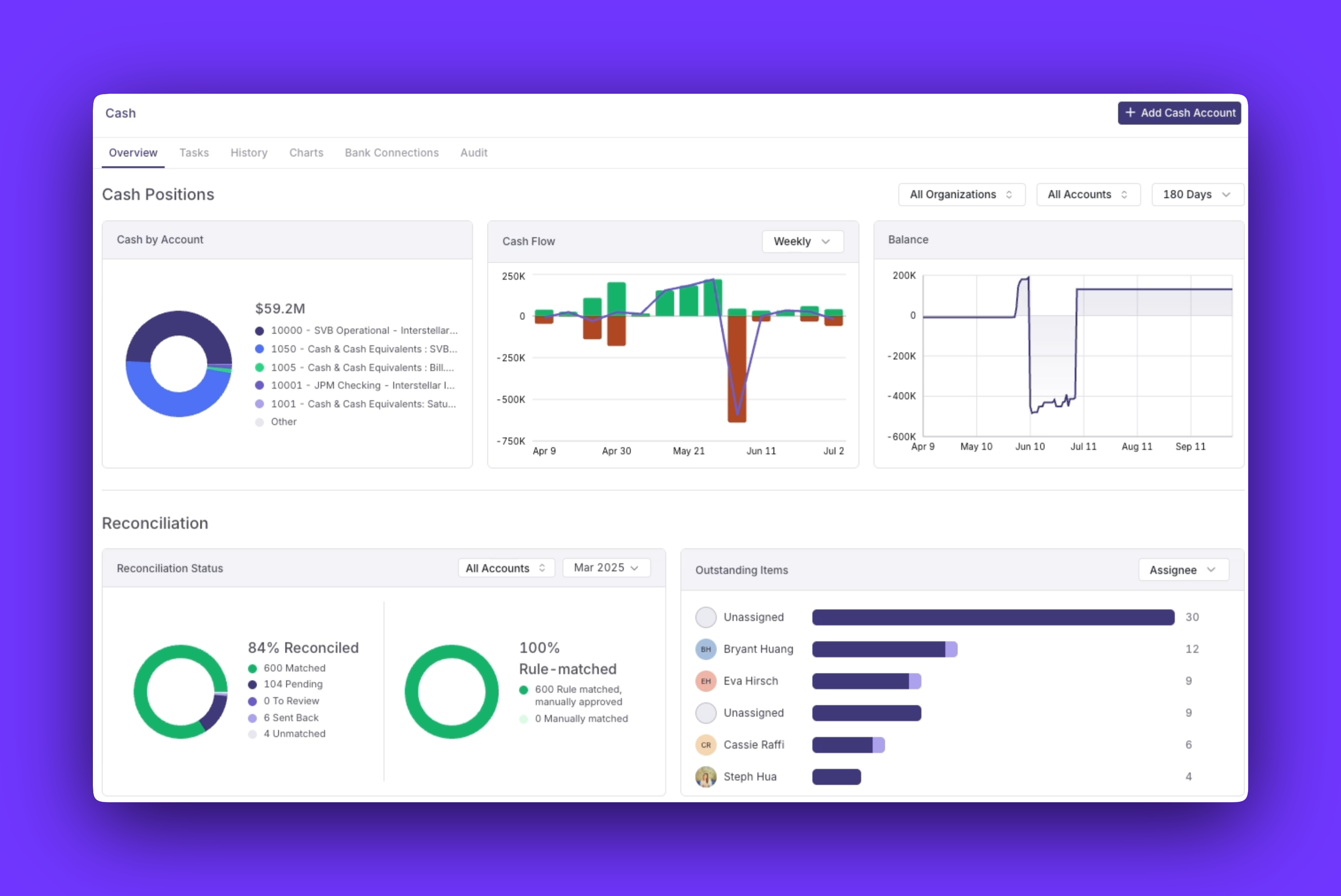
Because the team approves every rule, it can also explain them. A reviewer can see why a match happened, and an auditor can follow the same logic without a call to the vendor.
Implementation and Support From a Hands-On Team
Numeric's implementation team gets accounting teams live quickly. Setup starts with the ERP connection. Teams can go live with the checklist and reconciliations first, then expand into cash and reporting as they're ready. Awardco signed up in January and closed on Numeric that same month. "The implementation process was super easy," said Controller Ryne Fertitta. "You connect to NetSuite, do a few quick setups, and you're good to go."
The support continues after go-live. At Brex, Sr. Accountant Kyle Gillingwater said the team could message, email, or call Numeric, "and within 24 to 48 hours, they were pushing a prototype to us." DailyPay Controller Sarah Hill said it directly: "By far Numeric has the best service that I've ever seen in a similar platform."
Numeric Pros
- Close depth in one place. Checklist, reconciliations, flux, reporting, and transaction monitors share one data layer.
- One platform for cash and close. Matching and JE automation in Cash Management feed the reconciliations they support.
- Transparent rules. Deterministic, plain-language rules with approval before production.
- Open AI architecture. A native MCP server lets teams build agent workflows with Claude, ChatGPT, or Copilot, with optional help from Numeric's Solutions team.
- Fast, supported implementation. Awardco closed on Numeric the same month it signed, and Masterworks called it the easiest integration of all its tools.
- Published proof across complex teams, including a public company close at Riskified, a global close at Paddle, and multi-subsidiary reporting at Masterworks.
Numeric Cons
- Transaction-level depth is available for NetSuite. Xero, QuickBooks, and Sage Intacct sync at the trial balance level.
- Journal entry write-back is NetSuite only.
Numeric Pricing
Numeric uses a platform plus per-seat model. See the pricing page for current plans.
Maxima Platform Overview
Maxima positions itself around "agentic accounting automation, from record to report." Its agents ingest bank and subledger files around the clock, prepare journal entries with no-code logic, match transactions, validate reconciliations, and propose variance explanations. Accountants log in to review and approve work that's already been prepared. The product covers journal entry automation, account reconciliation, transaction matching, flux analysis, and cash accounting, with a Close Orchestrator for tasks and reviews, all run by its core agent, Max. Implementation is hands-on, with Maxima's team building each customer's workflows.
Maxima raised $41 million across its seed and Series A in November 2025, with Redpoint Ventures and Kleiner Perkins among its investors, and names Scale AI, SpotOn, and Rippling as customers.
Maxima Pros
- Workflows built for you by Maxima's team for preparing journal entries from sources like payroll, billing, and bank files.
- A broad connector library across banks and business applications.
- Positive early G2 feedback on support responsiveness.
Maxima Cons
- A smaller public review base, with 21 G2 reviews at the time of writing.
- Some reviewers mention limited customization, and one describes the subledger upload process as clunky.
- No public-company case studies. Every customer story on Maxima's website features a private company, at the time of writing.
Maxima Pricing
Maxima charges a platform fee based on business size plus per-module fees, according to its site. It doesn't publish figures.
Feature by Feature Comparison
Both platforms cover the core close workflows, so the differences show up in how the work gets done. The table looks at who configures the automation and how a reviewer traces each result back to the transactions behind it. The last column is a list of things worth testing in your own demos.
Cash is where Numeric's approach shows up most clearly in results. Brex moved its cash and close management to Numeric from BlackLine and cut the time spent on manual cash matching by 50%, bringing its close from six business days to four. "Implementing Numeric is one of the best decisions I've made as Controller over my 7 years at Brex," said Controller Kevin Moore.
Who Builds and Owns the Workflows: Numeric vs. Maxima
Maxima's model puts agents in the preparer's seat. Its team builds the workflows for each customer during implementation, and the agent prepares the journal entries and groups the matches for the accountant to review.
That setup works until the business changes. Because the vendor built the logic, a new entity, bank account, or accounting policy goes back to the vendor's team before the workflow can follow it. The accountant also ends up reviewing output from rules they didn't write, which makes it harder to explain a result to an auditor or catch a rule that has drifted from how the business actually runs.
Numeric keeps that logic with the accounting team. Close and cash workflows come already built, AI drafts each rule, and a manager approves it before it runs. Whoever owns the account updates the rules on their own schedule. Teams that want agents build them with the models they already use, like Claude or ChatGPT, through Numeric's MCP server, with Numeric's Solutions team available to co-build the first few.
Say the company opens a new bank account in a second entity. In Numeric, the accountant who owns cash drafts the matching rule with the AI assistant, a manager approves it, and it runs on the next bank feed. When the auditor later asks why a deposit matched a group of invoices, the reviewer opens that rule and the transactions behind it and walks through the logic line by line, because the team wrote it.
When to Choose Numeric or Maxima
Choose Numeric if
- You want close management depth and automation in the same platform, so you aren't trading one for the other or paying for two tools.
- Your team wants to configure and own its automation, with rules reviewers and auditors can follow.
- You run on NetSuite and want transaction-level visibility across reconciliations, flux, and reporting.
- Out of the box automation and a fast implementation matter to your team.
- You want to own your agents, built with Claude, ChatGPT, or Copilot on top of your financial data, with help from Numeric's Solutions team if you want it.
Choose Maxima if
- Your main goal is handing preparation of specific high-volume journal entry workflows to agents Maxima's team builds for you.
- Your team prefers a hands-on engagement with the vendor during setup, and is comfortable with per-module pricing as workflows grow.
Evaluating AI Close Platforms: Questions to Ask
Most finance teams are already on this path. Gartner found that 59% of finance leaders were using AI in their finance function in 2025, and in a March 2026 Gartner survey of 204 finance leaders, 63% said AI implementation moved slower than they expected. As Gartner Director Analyst Marco Steecker put it, "Finance teams have certainly made AI use more common, but CFOs now need to prove that AI is improving decisions."
A good demo shows the product at its best. These questions help you see how it will work on your close six months after go-live.
- Who configures and changes automation rules after go-live, and how long does a change take?
- Can a reviewer see the exact logic and transactions behind an automated match or journal entry?
- How does pricing change as we add workflows, bank accounts, or entities?
- What does implementation require from our team, in hours, and who on the vendor side is involved?
- Which parts of our close will still live in spreadsheets after we're live?
- Can we bring our own AI tools to the data, or only use the vendor's agents?
- Does automation work out of the box, or does the vendor's team build it for us during implementation?
The most useful test is to bring your messiest workflow to both demos. A one-to-many cash match or a recurring intercompany entry will tell you more about fit than a standard product tour. If you're still building a shortlist, this roundup of the best financial close software covers more options. The Numeric vs. Ledge comparison looks at another agent-focused platform.
Beyond the Close: Numeric's Financial Data Platform
Teams comparing AI close platforms are often feeling the limits of the system underneath the close. A journal entry flattens the business context behind it, like the contract, the customer, or the usage event, so finance ends up recreating that context in spreadsheets each close.
Numeric's ERP replacement, the Financial Data Platform (FDP), runs on data-centric accounting. It's a data lakehouse with accounting intelligence built on top, holding every contract and invoice along with the business events behind them in one unified financial graph. Journal entries are derived for you from those events instead of drafted by hand, and the system enforces controls as it goes.
Reporting is where teams feel the difference first. Because the context stays attached to each transaction, a team can report by department or location without reclassing entries or exporting to spreadsheets. The same holds when the business changes. If a reorg moves departments across offices, the FDP re-derives the accounting around the new structure and the income statement updates with it, while a traditional ERP would need those entries reclassed and reposted by hand. Teams can also build background agents in Agent Builder and small internal apps in App Studio, running on the same data the accounting does.
.svg)
Built runs its billing and revenue on the FDP, working from live data tied to the underlying transactions. The FDP freed up two FTEs of billing and revenue work, and invoices now go out four business days earlier. "We're almost operating in a different century, it feels like, from a data perspective," said Controller Asia McKnight.
Moving to the FDP doesn't require a single cutover. A team can start on Close Management, Cash Management, or Billing and Revenue today and bring the rest of its financial data onto the full FDP once the case for it is clear.
Where Do You Want Your Close to Be in 2027?
Numeric and Maxima both automate close work. The bigger difference is what your team owns once the automation is running. With Numeric, that's a close platform built on live transaction data and rules the team can explain to any auditor. When it's ready for agents, the team builds them with its own AI tools on that same data. See how Numeric handles your close on a walkthrough.

Related Content
Numeric vs. Maxima: Which AI Close Platform Fits Your Team?
Numeric and Maxima both automate close work. Compare how each handles reconciliations and cash matching, who owns the rules, and when each one fits.
.png)
7 NetSuite Reporting Tools, and When to Just Replace NetSuite
Compare 7 NetSuite reporting tools by use case and cost, and learn when replacing NetSuite solves reporting problems at the source.
.png)
What Is Multidimensional Accounting? Benefits, Examples, and 3 Steps to Set It Up
Learn how multidimensional accounting tags transactions by department, product, and customer, with examples and 3 steps to set it up.