Billing and Revenue Management: A Guide for SaaS Finance Teams


Month-end is when the gap between billed and earned shows up. The billing system says a customer was invoiced $72,500 this year, the revenue schedule says $42,083 has been earned through July, and someone on the revenue team has to show why both numbers are right before the books close. When a mid-term upgrade landed in one system and never reached the other, that afternoon goes to a spreadsheet.
Billing and revenue management is the work of keeping those two numbers connected from the signed contract onward. Numeric's Billing and Revenue product does it by running invoicing and ASC 606 revenue recognition from the same contract record, so an upgrade, an early renewal, or a credit updates both sides at once.
Key Takeaways
- Billing and revenue management covers the full order-to-cash cycle for B2B software companies, from CRM deal terms through ASC 606 revenue recognition.
- Billing tracks what the customer owes and revenue recognition tracks what the company has earned, and the two drift apart when separate systems each need a manual update for every contract change.
- Upgrades, early renewals, cancellations, and credits each have a specific accounting effect, so any evaluation should start with how a solution handles a real mid-term change.
- Numeric's Billing and Revenue product turns one contract into invoices, revenue schedules, and accounting entries, and updates all of them together when the deal terms change.
What Is Billing and Revenue Management?
Billing and revenue management (BRM) is the set of processes that turn a signed customer contract into accurate invoices, collected cash, and correctly recognized revenue. The term grew up in telecom and large enterprise software, and for SaaS and AI companies it describes something more practical, which is how the finance team runs order-to-cash.
Order-to-cash is everything from a signed deal to collected payment. It includes the contract and its deal terms, the invoices sent against it, the payments that come in, and the revenue the company records as it delivers the service. For a subscription or hybrid business, that cycle also absorbs steady contract changes.
Two records do most of the work. Billing tracks what the customer owes and when. Revenue recognition tracks what the company has earned, following the accounting rules for revenue recognition set out in ASC 606. A customer who pays $60,000 upfront owes nothing more once the invoice clears, while the company still earns that revenue month by month. Both records start from the same contract, and billing and revenue management keeps them telling the same story as that contract changes.
Why Billing and Revenue Management Matters
Billing and revenue management is what lets the revenue number on the income statement hold up at close and in audit. When it runs well, finance gets four things.
- Revenue that ties out. Billed revenue, recognized revenue, and deferred revenue reconcile to the same contracts every period.
- Invoices that go out on time. Contract terms and usage are ready when the billing period ends, so invoicing doesn't wait on a spreadsheet.
- Less revenue leakage. Usage, upgrades, and price changes all make it onto an invoice, so billable revenue doesn't get missed.
- An audit trail auditors can follow. Every revenue figure traces back to the contract, invoice, and usage behind it.
The value grows with contract volume, since every upgrade, renewal, and credit is another chance for billing and revenue to drift.
The Six Parts of Order-to-Cash
Order-to-cash moves through six parts, and each one picks up where the last leaves off, starting with the signed contract and ending with the revenue reports leadership and auditors rely on.
Contracts and Deal Terms
Every invoice and every revenue schedule starts with the contract. Deal terms come from the CRM, usually Salesforce or HubSpot, where sales has recorded products, prices, quantities, start dates, and billing frequency. The finance team then checks those terms against the signed agreement, since the CRM record and the signed PDF can differ. This handoff from sales to finance is where order-to-cash meets the quote-to-cash process, which covers pricing, quoting, and contract approval before the deal is signed.
Catching a mismatch here saves work later, since a wrong start date shifts the whole revenue schedule.
Invoicing
Invoicing turns contract terms into bills. A single B2B software contract can carry a recurring subscription fee, a one-time implementation fee, and usage charges calculated from what the customer consumed, often on the same invoice.
Invoicing also handles proration and contract changes. For usage charges, the team pulls usage data from a data warehouse, matches each customer's activity to the right contract and rate, and confirms the totals before each invoice goes through review and approval.
Sales Tax
Sales tax is calculated at the invoice level. A SaaS company selling across several states has to determine taxability by product and apply the right rate for each customer's location, so many finance teams connect billing to a dedicated tax engine.
Payments and Cash Application
Payments come in through processors like Stripe and through bank transfers, and cash application matches each one to the invoice it pays. As invoice volume grows, automated matching on invoice number, amount, and customer leaves the team to review only the exceptions.
Revenue Recognition Under ASC 606
ASC 606 decides when revenue lands on the income statement, and that timing follows delivery of the service. The standard asks the team to identify the contract, identify each performance obligation, determine the transaction price, allocate that price across the obligations, and recognize revenue as each one is satisfied. Our guide to revenue recognition for SaaS walks through all five steps.
Three ideas carry most of the weight for subscription and hybrid businesses. Deferred revenue is the portion billed but not yet earned. Standalone selling price (SSP) is what the company would charge for each element sold on its own, and a bundled deal is allocated by relative SSP even when the invoice shows different prices for each line. Variable consideration covers amounts that can change, like usage fees or performance credits, which the team estimates and includes only to the extent a significant reversal is unlikely.
Revenue Reporting and the Audit Trail
Finance leaders report revenue by product, customer, and sales rep for board decks and pricing decisions. Auditors work from the other direction, picking a revenue balance and asking the team to trace it back to the contract, invoices, and usage behind it. When those records sit in one place, each audit sample becomes a quick lookup.
Why Billing and Revenue Drift Apart
Billing and revenue usually start a contract in agreement and drift as it changes. The cause is structural, since the billing tool holds one copy of the contract, the revenue schedule holds another, and each copy needs its own update every time the deal terms move. A worked example shows how quickly the two separate.
A Worked Example: One Contract Through an Upgrade
The contract. Take a 12-month contract signed on January 1. It covers a platform subscription for $50,000 and an implementation project for $10,000, invoiced upfront for $60,000.
Step 1: Allocate the price. Assuming implementation is a distinct performance obligation, with SSPs of $60,000 for the subscription and $15,000 for implementation, ASC 606 allocates the $60,000 transaction price by relative SSP, with $48,000 going to the subscription and $12,000 to implementation. The invoice and the revenue schedule show different numbers from day one, and both are correct.
Step 2: Recognize revenue through June. Implementation wraps up in February, so its $12,000 is recognized across January and February, while the subscription earns $4,000 a month. By June 30, the company has recognized $36,000, and the contract carries $24,000 of deferred revenue.
Step 3: The customer upgrades. On July 1, the customer upgrades to a higher tier priced at $75,000 a year. Billing sends a prorated invoice for $12,500, which covers the extra $25,000 annual rate for the six months left, and moves the renewal price to $75,000.
Step 4: Classify the change. Revenue recognition has a decision to make first. The higher tier is a distinct service, so the accountant checks whether the $12,500 reflects its SSP.
- If it does, the upgrade is a separate contract, and its $12,500 is recognized over the remaining six months alongside the original $4,000 a month.
- When the upgrade carries a discount below SSP, the change is treated prospectively, as if the original contract ended and a new one began, and the $24,000 still unrecognized plus the new $12,500 are spread across the six remaining months.
Implementation was already delivered, so its revenue stays where it is under either treatment. A cumulative catch-up adjustment applies only when the remaining services are not distinct from what was already delivered, which is uncommon for a subscription upgrade.
Step 5: The result. Here both treatments land at about $6,083 a month for July through December. The documented classification still matters, because the two paths produce different numbers once a contract has more than one obligation left to deliver.
Now run the same upgrade with billing in one tool and the revenue schedule in a spreadsheet. The $12,500 invoice goes out on July 1, and until someone updates the workbook, July revenue posts at $4,000, which understates revenue by about $2,083 and leaves deferred revenue $2,083 too high. A busy month brings dozens of changes like this one, so the reconciliation between the two systems grows into one of the longest tasks of the month.
How Contract Changes Affect Billing and Revenue
Each type of contract change has its own effect on the invoice and on the revenue schedule. Under ASC 606, most count as contract modifications, and the team classifies each one before posting any accounting.
Upgrades
Billing issues a prorated invoice for the added amount and resets the renewal price. On the revenue side, the team classifies the change as a separate contract or a prospective modification, as in the example above, and updates the schedule from the effective date forward. Revenue already recognized for earlier months stays as it was.
Early Renewals
An early renewal signs the customer to a new term before the current one ends, often at a new price. Billing follows the renewal terms, which may co-term the new period or start a fresh invoice cycle. When the renewal price reflects SSP, the added months form a separate contract that starts recognizing revenue when the new term begins. If the customer gets a discount on the months left in the old term, the team treats the change prospectively and spreads the remaining unrecognized consideration plus the renewal price across the rest of the old term and the new one.
Cancellations
Billing stops future invoices and, if the contract allows a refund for unused service, issues a credit note or refund. Revenue recognition for the cancelled service ends on the termination date, and any refund reduces deferred revenue directly. When the prepaid amount is nonrefundable and the company has no further service to deliver, the remaining deferred balance can be recognized at that point, and any termination fee becomes part of the contract's consideration.
Credits
Billing issues a credit note against an open invoice or the next one. For revenue, most credits are price concessions that reduce the transaction price. A credit tied to service already delivered, such as a service level credit for last month's outage, reduces revenue in the current period, and one toward future service reduces revenue over the remaining term. When credits follow a predictable pattern, ASC 606 asks the team to estimate them at the start of the contract as variable consideration.
A fair objection is that most contracts never change, so handling the exceptions by hand looks cheaper. In practice, changes cluster in the growing accounts that matter most, and each one repeats the same classification and schedule update. Automation applies the team's policy the same way on every change and moves billing and revenue together, which is the core idea behind revenue recognition automation.
How to Evaluate a Billing and Revenue Management Solution
The most useful evaluation runs a real contract with a mid-term change through each solution, using these criteria and demo questions.
The market for these tools falls into a few broad categories. Billing platforms handle subscription invoicing and payments, with revenue recognition often sold as a separate module. Usage billing tools specialize in pricing consumption and turning usage into invoices. Revenue recognition tools build ASC 606 schedules from data a billing system sends them. ERP add-ons such as NetSuite Advanced Revenue Management (ARM) extend the general ledger with revenue recognition configured inside the ERP.
The question to bring to every vendor is how many handoffs remain between the signed contract and the general ledger, since each handoff is another reconciliation the team owns every month.
Best Practices for Billing and Revenue Management
Whatever system a team runs, a few habits keep billing and revenue in step.
- Review contract terms before the first invoice. Checking the CRM record against the signed agreement catches errors while they affect one invoice instead of a full revenue schedule.
- Document the contract modification policy. A written rule for when an upgrade is a separate contract and when it is a prospective change means every accountant classifies changes the same way.
- Tie out billed, recognized, and deferred revenue every period. A monthly rollforward of deferred revenue by contract shows drift while only one or two changes sit behind it.
- Keep billing and revenue on one contract record. Fewer copies of the contract mean fewer handoffs to reconcile.
- Keep the audit trail with the transaction. Linking each revenue entry to its contract, invoice, and usage turns audit sampling into a lookup.
- Roll out in stages. Starting with new contracts or one product line lets the team prove the setup before moving the full book of contracts.
How Numeric Runs Billing and Revenue From One Contract
Numeric's Billing and Revenue product runs order-to-cash in one place, from the signed contract through revenue recognition. It takes a customer's contract and produces the invoices, the revenue schedule, and the accounting entries from it, and when the contract changes, everything downstream updates on its own. Most of the strain in those six parts comes from one cause, which is separate copies of the contract. Numeric runs billing and revenue on the same contract record instead.
- Contracts and deal terms come in from Salesforce or HubSpot, and each contract is captured in the platform with its full terms, so every invoice and schedule downstream starts from the same record.
- Invoicing draws on that same contract for subscription, services, and usage. The billing side of the product takes in usage data, matches it to each contract, flags usage that matches no contract for review so it doesn't turn into revenue leakage, and generates invoices ready to be sent out.
- Sales tax is resolved on each invoice as charges are grouped by customer.
- Payments and cash application stay tied to each invoice, since every invoice is linked to its contract, usage events, and payment status, so a customer question takes one lookup.
- Revenue recognition under ASC 606 builds schedules from invoices or usage and allocates bundled deals by SSP. With revenue recognition in Numeric, revenue updates on its own when a customer upgrades, renews early, cancels, or receives a credit.
- Revenue reporting and the audit trail come from the same records, so revenue can be reported by product, customer, or sales rep, and every revenue number traces back to the original contract and usage, so finance and RevOps work from the same view.
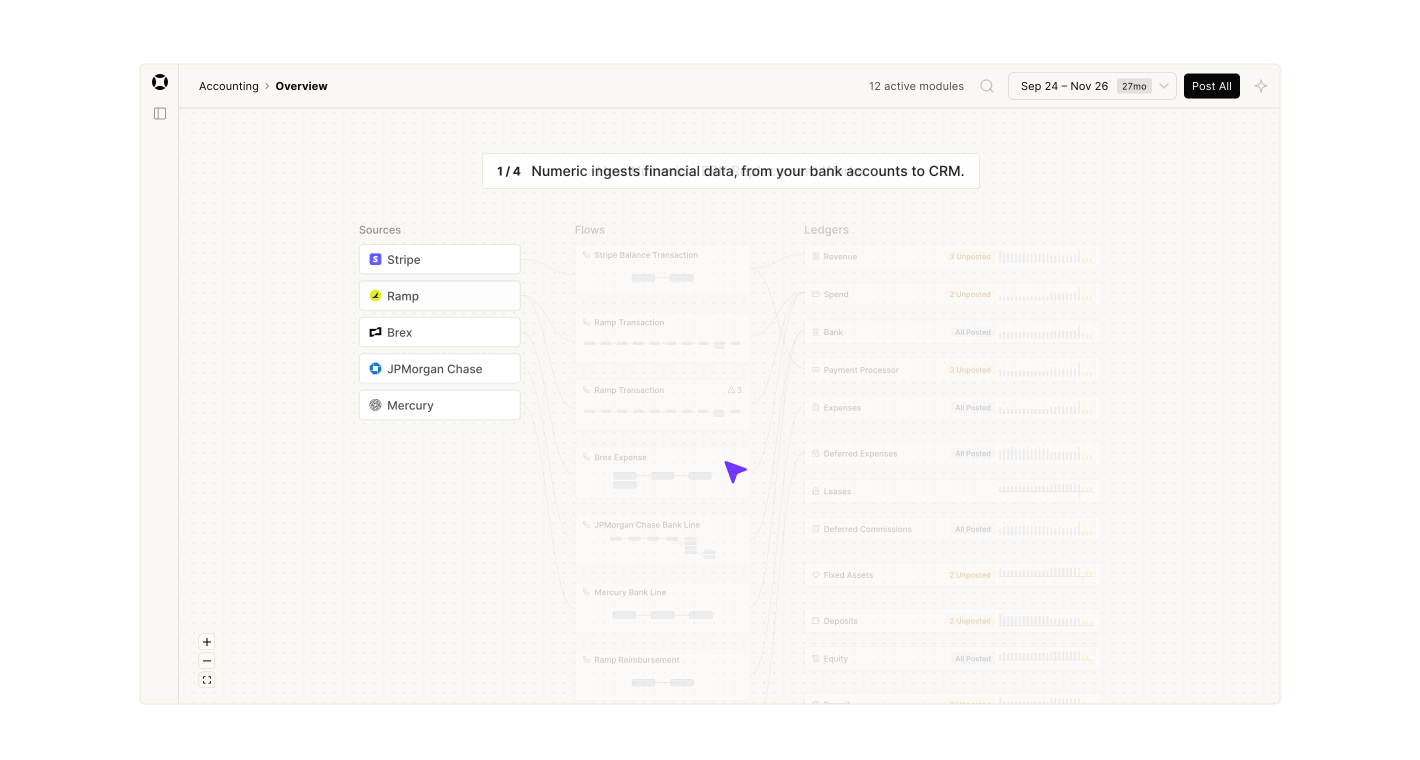
Back in the worked example, the July upgrade becomes a single change to the contract. Numeric uses that change to create the prorated invoice and update the revenue schedule, and it applies the team’s modification policy the same way it does on every contract. Pricing rules live in Numeric too, so finance can launch a new pricing model without switching billing systems.
How Built Runs Billing and Revenue on Numeric
Built Technologies, the real estate finance platform that connects more than 340 lenders, runs billing and revenue recognition for its usage-based billing model on Numeric's Financial Data Platform (FDP), after moving its accounting onto it in early 2026. The team freed two FTEs' worth of bandwidth from billing and revenue work and now delivers invoices to customers four business days earlier. Controller Asia McKnight described how that changed her team's role. "We don't really have a heads-down period of weeks on end when we're not available to the business," she said. "Our whole team is available on a daily basis." The full story is in the Built case study.
Billing and Revenue requires NetSuite as the accounting system when used on its own, and revenue entries and invoices export to NetSuite. Getting to the full platform doesn't require a single cutover, either. A team can start on Billing and Revenue alone and bring the rest of its financial data onto the Financial Data Platform once the case for it is clear.

Test Any Solution With One Real Contract
A practical test for any shortlist is to take one real hybrid contract with a mid-term upgrade and ask each vendor to run it end to end. Watch whether the invoice, the revenue schedule, and the deferred revenue balance all move from that single change.
If your team reconciles a billing system against revenue schedules every month, schedule a demo to see Numeric run that contract through billing and revenue together.
Billing and Revenue Management FAQs
What is billing and revenue management?
Billing and revenue management is the set of processes that turn a signed customer contract into invoices, collected payments, and revenue recognized under ASC 606. It keeps what was billed and what was earned tied to the same contract as that contract changes.
What is the difference between billing and revenue recognition?
Billing determines what the customer owes and when the company invoices it. Revenue recognition determines when the company has earned that money and can record it on the income statement, which under ASC 606 follows delivery of the service. An upfront annual invoice therefore creates deferred revenue that is released month by month.
What are the three types of billing?
The three common billing types for software companies are recurring billing, usage-based billing, and one-time billing. Recurring billing charges a fixed subscription fee each period, usage-based billing charges for what the customer consumed, and one-time billing covers charges like implementation or setup fees. Many B2B contracts combine all three on a single invoice, which is why billing and revenue recognition both need to start from the full contract.
What are the benefits of billing and revenue management?
Billing and revenue management keeps invoices, recognized revenue, and deferred revenue tied to the same contracts. That gives finance on-time invoicing, a faster tie-out at close, less revenue leakage from missed usage or contract changes, and an audit trail from every revenue figure back to its contract.
What is revenue leakage?
Revenue leakage is revenue a company has earned but never bills or records. It often comes from usage that matches no contract, an upgrade that never reaches the billing system, or a price change applied late. Billing and revenue management reduces it by matching every usage event and contract change to the right contract before invoices go out.
What is order-to-cash?
Order-to-cash is everything from a signed deal to collected payment. It includes capturing deal terms, sending invoices, calculating sales tax, matching payments to invoices, and recognizing revenue as the service is delivered.
Does billing and revenue management software work with NetSuite?
Many billing and revenue management solutions connect to NetSuite, and the method varies by vendor, as our guide to NetSuite integrations by use case explains. Numeric's Billing and Revenue product works with NetSuite as the accounting system today, with revenue entries and invoices exported to NetSuite.
Related Content
Billing and Revenue Management: A Guide for SaaS Finance Teams
Billing and revenue management keeps invoices and ASC 606 revenue tied to one contract. See how contract changes affect both and how to evaluate a solution.
Automated ASC 842: From Lease PDF to Audit-Ready Schedule
How to automate ASC 842 lease accounting, from extracting lease terms to the ROU asset, lease liability, and journal entries your auditors can trace.

ERP for SaaS: How to Choose an Accounting System Built for Subscription and Usage Revenue
A guide to choosing an ERP for SaaS, covering ASC 606 revenue recognition, usage-based billing, multi-entity, reporting, and a checklist for vendor demos.