Cash Flow Management in 2026: Complete Guide for Controllers and CFOs

.png)
Here's a true and perhaps sobering fact: only around half of new businesses survive five years.
That means half of businesses close down within five years. On a ten-year horizon, this figure jumps to 65%. And sadly, around 20% of businesses close within the first year of operation.
Why? The same dataset indicates that 82% of business failures involve cash flow problems. This doesn't mean that a lack of cash is the only reason why businesses go under, but it does point to cash flow as a key symptom of other forces at play. The fundamentals of the business obviously impact cash flow, but so do other factors like interest rates, the funding environment, payment cycles, and broader liquidity considerations.
So, while earning more revenue and cutting costs can help a business survive, so can competent stewardship by CFOs, controllers, and accountants who understand that the difference between a business lasting five years, ten years, or longer can come down to cash flow management.
In order to practice optimal cash flow management, teams need data and tools that enable them to ask more sophisticated questions beyond, "can we make payroll?". Teams who can implement proactive, scenario-based cash planning based on accurate historical and real-time data are more likely to develop cash flow management strategies that support the fundamentals of the business.
This article will serve as a guide to cash flow management for modern accounting teams. With the insights provided here, teams can turn cash flow management into an asset that protects the business and increases the likelihood of its future survival.
Cash Flow Management, Explained
Cash flow management is the process of tracking, analyzing, and optimizing the timing and magnitude of cash inflows and outflows. This set of processes is essential because it drives the business's ability to meet obligations, avoid shortfalls, and fund ongoing growth.
But how is cash flow actually measured?
At its core, cash flow begins with net income. Then, non-cash charges like depreciation are added back (reducing net income). Next, working capital movements capture the gap between when revenue and expenses are recognized in the GL versus when cash actually flows in or out of accounts. These adjustments are the bridge between the cash flow statement and the general ledger.
Three Categories of Cash Flow
To understand cash flow management, one helpful framing is to separate cash flow into three categories:
- Cash flow operations: This represents the cash generated or consumed by core business activities (i.e., selling products or services). For instance, a SaaS company may collect $500K in subscription payments and pays $300K in salaries and vendor invoices, netting $200K in operating cash flow for the period in question.
- Cash flow investing: This represents cash that goes out or comes in from long-term assets and investments. This category includes investments that will generate value over time but aren't part of daily operations. For example, a manufacturer may spend $2M purchasing new production equipment, which will appear as a cash outflow in this category.
- Cash flow financing: This represents cash movements related to how the business is funded, either through debt, equity, or returns to investors. For example, a private equity-backed restaurant group may raise $40M in leveraged debt to acquire a competing chain, recording the disbursement as a cash inflow in the financing section.
Cash flow from operations is the primary indicator of day-to-day financial health of the business. Cash flow from investing reflects the business's capital allocation decisions, which is relevant for long-term performance. Cash flow from financing shows how the business funds itself and manages its capital structure over time.
Taken together, the three categories offer a complete picture of where cash comes from and where it goes.
Cash Flow Management Across Business Stages
A general understanding of cash flow (and possession of the tools to manage it) is only the foundation. The specifics of your business, and especially its maturity level, determines the priorities that your team should follow to protect the business and ensure its survival.
Early-stage or venture-backed companies, for example, may emphasize runway and covenant compliance. When a company is pre-profit and dependent on external funding, the risk of running out of cash before reaching sustainability or the next financing event is real. Covenant compliance also matters because debt agreements often include performance thresholds that, if breached, can trigger default.
To manage these priorities, accountants typically build rolling cash flow forecasts (often 13-week models) to project runway, monitor burn rate, and track covenant metrics.
Mid-stage companies tend to shift their focus toward working capital efficiency and capital allocation. As revenue scales, the most significant risk is that growth could outpace liquidity. A fast-growing business can become cash-poor even while profitable, particularly if it carries significant inventory or extended payment terms with customers.
To address these priorities, accountants focus on optimizing AR/AP timing, maintaining accurate liquidity cash forecasts, and managing the company's funding strategy.
Why Cash Flow Management Matters (And What It Impacts)
Cash flow management is a core business discipline. It involves specific, repeatable tasks that are executed as part of day-to-day operations, but that doesn't diminish its strategic significance. Cash flow management affects operations, growth, and can even determine the organization's odds of survival. Remember: 82% of business failures involve cash flow.
Cash Flow And Business Survival
In practice, suboptimal cash flow management can create cash shortages. Even profitable businesses are susceptible to mismanagement, and the cash shortages that result can snowball into existential problems.
Businesses that lack the cash to cover vendor payments or meet debt covenant thresholds expose themselves to material costs in the form of fees, term changes, or other penalties. When cash is insufficient to cover payroll or fulfill investment commitments, the reputational damage is less quantifiable but equally serious.
These pressures may not be existential at first, but over time they can determine whether a business survives. Reputational damage and doubts about creditworthiness that might be manageable in isolation can compound, leaving the business far more vulnerable the next time a cash crunch arrives.
Strong liquidity management, on the other hand, protects the business from such outcomes. Moreover, having cash available during a sectoral or systemic downturn opens strategic avenues.
Impact On Operations, Growth, And Resilience
When cash flow is healthy, the benefits can extend beyond internal stakeholders. External suppliers, lenders, and analysts value solid cash flow management because it signals reliability and broader management effectiveness. Consequently, the business may enjoy more favorable negotiation terms or an increase in perceived brand value (which boosts everything from recruiting to business development and growth).
During a shock, companies with strong cash positions can tap into liquidity to meet obligations. But they can also act opportunistically to hire talent, conduct M&A, or purchase inventory at the precise time when competitors are forced to act defensively. The key is not necessarily to maintain reserves in case of a disruption, but to practice cash flow management techniques that account for a variety of outcomes.
Cash Flow, Working Capital, And Runway
To keep operations running smoothly, every organization needs access to short-term capital. Without it, they can't pay employees, suppliers, or operating costs. In the worst cases, not meeting these obligations leads to insolvency.
That's why finance teams carefully monitor working capital, which is the amount of cash available to fund day-to-day operations (after accounting for short-term obligations).
In order to effectively manage working capital, teams study the Cash Conversion Cycle, or CCC, which essentially measures how long cash is tied up in the operating cycle. A lower CCC means that inventory is purchased, sold to generate AR, and then that AR is collected quickly. A higher CCC means that these steps take longer to complete, and cash flow is slower.
If cash flow is slow, that means the business has higher working capital needs.
In addition, some businesses pursue strategies that don't generate a profit at all. Periods of unprofitability can be justified by a strategy that seeks to establish a brand or carve out market share, but in such cases, businesses should monitor working capital even more closely. If an organization isn't turning a profit, they risk running out of cash or "runway" unless new capital is infused, which makes the finance team's role even more instrumental.
Common Cash Flow Challenges For Modern Finance Teams
As finance teams adopt modern tools, automated workflows will accelerate the production of critical insights, reports, and forecasts. However, the modernization journey doesn't happen all at once, and cash flow management challenges will persist even as teams implement changes that will ultimately lead to smoother processes.
Symptoms Of Poor Cash Flow Management
When teams don't practice effective cash flow management, the consequences ripple through the organization.
Symptoms of weak cash management can include activities which drain time and effort from finance teams and leadership. For instance: needing to constantly check bank balances manually via bank portal logins, frequently resorting to short-term borrowing to meet payroll, or chronically paying vendors and suppliers late. If your organization exhibits these symptoms with any regularity, it's likely that cash management is part of the underlying ailment.
Stakeholders don't want these symptoms to persist. But the questions that they ask in order to resolve them (such as, "do we have enough cash to make payroll next week?" or, "What is our runway if revenue drops 20%?") aren't easy to answer using backward-looking reports built using stale data.
Process And Data Gaps Inside Finance Teams
Unfortunately, many teams are forced to use stale data and lagging reports because the cash flow management tools at their disposal can't do better.
Fragmented data sources and the manual processes required to reconcile them are one root of the problem. Another root is the month-end close, which can take a week or longer. To deliver a better financial close, teams must implement automation and AI; until this happens, legacy systems and spreadsheets will continue to act as bottlenecks on cash flow management.
Modern teams are speeding up workflows and empowering stakeholders by using real-time tools to provide rolling cash data. This data, in turn, powers more timely reports and dashboards. Furthermore, the month-end close can be accelerated by implementing continuous accounting, which distributes close tasks rather than concentrating them at period-end.
Four Key Strategies For Better Cash Flow Management
Cash flow categories, business-stage priorities, and commonly-encountered obstacles provide necessary context. But to actually improve cash flow management, teams should consider the following four strategies.
1. Build And Maintain A 13-Week Rolling Cash Flow Forecast
The 13-week rolling cash flow forecast is a standard tool for liquidity management. Thirteen weeks is granular enough for weekly decision-making, but farsighted enough to surface emerging issues before they become crises.
To construct this forecast, start with your opening cash balance. Layer in weekly expected inflows (collections, new sales receipts) and outflows (payroll, vendor payments, debt service, taxes). Document key assumptions (e.g., "assume 85% of AR collected within terms").
The forecast is only valuable if it's maintained according to a regular cadence. Update weekly, compare projections against actuals, and run variance analysis to understand where the model diverged. Over time, the forecast will benefit from sharpened assumptions and improved accuracy. Reliability depends on the data feeding it: automated bank and ERP feeds reduce reconciliation burden, and a streamlined month-end close ensures the underlying numbers are trustworthy.
2. Optimize Receivables (AR) For Faster Inflows
Cash doesn't land in your organization's account when revenue is recognized. It arrives when the customer pays, making AR optimization one of the most effective cash levers.
Start by tightening and standardizing credit policies. Every customer should have documented terms, credit limits, and escalation paths. Where possible, negotiate shorter terms (particularly with new or lower-volume customers).
Operationally, prompt and accurate invoicing is an easy win. Delayed or error-ridden invoices create disputes, and disputes delay payment. Automated reminders reduce the effort of chasing payments, while early-payment discounts can accelerate collections.
The key enabling tech for better AR is having clean AR subledger data. Strong cash application processes, including auto-matching capabilities, reduce unapplied cash and improve visibility into expected inflows.

3. Optimize Payables (AP) Without Damaging Relationships
If AR optimization accelerates inflows, AP optimization manages the timing of outflows. The goal isn't to pay late, but rather to use full terms without incurring late fees or jeopardizing vendor relationships.
If a vendor offers net-30 terms, paying on day 7 reduces your cash position three weeks early without necessarily creating any benefits to the vendor relationship. During tighter periods, try segmenting vendors by criticality: pay strategic vendors (like sole-source suppliers or key technology providers) on time, and deprioritize non-critical vendors if needed (provided your team communicates proactively). AP automation supports both visibility and control through automated approval workflows, payment scheduling, and centralized dashboards.
4. Financing Tools, Buffers, And Risk Management
Even with optimized AR and AP, external financing tools and cash buffers matter. Ideally, you should arrange them before a crisis, not during one.
Common tools include revolving lines of credit, short-term borrowing facilities, invoice financing, and covenant-lite debt structures.
Beyond credit facilities, maintaining a buffer of three or more months of core operating expenses can act as a cushion against disruptions. Teams should also map contingency levers in advance: which expenses can be deferred? Which credit lines can be drawn? At what thresholds does each lever activate? These decisions are critical for shaping your broader cash flow management strategy and can benefit from input across finance and leadership, so consider an inclusive process for their resolution.
How Accounting Functions Ladder Up Into Cash Flow Management
Cash flow management is sometimes framed as a treasury or FP&A responsibility. In reality, accounting is the operational engine behind nearly every input that supports those functions.
Accounts Receivable As The Inflow Engine
AR is where revenue converts into cash. From order entry to invoicing to collections to cash application, any breakdown slows down the cash conversion cycle (and thus also impacts working capital). Late invoices delay payment terms. Errors trigger disputes. Weak cash application leaves payments unapplied, distorting aging reports and making inflows harder to forecast.
Better AR reporting and aging analysis supports proactive collections. When teams can segment overdue accounts by risk, size, or relationship, they can prioritize collections outreach strategically, which further optimizes cash flow and reduces liquidity risk over the long run.
Accounts Payable, Procurement, And Payment Policies
The same way that AR policies drive cash inflows, AP controls determine cash outflows. Approval workflows, payment run schedules, and vendor record hygiene all influence outflow timing, and an optimal AP strategy accounts for all three processes.
Creating alignment between procurement and AP is equally important: vendor terms and cost of goods both have impact, and the organization's cash flow strategy should incorporate both. Purchase order discipline also prevents spending from creating unexpected outflows, and when finance and operations teams are both aligned on payment strategies, outflow timing becomes much more predictable.
The Financial Close As The Data Foundation
Cash flow management can only be as good as the financial close that supports it.
If reconciliations are out of date or bank accounts haven't been reconciled, the cash position that forms the basis for all downstream decisions is inherently unreliable. Those decisions, in turn, cannot be made with confidence. Continuous accounting practices (like ongoing reconciliations, real-time transaction monitoring, and automated journal entry workflows) distribute close tasks across the period, producing timelier data. As a result, your team can make more accurate forecasts and more confident decisions.
Numeric unifies the close, account reconciliations, and cash management in a single workspace. When close data flows directly into cash visibility without manual handoffs, the time and effort savings compound for your finance team and the organization's stakeholders.
FP&A, Treasury, And Strategic Cash Decisions
FP&A and treasury build medium- to long-range forecasts. They also develop capital allocation plans and bank structures using actuals produced by accounting. Every day that can be shaved off the close is a day that can go toward analysis and strategy.
When accounting and FP&A share a common data platform, data sharing for variance analysis on cash drivers becomes seamless. Numeric enables a structured, repeatable approach to variance analysis and reporting by giving your team unified access to the relevant data.
Get Real-Time Cash Flow Visibility With Numeric
.png)
How Technology And Automation Transform Cash Flow Management
Modern accounting tools deliver speed, accuracy, and continuous insights for teams who want to optimize cash flow management. AI and automation handle repetitive, high-volume work, while the team focuses on analysis, judgment, and strategy.
Limitations Of Spreadsheet-Only Cash Management
Many teams still manage cash through spreadsheets. The manual version of cash flow management involves exporting data from bank portals, manually matching against GL entries, maintaining offline forecast models, and building insights into decks by hand. Often this set of workflows depends on one or two people who possess the requisite institutional knowledge.
The risks compound quickly:
- Version control issues and hidden formula errors
- Delayed updates and lack of auditability
- Extreme dependence on tribal knowledge
- No real-time answer when leadership asks, "where is cash today?"
Even small teams have no reason to continue to use spreadsheets exclusively. Alternative tools consume much fewer finance team resources while also providing secondary benefits like auditability and data security.
What To Look For In Cash Flow And Cash Management Tools
When evaluating purpose-built cash management tools, key capabilities include full bank feeds, automated transaction ingestion, robust cash reconciliation (including complex match types like one-to-many and partial matches), and direct ERP integration.
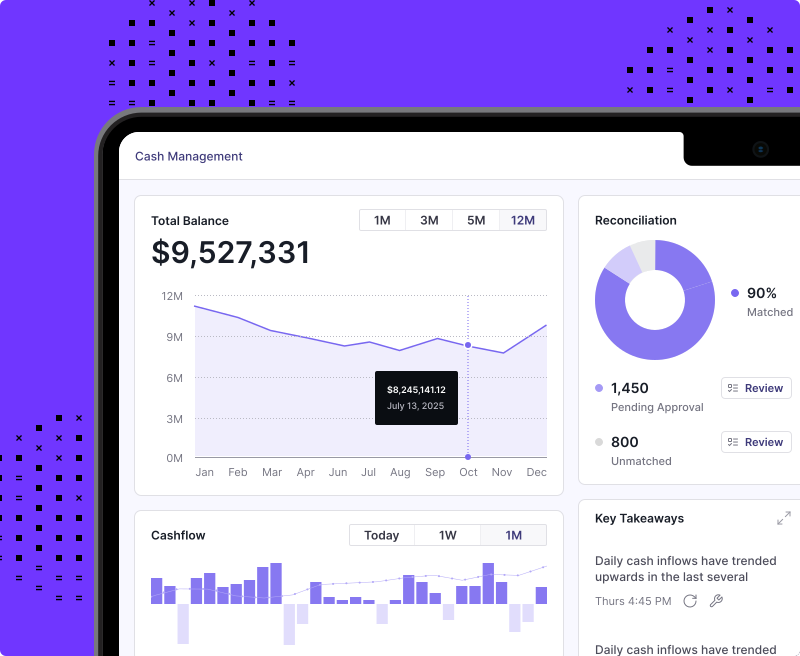
Workflow features are also key. Look for approval chains, audit trails, exception handling, roles and permissions, and documentation that satisfies internal control and audit needs. Best-in-class platforms also integrate cash management with close management and analytics, ensuring one source of truth for all cash flow.
AI, Real-Time Data, And Continuous Accounting For Cash
AI-driven rules engines can automate 90% or more of cash matching, and even improve over time by suggesting new rules based on observed patterns. Continuous accounting amplifies the impact of this iterability by generating more data at a more regular cadence.
AI also supports anomaly detection and narrative generation for variance analysis. Together, these capabilities shift cash management from a periodic, backward-looking exercise to a continuous, forward-looking discipline.
How Numeric Supports Modern Cash Flow Management
Numeric brings close management, cash matching, account reconciliation, and analytics together on a single platform. It automates transaction matching with AI-powered rules that learn from your data. It also supports complex match types and integrates with ERPs, banks, and other modern tools.
Because Numeric also manages the financial close, reconciliation and journal entry data flows directly into cash reporting. There's no manual handoff, no version mismatch, and no waiting until the close is finalized to understand your cash position.
The results speak for themselves. After implementing Numeric, Brex reduced their close from 6 to 4 days — a result Controller Kevin Moore called one of the best decisions he'd made in his 7 years at the company.
Next Steps Towards Better Cash Flow Management
Cash flow management is a continuous discipline that depends on accurate accounting data, strong processes, and the right tools.
Accounting teams are uniquely positioned to modernize this discipline. The data originates in the GL, reconciliations happen in accounting, and the close determines when the data is reliable enough to act on.
As a starting point, audit your current cash workflows. Identify where manual processes create delays or errors, and look for one or two quick wins: an automated bank feed, a faster reconciliation cycle, or a standardized AR follow-up process. From there, explore purpose-built platforms like Numeric that can create a continuous, real-time cash management environment where the close, the cash position, and the forecast are unified and dependable.
Related Content
.png)
Expense Allocation in Accounting: From Shared Costs to True Margins (and Why the Usual Methods Break)
Learn what expense allocation involves, why it's essential for fully loaded P&Ls and true margins, and why spreadsheet models and aggregate JEs keep failing, plus how to fix the root cause.
.png)
Multi-Entity Consolidation: What It Involves, Why It Breaks, and How to Fix It
Learn what multi-entity consolidation involves, why it breaks as companies grow, and why both Excel and add-on tools share a structural flaw. A guide for controllers and VPs of finance.
.png)
How to Build an AI Audit Trail for Your Accounting Workflows
A practical guide to AI audit trails for accounting: what to capture, why SOX, PCAOB, and GAAS require traceability, and how to audit AI agents and skills, not just AI features bolted onto your close software.