Metered Billing Solutions: A Buyer's Guide for SaaS and AI Finance Teams


Most demos of metered billing solutions go the same way. The vendor starts with a single product event, walks it all the way to a revenue report, and shows their platform handling every step in between.
If you're sitting through those demos, you probably landed here for one of three reasons.
- Usage pricing is growing at your company, and finance has been asked to choose a billing system before volume picks up.
- Your engineers already built metering, and you want to know which parts of billing to hand to a vendor.
- You've seen a few demos now, and the options are starting to look alike.
Sound familiar? Wherever you're starting from, the answer begins in the same place. A metered billing solution turns product usage into invoices at the prices in each customer's contract, and some solutions also recognize the revenue from that usage. Before comparing vendors, decide which of those jobs your own team should run.
Andrew Bihl, CTO at Numeric, recommends that usage-priced companies keep metering with their engineers and run invoicing and revenue recognition in one system on the same contract, so engineering keeps control of the usage and pricing customers see, and finance gets invoices and revenue that match because they come from the same terms.
This guide compares the five main types of metered billing solutions and how to decide which parts of billing your team should own. It also covers what to look for in a demo, the questions to ask every vendor, and how Numeric's Billing & Revenue works with the metering your engineers already run.
Key Takeaways
- A metered billing solution turns usage into invoices at contract prices, and some solutions also recognize the revenue from that usage.
- Usage billing platforms, subscription billing platforms, paired billing and revenue tools, ERP billing modules, and back-office billing and revenue systems each cover a different share of the work between a product event and recognized revenue.
- Usage-priced companies with fast-changing pricing or high event volume usually keep metering with their own engineers, because customers see it in the product.
- When invoicing and revenue recognition run on the same contract, invoiced amounts and recognized revenue come from the same terms, so finance has one set of numbers to check.
- Numeric's Billing & Revenue takes usage from a company's own systems and produces invoices, revenue schedules, and accounting entries from one contract, so finance can trace every invoice and revenue number back to the same contract and usage.
What is a metered billing solution?
A metered billing solution charges customers for what they use. It takes usage, such as API calls or tokens, applies the prices in each customer's contract, and turns the result into invoices.
In his post on why AI companies should own their metering, Andrew Bihl breaks billing into four jobs that sit behind every metered billing setup.
- Metering collects usage and applies prices to it.
- Invoicing sends invoices, credits, and refunds to customers.
- Revenue accounting recognizes revenue under ASC 606.
- Contracting holds the commercial terms every other job depends on.
Metered billing solutions differ in which of these jobs they cover, and that difference is the clearest way to compare them.
The main types of metered billing solutions
Each type of solution is built around a different job. For a finance team, the useful question is which jobs a solution leaves for them to handle in another system each month.
Usage billing platforms, subscription billing platforms, paired billing and revenue tools, and ERP billing modules all keep metering in a vendor's platform. Back-office billing and revenue systems like Numeric's Billing & Revenue work with the metering a company's engineers already run, so the first decision is which parts of billing to keep in-house.
Decide what your team should own before you compare vendors
Andrew's rule for usage-priced companies is to build in-house where billing shapes the product and the customer experience, and to buy the work customers never see. Metering is usually part of the product. Customers see their usage and their remaining balance in the product, so decisions about pricing changes and usage limits are product decisions.
His post offers four questions to help a team decide.
- Do we expect to keep changing our usage pricing?
- Do customers expect to see their remaining balance in real time?
- Does our usage volume reach billions of events a month?
- Are we adding limits or spend analytics for customers?
A yes to these questions points toward keeping metering with engineering. Andrew describes how the work then splits between the two teams.
"Billing engineers own the metering side, and both teams work from the same agreement model as pricing and contracts change."
Andrew Bihl, CTO at Numeric
What happens when one platform runs metering through invoicing
When one platform owns everything from metering to invoicing, growing companies often end up building around it. Engineering teams collect and aggregate events themselves before sending them to the vendor, to bring the event volume down. Enterprise agreements that the platform's contract model wasn't built for move into a second system. Revenue recognition shifts into spreadsheets or another tool.
Each of these workarounds makes the platform harder to move off later, because pricing, usage data, and invoicing all depend on it.
When a full metering platform makes sense
A usage billing platform can be a good fit for an early-stage company with simple pricing and modest event volume that wants its engineers focused on the core product. The platform handles metering and invoicing from the start, and the company can revisit the setup as pricing and volume grow, using the questions in Numeric's guide to switching to a usage-based pricing model.
Run invoicing and revenue recognition on the same contract
The back office works best as one system. Everything needed to invoice a customer is part of what revenue recognition needs, and revenue accounting also needs the full contract terms and the state of billing. The difference between what has been billed and what has been earned becomes deferred revenue or unbilled receivables, so the two can only be calculated with both in view.
When invoicing and revenue recognition run on one contract, billings and revenue come from the same terms, and finance has one set of numbers to check. For the revenue accountant, a contract change is entered once. When a customer upgrades or cancels, the invoice and the revenue schedule both update from that contract.
How to evaluate a metered billing solution
Once a team knows it will keep metering in-house, the evaluation centers on the back office. These are the capabilities worth checking in every demo.
- Usage intake from your own systems. The solution takes usage from the company's data warehouse or metering layer, as individual records or already aggregated, so engineering keeps the meter it already runs.
- Usage matched to the contract. Each usage record is matched to the right contract and performance obligation, and anything that doesn't match is held back with the reason, so it is resolved before it reaches an invoice or the revenue schedule.
- One contract for every pricing model. Subscription and usage products sit on the same contract, along with committed usage, pay-as-you-go usage, monthly minimums, and prepaid credits.
- Billing and revenue recognition on the same contract. Revenue schedules build from the contract's performance obligations, and deferred revenue and unbilled receivables come from the same contract that produces the invoice.
- Contract changes that update everything. Upgrades, early renewals, cancellations, and credits update billing and revenue together, with the history of the original contract kept intact.
- A trail auditors can follow. Any revenue number traces back to the contract term, performance obligation, and usage behind it.
- Fit with your accounting system. Invoices and revenue entries reach the general ledger the team already uses, or the solution runs on a ledger of its own.
- Clear ownership of setup. The vendor explains who connects the CRM, the warehouse, tax, payments, and the ledger, and how much of that work lands on engineering.
Numeric's billing and revenue management guide goes deeper on ASC 606 requirements, including contract changes and how a bundled price is split across a deal. For feature and pricing detail on individual vendors, see Numeric's roundup of usage-based billing software.
Questions to ask every metered billing vendor
Take these questions into each demo. A good answer is specific and shows the workflow in the product.
- What happens to usage that doesn't match any contract? A strong answer shows unmatched usage held for review with the reason it couldn't be matched, before it is invoiced or counted as revenue.
- Can one contract hold a subscription and usage-based products together, and how is revenue recognized for each? Look for both on the same contract, with the subscription recognized evenly over the term and usage recognized as it is incurred.
- How are committed usage, monthly minimums, and unused prepaid credits handled in revenue? The vendor should walk through a commitment being drawn down and show where any shortfall or unused credit lands.
- When a customer upgrades or cancels mid-term, what updates automatically? The invoice, the revenue schedule, and the deferred revenue balance should all move from one change to the contract.
- Can I start from a revenue number and trace it back to the contract and usage behind it? Ask to see it live, starting from a monthly revenue total.
- Do you need raw events, or can you take usage we've already aggregated? A good fit accepts usage in the shape your engineers already produce.
- Where does revenue recognition run, and what will my team reconcile each month? The answer tells you how many systems your month-end depends on.

Pair your metering with Numeric's Billing & Revenue
Engineering keeps metering, along with the usage, live pricing, and balances customers see in the product. Numeric's Billing & Revenue takes usage from the company's own systems, such as Snowflake or Databricks, as individual records or already aggregated.
Deal terms come in from Salesforce or HubSpot. AI reads the signed contract and checks it against the deal booked in the CRM, so errors are caught before the first invoice goes out. Numeric's team sets up these connections with each customer.
Invoices and revenue from the same contract
Once usage arrives, Billing and Revenue Recognition both work from the customer's contract.
- Invoices come straight from the contract, with matched usage priced by the contract's terms and billed alongside any subscription fee.
- Revenue schedules build from the contract's performance obligations, with subscriptions recognized evenly over the term and usage recognized in the month the usage is incurred.
- Committed usage is drawn down as the customer uses it, monthly minimums are supported, and unused prepaid credit is recognized as breakage at expiry or rolls over into a renewal.
- Upgrades, early renewals, cancellations, and credits update billing and revenue together, with the history of the original contract kept intact.
- Invoices and revenue include only usage that matches a contract. Anything that doesn't match is held back with the reason, so the team sorts it out before the invoice goes out.
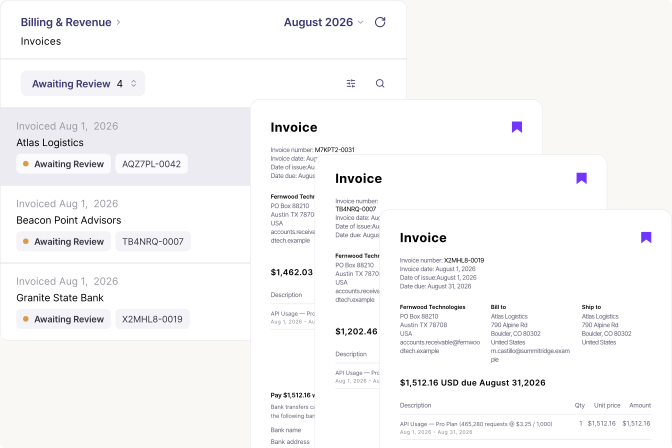
Every revenue number traces back to the contract and the usage behind it, which makes audit requests and customer invoice questions faster to answer.
How Built runs billing and revenue on Numeric
Built, the AI-powered real estate finance platform connecting lenders, owners, developers, and contractors, needed a system that could handle usage-based billing. Running billing and revenue on Numeric freed up 2 FTEs worth of bandwidth from billing and revenue work, and Built now delivers invoices to customers 4 business days earlier.
"We're almost operating in a different century, it feels like, from a data perspective."
Asia McKnight, Controller at Built
Runs alongside NetSuite or on Numeric's ERP replacement
Billing & Revenue runs alongside NetSuite, with invoices and revenue entries exported to NetSuite. Teams ready to move their full accounting can run it on Numeric's ERP replacement, the Financial Data Platform.
Billing & Revenue is built for complex SaaS, fintech, and usage-based revenue businesses in need of a unified data platform, especially companies whose engineers already run their own metering. If you're interested in switching, you can start your journey here.
Bill and recognize revenue for every contract change without updating two systems.
Final thoughts
Once a team knows which parts of billing its engineers will keep, it can judge every vendor by how well it runs invoicing and revenue recognition on the same contract. The questions above give finance a way to test that in a single demo.
If your engineers own metering and your finance team needs billing and revenue on one contract, see how Numeric's Billing & Revenue works.
FAQs about metered billing solutions
A metered billing solution is software that charges customers for what they use by turning measured usage into billable amounts and invoices. Some solutions also recognize the revenue from that usage.
Metered billing measures usage and prices it. Usage-based billing is the full process of charging for consumption, which also includes invoicing and revenue recognition.
Companies with fast-changing pricing, real-time customer balances, or very high event volume usually keep metering in-house and buy a system for invoicing and revenue recognition. Early-stage teams with simple pricing and modest volume can start with a usage billing platform.
It depends on the type of solution. Some recognize revenue in the same system, some pass usage to a separate revenue tool, and some offer revenue reporting, so ask each vendor where revenue recognition runs and what finance reconciles each month.
Revenue follows the contract's performance obligations, and invoicing sets billing timing. Usage has to be tied to the right contract and obligation, and the difference between what was billed and what was earned becomes deferred revenue or unbilled receivables.
For AI companies that keep metering in-house, Numeric's Billing & Revenue runs invoicing and revenue recognition on the same contract. It takes usage from the company's own systems and produces the invoices, revenue schedule, and accounting entries from one contract.
Related Content
Metered Billing Solutions: A Buyer's Guide for SaaS and AI Finance Teams
Compare the main types of metered billing solutions, decide what your team should own, and learn what to ask vendors about invoicing and revenue recognition.

Is Your AI Bill Growing? Here Are the Steps to Take Before You Tighten Team Budgets
How finance leaders at Glean, Figma, and Numeric track AI charges, set token budgets, and lower the cost of recurring AI work.

What Four Years in EMEA Taught Us About Finance Teams and AI Adoption
Four years of working with EMEA finance teams showed us how they adopt AI, from high standards for controls to local partners, peer learning, and a strong data foundation.