Perfecting Prepaid Reconciliation: Best Practices + Tools to Automate


When done right, prepaid reconciliation is a seamless accounting process that ensures accurate financial reporting and compliance. When done wrong, it’s a minefield of errors, misstatements, and wasted hours. For Controllers and accounting teams managing high volumes of prepaid expenses, whether for insurance, rent, or subscription services, staying on top of reconciliations is non-negotiable.
From verifying initial entries to automating monthly adjustments, prepaid reconciliation is all about precision. This guide will walk you through the steps to streamline your process, avoid costly mistakes, and free your team to excel at more strategic work.
Most of that precision work exists because of where prepaid balances live today. A contract gets signed and an invoice gets paid, and by the time that payment reaches the general ledger it’s a journal entry with no memory of the contract terms behind it. So someone has to build an amortization schedule in a spreadsheet just to know what that entry should track going forward, then tie the two together by hand every month.
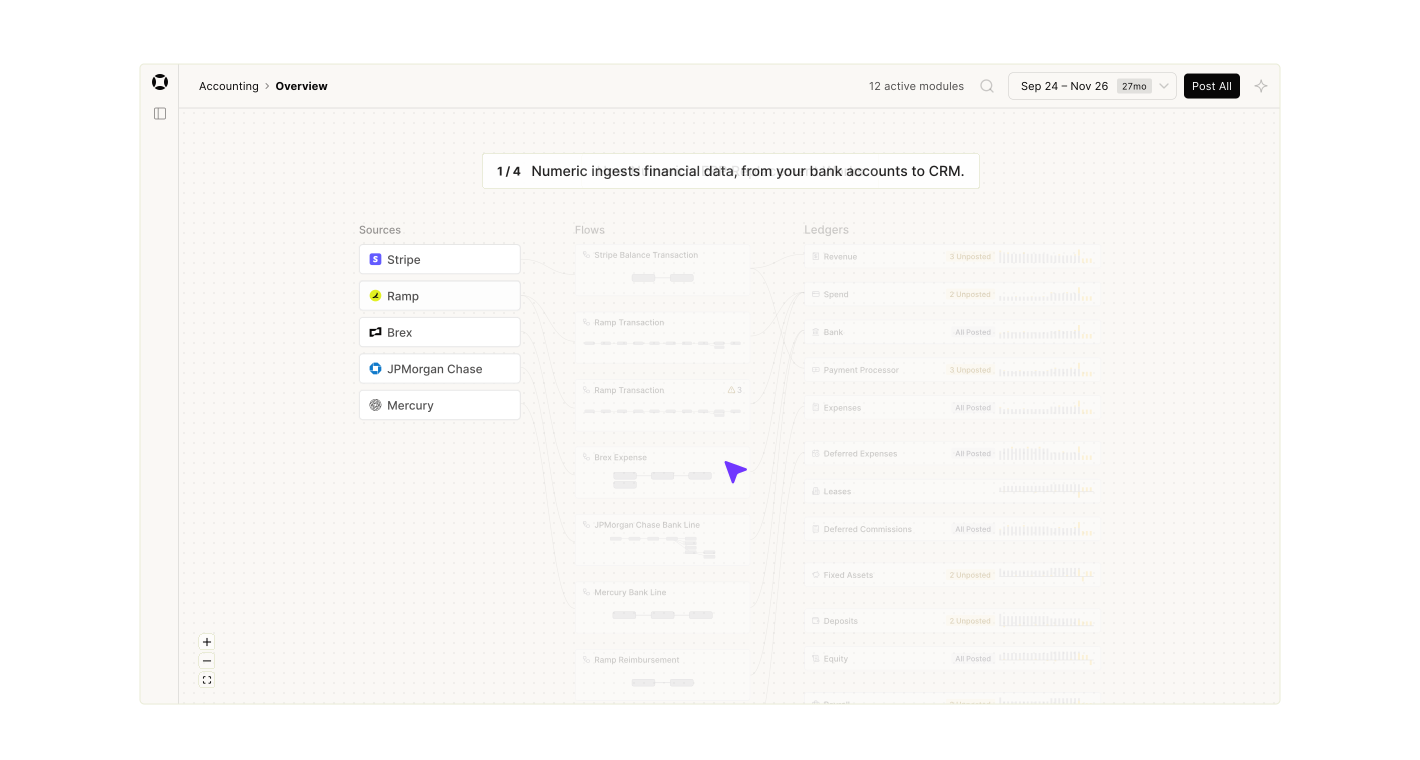
Numeric’s ERP replacement, the Financial Data Platform, starts from the contract instead. It keeps each prepaid contract in its financial graph, the connected record of your contracts and invoices and the business events that happen to them, and a Ledger runs the amortization from there. Because the schedule and the monthly entries come from the same record, they stay in sync on their own.
Understanding Prepaid Expenses
Prepaid expenses are payments made in advance, or prepayments, for goods or services that will be used in future accounting periods. These transactions are recorded as current assets on the balance sheet and expensed over time to align costs with the periods in which benefits are received.
For example, when a company prepays for an annual insurance policy, the full payment is initially recorded as a prepaid asset. Each month, a portion of that cost is recognized as an expense, ensuring the financial statements accurately reflect when the benefit is received. Other common prepaid expenses include rent, software subscriptions, maintenance contracts, and even regulatory payments like taxes and utilities.
Accounting teams must ensure prepaid expenses are classified correctly. If the benefit extends beyond 12 months, the prepaid balance is divided into current and non-current assets to maintain compliance with financial reporting standards.
Recording Prepaid Expenses
To accurately record prepaid expenses, teams must follow a structured bookkeeping process. When the initial payment is made, it is recorded as an asset by debiting the prepaid expense account and crediting cash or accounts payable. This treatment ensures that the expense is not immediately recognized, which would otherwise distort the company’s financial results.
Over time, as the benefit is used, a portion of the prepaid balance is expensed in alignment with the matching principle of accrual accounting. For example, if a company pays $12,000 upfront for an annual insurance policy, the following journal entry applies:
- Upon payment: Debit "Prepaid Insurance" $12,000; Credit "Cash Account" $12,000
- Each month: Debit "Insurance Expense" $1,000; Credit "Prepaid Insurance" $1,000
Ensuring accurate documentation and approvals is essential. Contracts and invoices should specify payment terms and benefit periods, while approvals from department heads help strengthen financial controls. Without proper oversight, prepaid expenses can be misclassified, leading to discrepancies in financial statements and audit risks.
Amortizing Prepaid Expenses
Amortization of prepaid expenses spreads the cost of a prepaid item over the period in which it provides value. This process prevents financial statements from reflecting an immediate, disproportionate expense in the period of payment. Instead, amortization ensures expenses are recognized progressively, aligning with revenue and operational activity.
A structured amortization schedule is essential to maintaining accurate financial records. This schedule should include clear start and end dates for expense recognition, ensuring adjustments are made promptly when contracts are modified, extended, or canceled.
In the Financial Data Platform, that schedule lives inside a Ledger. A Ledger works like a subledger built into the system: it holds the prepaid contract and moves value from the prepaid asset to expense each period based on the amortization rule you set. The monthly journal entries are derived from the contract and staged for you, and the schedule your team reviews is built from that contract too.
For prepaid expenses that span multiple years, classification is critical. Consider a company that pays $90,000 upfront for a three-year software subscription. At signing, $30,000 remains in the prepaid asset account as a current asset, while the remaining $60,000 is classified as a non-current asset. Proper classification allows stakeholders to assess long-term financial commitments with clarity.
When a contract is extended or canceled, your team updates the contract itself, and the remaining schedule and the entries that follow update with it. The contract stays the one place to check.
Step-by-Step Guide to Prepaid Expense Reconciliation
1. Compile Documentation
Gather all prepaid contracts, invoices, and supporting documentation. Without complete records, discrepancies can arise, leading to misstatements in financial reports and balance sheet reconciliations.
2. Verify Initial Entries
Review the original journal entry to ensure prepaid expenses were recorded correctly and classified as assets rather than expenses. Confirm that amounts match supporting documents and the trial balance.
3. Update Amortization Schedules
Adjust amortization schedules to reflect any contract changes, including extensions, terminations, or modifications. Failing to update schedules can result in inaccurate expense recognition and impact the financial close process.
4. Post Monthly Adjusting Entries
Recording adjusting journal entries each month ensures expenses align with the appropriate accounting period and prevents overstating assets on the balance sheet.
5. Reconcile Ledger Balances
Compare prepaid expense balances in the general ledger with amortization schedules. If discrepancies arise, investigate the cause and make necessary corrections.
With the Financial Data Platform, this step looks different. The balance and the schedule come from the same contract, so review shifts from tying two copies together each month toward checking the exceptions the system flags.
6. Investigate and Resolve Discrepancies
Identify and address missing entries, duplicate postings, or misclassifications. Timely resolution of these issues ensures accurate financial reporting and prevents larger errors from accumulating over time.
7. Ensure Compliance with Accounting Standards
Verify that prepaid expenses are managed in accordance with GAAP, IFRS, and relevant regulatory requirements. Regular compliance reviews help teams stay aligned with evolving accounting standards.
Streamline Prepaid Reconciliation with Numeric’s Prepaid Expense Template
Tracking prepaid expenses across multiple vendors, amortization schedules, and adjusting entries can be tedious without a structured approach. Our Prepaid Expense Workpaper Template simplifies reconciliation by providing an organized way to track prepaid balances, automate amortization schedules, and ensure accurate expense recognition.
By using this template, finance teams can:
- Maintain a structured record of prepaid expenses, amortization schedules, and adjustments.
- Easily compare prepaid expense accounts with the general ledger trial balance.
- Improve account reconciliation efficiency by reducing manual errors and inconsistencies.
Keep every prepaid balance tied to its schedule. Download the free prepaid expense workpaper template.

Leveraging Technology for Efficient Reconciliation
Reconciling prepaid expenses takes real time, and most of it goes to keeping the spreadsheet schedule and the general ledger in agreement. The Financial Data Platform moves that work into the system. Policies like amortization periods and capitalization thresholds become rules the Ledger applies to every new prepaid contract, so treatment stays consistent from one vendor and one period to the next, and your team spends its review time on the exceptions.
Assessing and Accounting for Impairment of Prepaid Expenses
Handling prepaid expenses doesn’t end with initial journal entries or amortization schedules. When circumstances change, accounting teams must reassess whether these expenses still provide economic benefits or have lost value. This involves revisiting original assumptions and determining if the goods or services will still be used as planned.
Evaluating Changes in Expected Economic Benefits
To determine recoverability, identify any factors that could reduce a prepaid expense’s value, such as operational shifts, regulatory changes, or vendor failures. For example, if an upfront-paid subscription becomes irrelevant due to a strategic pivot, it may need to be written off.
Compare the prepaid balance to its expected benefits. If the benefit is less than the carrying amount, recognize the impairment. This process often requires collaboration with department heads to understand resource utilization.
Accounting for Service Cancellations or Non-Use of Prepaid Assets
If a service tied to a prepaid expense is canceled or unused, adjust accounting records promptly. Determine if a refund or credit is available. If so, reclassify the amount to accounts receivable. If not, write off the remaining balance as an expense.
For example, if a $24,000 annual software subscription is canceled after six months with no refund, the remaining $12,000 must be expensed. The journal entry would debit "Software Subscription Expense" by $12,000 and credit "Prepaid Software Subscription" by $12,000.
Unused prepaid assets also require review. If a maintenance contract is tied to decommissioned equipment, explore reassignment or renegotiation. If neither is feasible, expense the unused portion immediately.
Guidelines for Writing Down Impaired Prepaid Expenses
If impairment is confirmed, reduce the prepaid expense to its recoverable amount, the lower of its carrying value or expected benefit. If no benefits remain, expense the entire balance. The journal entry typically debits an expense account and credits the prepaid expense account.
For instance, if a company prepays $50,000 for event space but cancels, and the vendor retains 20% as a fee, the $10,000 fee is expensed and the remaining $40,000 is reclassified to a receivable. The entry debits "Cancellation Fee Expense" by $10,000 and "Accounts Receivable" by $40,000, and credits "Prepaid Event" by $50,000.
Maintaining detailed documentation of impairment analyses, including justification and vendor communications, ensures audit readiness and transparency.
Impact on Financial Statements and Reconciliation Processes
Impairments affect financial reporting by reducing assets on the balance sheet and increasing expenses on the income statement, impacting net income and key metrics like current ratios or EBITDA.
Reconciliation processes must incorporate impairment adjustments. Update amortization schedules and verify that the general ledger aligns with the revised prepaid balance. For example, if part of a prepaid insurance balance is impaired, the reconciliation should confirm that both the asset and expense accounts match the updated schedule.
Failing to recognize impairments can overstate assets and understate expenses, leading to audit concerns. Regular reviews of prepaid balances, especially at month-end and year-end, help identify impairments early and maintain reporting accuracy.
Build prepaid schedules straight from the contract. See how the Financial Data Platform derives the schedule and the monthly entries for you.
Common Mistakes to Avoid During Reconciliation
Even experienced teams encounter challenges in prepaid expense reconciliation. Avoid these common errors to maintain accuracy and stay audit-ready.
Incorrect Amortization Periods: Expense recognition must align with the benefit period. Misalignments, such as recording a quarterly payment as a monthly expense, can distort financials. Always verify that amortization schedules reflect contract terms.
Missing Adjusting Entries: Monthly adjusting entries prevent prepaid accounts from being overstated and expenses from being underreported. Skipping these entries leads to discrepancies, particularly at period-end. Automating adjustments or setting reminders can help.
Overlooking Contract Changes: Failing to update schedules for contract modifications, such as extensions or terminations, leads to outdated balances and errors. If a software subscription is extended by three months but the schedule remains unchanged, the reported expense won’t align with actual usage.
Duplication of Entries: Entering prepaid expenses or amortization multiple times inflates both asset and expense accounts. This often happens in manual reconciliations when multiple team members handle the same accounts. Clear workflows and review processes help prevent duplication.
Neglecting Regular Reconciliation: Skipping reconciliation allows errors to compound, making them harder to correct later. A mistake in January, if unnoticed, can create a significant variance by December. Monthly reconciliation helps catch issues early.
Ignoring Foreign Exchange Impacts: Prepaid expenses in foreign currencies must be adjusted for exchange rate fluctuations. Failure to account for these changes can result in misstatements. Adjusting for currency gains or losses ensures accurate reporting.
Tailoring reconciliation processes to your organization’s specific needs, whether based on industry regulations, transaction volume, or currency exposure, prevents inefficiencies and inaccuracies from a one-size-fits-all approach.
Best Practices for Managing Prepaid Expenses
Establish Clear Policies and Procedures: Standardize recording, tracking, and amortization rules. Define materiality thresholds, proper accounts for different prepaids, and amortization timelines. Having clear policies reduces confusion and enhances consistency.
Provide Ongoing Training for Staff: Keep accounting teams updated on prepaid expense processes, contract interpretation, and relevant accounting standards. Regular training minimizes errors and improves reconciliation efficiency.
Strengthen Internal Controls: Implement controls to catch errors and prevent fraud. Require dual approvals for significant prepaid transactions and establish review processes for adjusting entries. For example, a manager might review any prepaid entries over $10,000 before finalization.
Schedule Regular Reviews: Conduct routine reconciliations to ensure prepaid accounts match amortization schedules and supporting documents. Monthly reviews identify missed entries or contract changes early, preventing cumulative errors.
Stay Current with Accounting Standards: Monitor updates to GAAP, IFRS, and industry-specific rules impacting prepaid accounting. For example, ASC 842 significantly changed how prepaid lease payments are handled. Staying informed helps maintain compliance and audit readiness.
Leverage Technology for Efficiency: Automate tasks like tracking amortization schedules, posting journal entries, and flagging discrepancies. On the FDP, every prepaid entry stays tied to the contract or invoice behind it, so an exception arrives with its source attached and review starts from the evidence.
Encourage Cross-Department Collaboration: Work closely with procurement and operations to enhance communication about prepaid transactions. For instance, procurement can notify accounting of upcoming large payments, while operations can flag contract modifications. Improved collaboration ensures accurate prepaid management and reconciliation.
By implementing these best practices, finance teams can streamline prepaid expense management, minimize errors, and enhance financial reporting accuracy.
See prepaid amortization run on the Financial Data Platform. Book a demo to walk through it with our team.
Bottom Line
Prepaid reconciliation ensures every dollar paid upfront earns its keep on the balance sheet. By keeping amortization schedules accurate, reconciling regularly, and addressing discrepancies as they arise, you can turn what might seem like a tedious exercise into a cornerstone of financial accuracy. Nail your prepaid reconciliations, and you’ll spend less time firefighting errors and more time focusing on the bigger picture.
Related Content

Numeric vs. Campfire: Features, Fit, and Key Differences
Numeric vs. Campfire ERP compared on what changes for your accounting team, from contract amendments and usage billing to reporting and audit support.

Numeric vs. Rillet: Features, Fit, and Key Differences
Numeric vs. Rillet compared on what changes for your accounting team, from contract amendments and usage billing to reporting and audit support.

Billing and Revenue Management: A Guide for SaaS Finance Teams
Billing and revenue management keeps invoices and ASC 606 revenue tied to one contract. See how contract changes affect both and how to evaluate a solution.