Numeric vs. Rillet: Features, Fit, and Key Differences


Finance leaders replacing NetSuite often end up with Numeric vs. Rillet on the same shortlist. Rillet is an AI-native ERP that puts a modern interface and AI features on a traditional general ledger. Numeric's ERP replacement, the Financial Data Platform, is a data lakehouse with accounting intelligence built on top, where journal entries are derived for you from the business events behind them.
Rillet modernizes the general ledger, while Numeric changes what the ledger is built from, and that difference shows up in the work itself. This guide follows a few ordinary moments in an accountant's month, like a mid-term contract amendment, a new reporting request from the CFO, or an auditor asking for the support behind a figure, and shows what your team would do in each product. It then compares the two on billing, reporting, AI, and implementation.
Key Takeaways
- In Rillet, as in NetSuite, the journal entry is the record the ledger keeps and reports from. In Numeric's Financial Data Platform, the underlying business record stays the source of truth, and each journal entry is derived from it and linked back to it.
- That changes the accountant's day. On Numeric, the morning starts with a handful of items to review and rules to approve, and a contract change, a new reporting cut, or an audit request is handled on the source record itself.
- Numeric runs billing and revenue recognition from the same contract and pulls usage straight from the data warehouse, so an amendment or a usage spike updates the invoice and the revenue schedule together. Rillet takes usage by API or file upload.
- Rillet focuses on getting teams onto its general ledger quickly, with most customers live within six weeks. Numeric lets teams begin with Billing and Revenue or Cash Management, prove it out next to their current system, and grow into the full platform.
- SaaS, fintech, and usage-based revenue businesses whose hardest work sits in billing, revenue, and reporting are the strongest fit for Numeric.
Numeric vs. Rillet at a Glance
What Is Numeric?
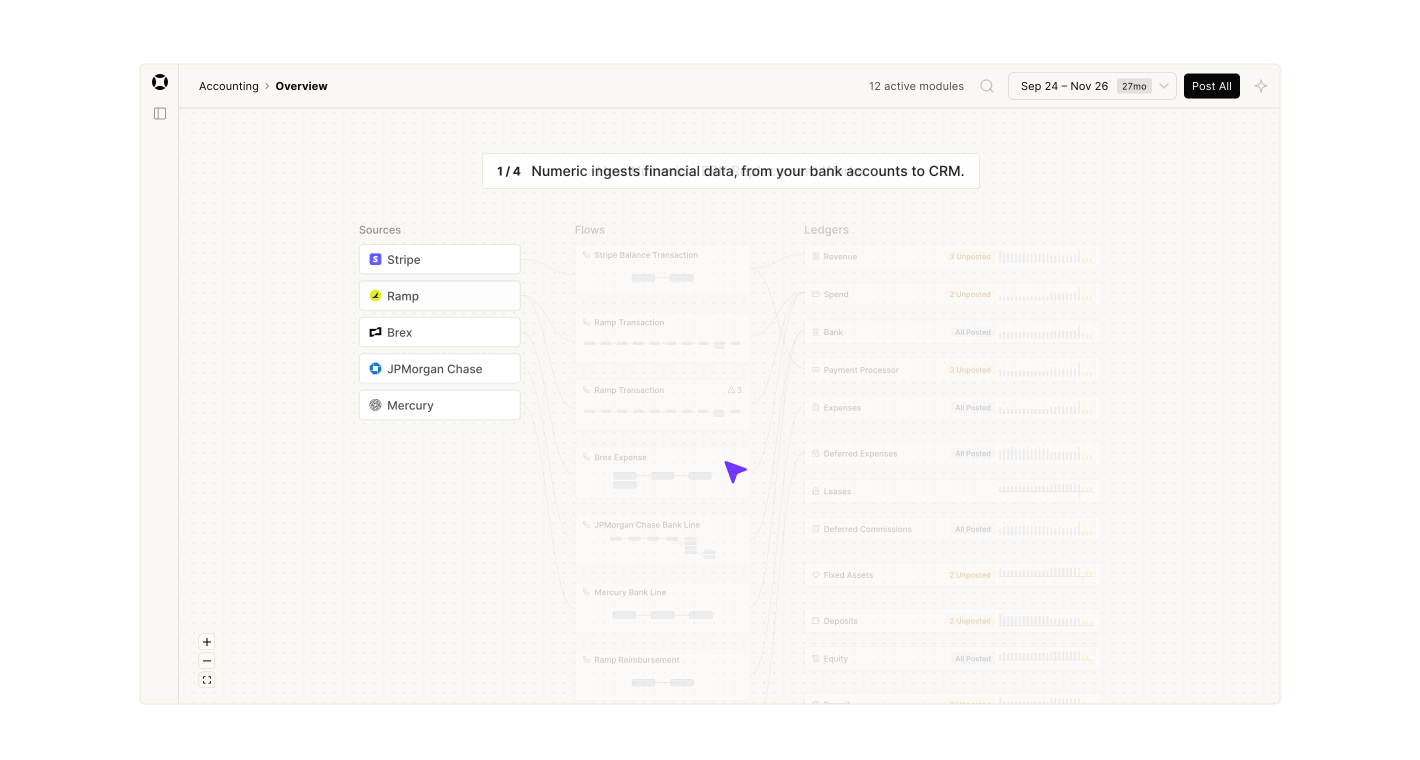
Numeric's Financial Data Platform does the job of an ERP and keeps a full record of what happened in the business along the way. Sources such as Stripe, HubSpot, Salesforce, Ramp, Brex, bank feeds, and data warehouses send business events into the platform, and Numeric produces the accounting from those events. Journal entries are staged, drafted, or derived for you, and each one stays linked to the business event behind it. Numeric calls this approach data-centric accounting, and it runs its own books on the Financial Data Platform.
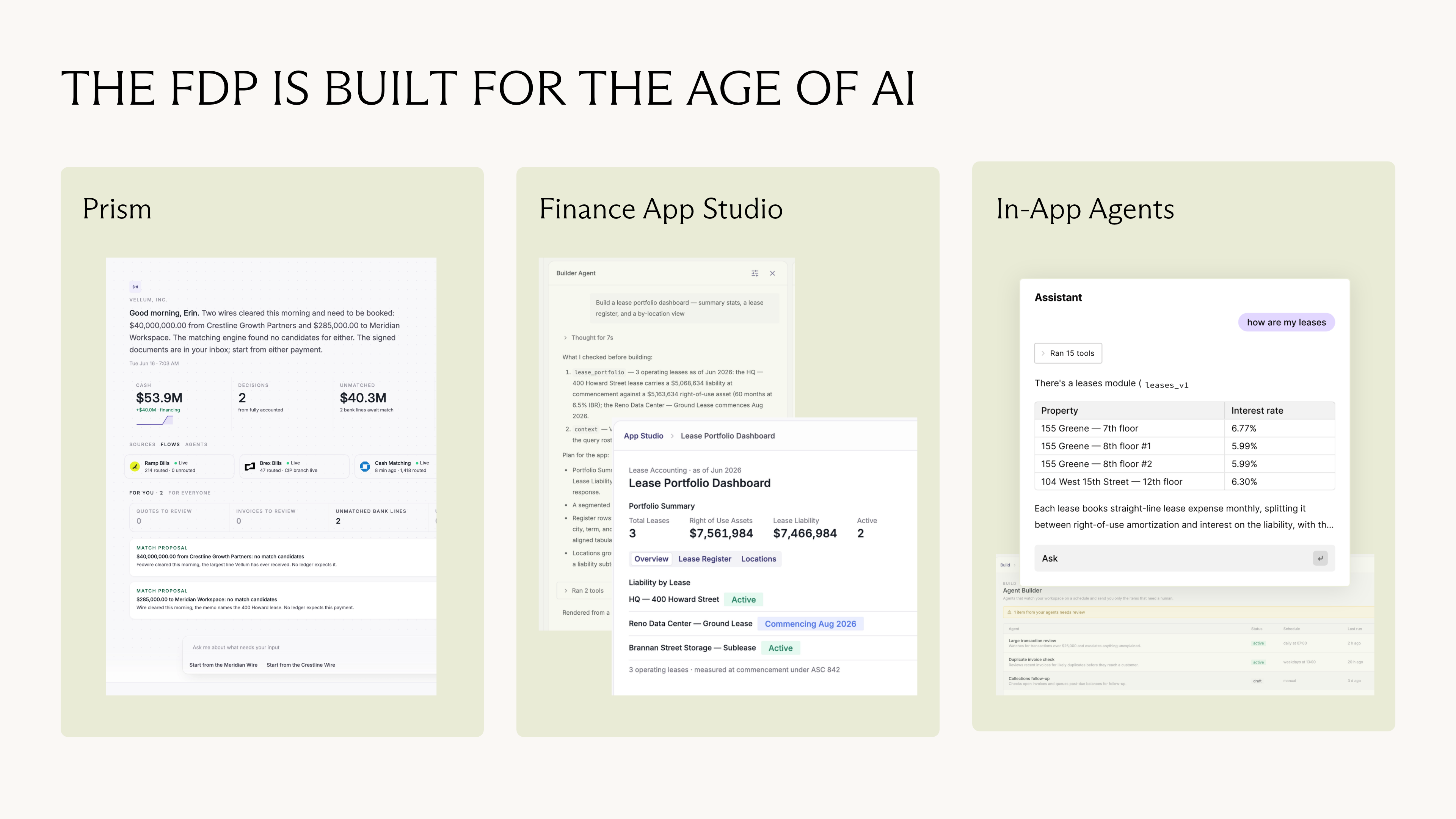
The platform includes Billing and Revenue, Agentic Subledgers, Reporting, Prism, and App Studio. Agentic Subledgers process incoming records like vendor invoices, working out how each one is accounted for and spread over time.
Ledgers in the Financial Data Platform support multiple entities, currencies, and consolidation. Intercompany accounting and transfer pricing at the most complex level sit outside what the platform supports today, so teams with heavy intercompany activity should walk through those flows during evaluation.
Numeric Pricing
Numeric prices the Financial Data Platform through a custom quote. For most teams it costs about the same as, or less than, their current NetSuite plus point-solution spend, with more functionality included.
What Is Rillet?
Rillet describes itself as an AI-native ERP. Nicolas Kopp and Stelios Modes founded the company in 2021, and it has offices in New York, San Francisco, and Barcelona. Its product centers on an automated general ledger, with AR and AP, revenue recognition, consolidation, and reporting built around it.
Like NetSuite and QuickBooks, Rillet runs on the traditional general ledger model, where journal entries, a chart of accounts, and separate subledgers organize the books. Its revenue module turns contract terms into ASC 606 revenue schedules and the corresponding journal entries, and those entries become the record the general ledger reports from. Campfire, another AI-native ERP, shares the same foundation. Our Rillet vs. Campfire breakdown compares the two in more depth, and our Numeric vs. Campfire comparison walks through Campfire in the same format as this guide.
Rillet Pricing
Rillet keeps its pricing private and quotes each customer based on the features used and the complexity of the business, with no per-seat fees. Our Rillet pricing guide covers third-party benchmarks and what drives the quote.
What Changes Day to Day for Your Accounting Team
Every ERP replacement promises less manual work, and the easiest place to see where they part ways is a normal month on the job. Rillet builds its books from journal entries, with contracts and invoices feeding them, while Numeric's Financial Data Platform builds them from the underlying business records and derives each entry from there. Below, the same month plays out twice, once in Rillet and once on Numeric.
A Month in Rillet
In Rillet, the day centers on the ledger, where the team reviews the entries each workflow produces. When a customer adds seats and moves to a lower usage rate in month six, Rillet's revenue recognition guide describes the amendment running through the revenue module, which updates the schedule and books new journal entries to the ledger. Rillet's accounts receivable page says usage comes in through the API or CSV uploads and gets applied to the contract and pricing rules.
Rillet's help docs show its income statement, ARR, and custom reports built from the standard and custom fields on its records. If the CFO asks for subscription revenue split into usage, fixed subscription, and services, going back two years, the new split depends on those fields already being in place on the transactions in question. When the auditor asks where a number came from, the change log Rillet documents on each journal entry shows who edited it and when.
A Month on Numeric
On Numeric, your team spends less of the month posting entries and lining up balances, and more of it reviewing the exceptions the system flags and approving the rules that handle them next time. Mornings start in Prism, where the Controller sees only the items waiting on a decision, since Numeric's target is for 90% or more of transactions to process without anyone touching them. When that same customer adds seats and drops the usage rate in month six, you update the contract once, and the invoice and the revenue schedule both pick up the change from the effective date. Usage events come straight from the data warehouse and get matched to each contract, so instead of tying an export to the invoices, the revenue accountant looks into the handful of events that didn't match before month-end.
When the CFO asks for that same revenue split going back two years, a team on Numeric sets up the new categories once as a reporting view and runs it against past periods, using detail the events already carry. Commission accounting stays tied to the rep and the deal, because the contract, usage, and discount sit in the same place. When the auditor asks where a number came from, you can trace the revenue figure back to the contract, the usage, and the policy behind it, so audit prep means pulling support that's already attached. If your team already works in Claude, the Numeric MCP lets it pull those same numbers and kick off work in the platform right from the chat.
What It Means for the Controller
On Numeric, the Controller's month shifts from posting entries and tying out balances toward setting accounting policy, working the exception list, and signing off on new rules as patterns repeat. Reconciliation moves toward continuous monitoring as events come in, with the tie-out still there for the items that need a person. Numeric calls this the work of a finance engineer, an accountant who programs how the system handles the books.
Numeric's own accounting team closes its books this way on the Financial Data Platform, with more than 98% of cash matched automatically.
Feature by Feature Comparison
Billing and Revenue Recognition
Numeric's Billing and Revenue product runs billing and revenue recognition on the same contract. Billing tracks what the customer owes, and revenue recognition tracks what the company has earned, so both start from the same terms.
Beyond the usage and amendment handling covered above, a few capabilities matter most to revenue accountants.
- Bundled deals. For a deal that combines subscription, services, and usage, Numeric allocates the price across each performance obligation based on standalone selling price, the way ASC 606 requires.
- Quotes from the CRM. Numeric ingests deal terms from Salesforce CPQ or HubSpot so the contract record starts from the deal sales closed.
- Contract validation. Numeric uses AI to check those deal terms against the signed contract, which catches mismatches before the first invoice goes out.
- Credits and refunds. Numeric applies credits, refunds, and variable consideration to the same contract, so billing and revenue move together.
Rillet also generates invoices from CRM contracts and posts its revenue schedules to the ledger as journal entries, with usage arriving by API or file upload.
Reporting and Analysis
Rillet's reporting runs on its general ledger accounts and the fields attached to them.
Numeric's reporting reaches past the chart of accounts because the business event stays alongside the accounting. Teams can slice revenue by customer, product, region, or any other detail without exporting to Excel. Reports like gross margin per customer, usage to billing to revenue by customer and SKU, or contribution margin by product line become practical to pull together for a board deck or an investor update.
AI and the Numeric MCP
Numeric's AI is designed around the work accountants already do. Rules produce the numbers, AI drafts those rules for an accountant to approve, and people review the exceptions, which is the model behind AI in Numeric. Across the platform, AI handles repetitive work like explaining why numbers changed month over month and suggesting payment matches.
App Studio lets finance teams describe a simple tool in plain language, and Numeric builds it on their data. The Numeric MCP connects AI assistants like Claude to a team's Numeric account, so they can pull data, push data, and do work in the platform using the team's own financial data.
Implementation and Rollout
Rillet's help center states that customers go live in four to six weeks, depending on business complexity and how much historical data needs to move over.
Numeric takes a staged path. Teams can start with one product line, such as Billing and Revenue or Cash Management, while the existing ERP stays in place, then move onto the full Financial Data Platform when they're ready. Billing and Revenue runs alongside NetSuite today, which makes it a natural first step for teams already on NetSuite. Most teams adopt the full platform through parallel testing, running it next to the current system and cutting over once the numbers line up.
Ownership of the configuration stays with the accounting team through a Numeric rollout. Asia McKnight, Controller at Built Technologies, described what that meant when her team chose Numeric.
"It was a system that was really flexible enough for us to scale as a business, but also our current team is able to configure the system in a way where we don't need a system administrator to understand how the system works and to maintain the current team size to support our growing operations."

Which One Is Right for Your Team?
The right fit depends on where the hardest part of your accounting sits.
Choose Numeric If Your Team
- carries usage-based or hybrid pricing, or changes contracts often
- wants usage to flow from the warehouse into billing and revenue on its own
- gets reporting requests that need more detail than account codes carry
- wants each number traceable to the source business event
- prefers a staged rollout over a single cutover
Choose Rillet If Your Team
- runs mostly standard subscription contracts with few mid-term changes
- prefers a single cutover on a short, fixed timeline
- builds most of its reporting from ledger accounts and standard statements
Either product can handle standard monthly or annual subscriptions. The gap grows once contracts change mid-term, usage drives the invoice, or the CFO wants revenue cut a new way, which is where SaaS, fintech, and usage-based teams spend most of their accounting effort.
Questions to Ask During Your Evaluation
How does the system handle a mid-term amendment? Take a 12-month deal with implementation, subscription, and usage, then add seats and lower the usage rate at month six. Ask each vendor to apply the change on its effective date, keep the original history, and show how the affected billing and revenue were updated. Your team still decides how to classify that amendment under ASC 606, a judgment call our guide to SaaS revenue recognition walks through step by step, and the system you choose should carry that decision through billing and revenue consistently.
Where does usage data come from each month? Ask whether usage flows in from your data warehouse automatically or gets exported and uploaded each period, and what happens to usage that doesn't match a contract.
Can you trace a revenue number back to its source? Pick one figure from a demo report and ask the vendor to walk it back to the contract and usage behind it, the same way an auditor would.
What does my Controller do differently on day 30? Ask each vendor to show the screen your Controller would open each morning and walk through how an exception gets handled from there.
Who owns the configuration after go-live? Find out how much your current staff can change on their own as pricing and contracts evolve, and how much depends on the vendor or a system administrator.
Why Teams Choose Numeric's ERP Replacement
Numeric built the Financial Data Platform to handle complexity. It ingests operational data from any source, turns it into financial data, and keeps it in one connected financial graph, a model of long-lived records like contracts and invoices along with the business events that happen to them. The general ledger becomes one report the system produces from that graph, and the chart of accounts becomes one mapping among many.
For revenue teams on Numeric, that means an upgrade or credit updates the invoice and the revenue schedule together. Controllers get the support for each number attached to the accounting, and FP&A gets cuts by customer and product without waiting on a new account structure.
Built Technologies moved its accounting off NetSuite and onto the Financial Data Platform, including billing for its usage-based models and the revenue recognition behind it. Since then, Built has freed up two FTEs' worth of bandwidth and delivers invoices to customers four business days earlier.
Final Thoughts
The clearest way to compare Numeric vs. Rillet is to bring your hardest contract to each demo. A deal that mixes usage with bundled services and a mid-term amendment shows how each product carries billing and the revenue schedule through your actual workflow, and where your team steps in along the way.
To see that walkthrough on Numeric's ERP replacement, schedule a demo and bring the contract along.
FAQ
Related Content

Numeric vs. Campfire: Features, Fit, and Key Differences
Numeric vs. Campfire ERP compared on what changes for your accounting team, from contract amendments and usage billing to reporting and audit support.
Numeric vs. Rillet: Features, Fit, and Key Differences
Numeric vs. Rillet compared on what changes for your accounting team, from contract amendments and usage billing to reporting and audit support.

Billing and Revenue Management: A Guide for SaaS Finance Teams
Billing and revenue management keeps invoices and ASC 606 revenue tied to one contract. See how contract changes affect both and how to evaluate a solution.